CastleLaxenburg

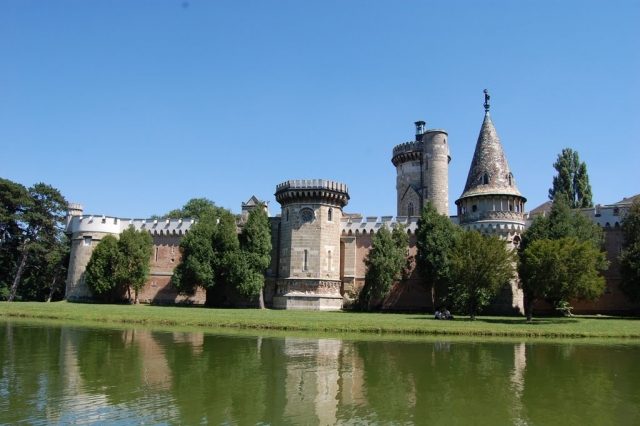
Franzensburg Castle

Franzensburg Castle

Museum

The Franzensburg is a castle in Laxenburg in the district of Mödling in Lower Austria, built between 1801 and 1836 in the style of an old castle. The name comes from the then Emperor Franz II, or I, who had it built in the middle of the palace park as a museum next to the existing castles of Laxenburg on an artificial island in the park pond.

The castle was planned by Johann Ferdinand Hetzendorf von Hohenberg in two parts (Knight's Castle and Squire's Castle) and was intended as a museum from the outset. With its recourse to medieval building forms, the Franzensburg is considered a milestone on the way to Historicism. Components of the parish church in Heiligenkreuz, which was demolished during the Josefinism, were used for this purpose. Also, salvaged pieces of older buildings are integrated into the castle, especially the reconstruction of the Klosterneuburg Capella Speciosa, the first Gothic-influenced building in the Danube region.

The construction of the castle coincided with the time when brick production began south of Vienna. Since the price of a single brick seemed too high, Emperor Franz unceremoniously bought the brickworks in Vösendorf and additionally Vösendorf Castle.

In 1806, a ferry was established, leading across the pond from the mainland to the island with the Franzensburg. In winter, it is replaced by a wooden bridge. On the opposite side, the island is accessible all year round via a stone bridge.

The castle and the surrounding palace pond are embedded in a palace park of about 250 ha, which was designed in the late 18th century in the style of English landscape gardens. It contains forests, meadows, several canals, a jousting arena, the Concordiatempel, and other structures such as the "Rittersäule" (Knight's Column), a marble bust of the emperor, and the Lusthaus.

Today, the park is a popular excursion destination. Guided tours are offered in the castle, and theater plays are staged in summer. In summer, rowing and electric boats can be rented on the pond.

Museum+

The museum was reopened in 2003 by Otto von Habsburg, after the castle had already been publicly accessible earlier. The collection, which mainly concerns the Habsburgs in Austria-Hungary, complements similar ones, such as in Bad Ischl, Schönbrunn Palace, or Gödöllő Palace in Hungary.

The museum also bears the Austrian Museum Seal of Quality.

When passing through the museum in the castle complex, various rooms can be visited:

  • Armory Hall - In this room, shields with the coats of arms of the 44 Austrian states and provinces are mounted on the ceiling.
  • Habsburg Hall - In the Franzensburg, the Habsburg Hall contains one half of the imperial statues by Paul Strudel (the other half is in the Court Library). In the Lorraine Hall, paintings of later emperors are grouped around a Kupelwieser portrait of Franz I, they are by Ferdinand Georg Waldmüller and Friedrich von Amerling, among others.
  • First Reception Hall
  • Second Reception Hall
  • Luise's Room - In the "Luise's Room", the ceiling, the two door panels, and the doors from Rappottenstein Castle from around 1600 can be seen.
  • Dining Hall
  • Lorraine Hall

Take Mobile History with you

You are reading this text for free. Premium adds what matters on the road: descriptions read aloud, sites found through your camera, whole regions taken offline.

  • Every description, including the ~17,700 Premium sites
  • Audio guide: have descriptions read to you on location
  • AR finder: see sites through your camera, with distance and bearing
  • Unlimited saved sites

14 days free, then from €2.99 a month. Cancel anytime.

Source: Wikipedia · Licence: CC BY-SA 4.0 · Image: Maciek Wegrzyn

This description draws on the facts documented in the linked Wikipedia article; Wikipedia content is licensed under CC BY-SA 4.0. Wording and editing: Mobile History.

Location: 48.0655, 16.3726