MonasteryGroßheubach

Franciscan Abbey Engelberg
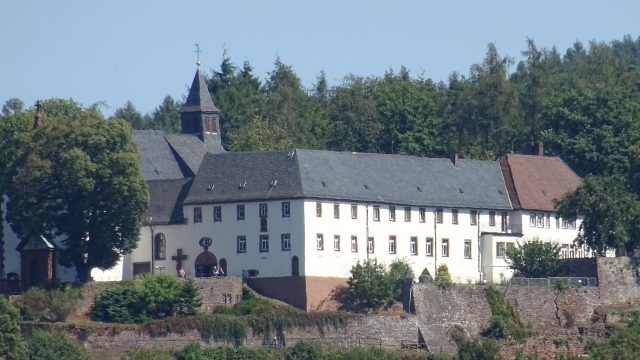
Franciscan Abbey Engelberg

Abbey

The Franciscan Monastery Engelberg is a monastery of the Franciscans (OFM) near Großheubach, in Lower Franconia; Diocese of Würzburg. The well-known pilgrimage site is also the official burial place of the Princely House of Löwenstein-Wertheim-Rosenberg and is located on the prominent Engelberg high above Großheubach, from where it can be reached, among other things, via 612 sandstone steps, the so-called "Engelsstaffeln" (Angel's Steps).

The history of Engelberg above the Main, then called "Rulesberg", goes back to the pre-Christian era. At that time, there was a pagan cult site there, of which the so-called "Hünenstein" or "Heuneschüssel", a massive rock with a bowl-shaped depression, still bears witness today.

Around 1300, a simple wooden chapel was built on the mountain and dedicated to the Archangel Michael. As leader of the heavenly hosts, he was preferably chosen as the patron saint of churches at sites of former pagan sanctuaries. Thus, the old "Rulesberg" gradually became "Engelberg". At the beginning of the 14th century (1310 is mentioned), a statue of Mary also came into the chapel, which is still revered there today as a miraculous image of grace and is the destination of pilgrimages.

The dual veneration of the Archangel Michael and the Mother of God Mary, as "Queen of Angels", is the origin of the local pilgrimage. Its oldest authentic document, whose content suggests a heavily visited but in need of repair chapel, dates from 1406.

As the number of pilgrims grew steadily, the Archbishop of Mainz, Anselm Casimir Wambolt von Umstadt, to whose diocese the area belonged at the time, called the Capuchins to Engelberg in 1630 and had a monastery built for them.

In 1828, the convent was taken over by the Bavarian Franciscans on the order of King Ludwig I of Bavaria.

Since 1724, Engelberg Monastery has been the burial place of the Wittelsbach collateral line of the Princes of Löwenstein-Wertheim-Rosenberg, who have resided at Löwenstein Castle in nearby Kleinheubach since 1721, which also houses a castle chapel that was formerly served by the Capuchins of Engelberg Monastery. Originally, the deceased were buried in the Engelberg monastery church; in 1840, the princes had a separate crypt chapel built on the monastery grounds for their family, which still serves as the family burial place today.

Engelberg Monastery above the Main is a permanent destination for numerous pilgrims and tourists. It is also known, among other things, for its dark beer from wooden barrels, which is served in the monastery tavern.

Volume 1 of the narrative "Maria Regina" by Countess Ida Hahn-Hahn (1865) revolves around Engelberg Monastery above the Main.

Take Mobile History with you

You are reading this text for free. Premium adds what matters on the road: descriptions read aloud, sites found through your camera, whole regions taken offline.

  • Every description, including the ~17,700 Premium sites
  • Audio guide: have descriptions read to you on location
  • AR finder: see sites through your camera, with distance and bearing
  • Unlimited saved sites

14 days free, then from €2.99 a month. Cancel anytime.

Source: Wikipedia · Licence: CC BY-SA 4.0 · Image: Jörg Heldt

This description draws on the facts documented in the linked Wikipedia article; Wikipedia content is licensed under CC BY-SA 4.0. Wording and editing: Mobile History.

Location: 49.7239, 9.2320