Cultural center
Franziskanerkloster Kerbscher Berg (Dingelstädt)
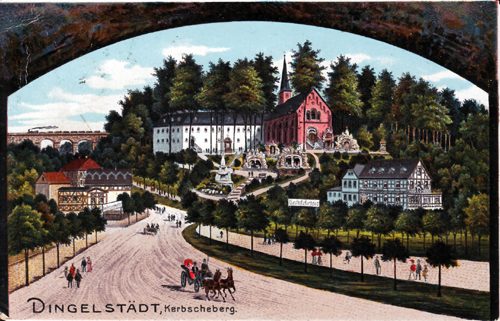
Franciscan Monastery+
The Franciscan monastery was established in 1864 with the construction of the first wing. After its completion in 1866, the monastery was consecrated by Bishop Konrad Martin. In 1875, the monastery was dissolved as a result of the Kulturkampf until its restoration in 1887. In 1889 and 1890, construction resumed on the present church by the Franciscan master builder Paschalis Graze, its consecration took place in 1893, and in 1901 it was consecrated in honor of the Japanese Franciscan martyr Petrus Baptist Blasquez and his companions from 1597. From 1899 to 1901, the monastery was further expanded by the construction of a south wing.
From 1918, monastic life flourished, which was abruptly ended by the National Socialists in 1944 with the confiscation of the house.
After the war, the Franciscans were able to return to their domicile in 1946.
Since 1961, the monastery has been the site of the annual diocesan women's pilgrimage. From 1966 to 1992, the monastery served as a novitiate monastery for Franciscans in the GDR. In 1994, the Franciscan order gave up the monastery as a branch. Subsequently, members of the women's community of the Society of Saint Ursula - in short: Ursulines - moved into the monastery apartments. The Diocese of Erfurt took over the area and established a family center, which opened in 1997. The house and garden were subsequently redesigned, and the church was renovated.
Kerbscher Berg+
The history of the development and use of the strategic advantages of the mountain location dates back to prehistoric times, when a hillfort was probably located on the site. Before 800 AD, a small church dedicated to Saint Martin was built on the mountain. Between 1134 and 1464, the Lords of Kirchberg are mentioned in documents. Until the beginning of the 16th century, the former village of Kirchberg existed in the northwest of the mountain, of which later only a church is mentioned.
In 1701, a new chapel dedicated to "St. Martin" was built; from 1752 to 1764, a sandstone Way of the Cross was erected around the Kerbscher Berg. In 1763 and 1764, the first 80 lime trees were planted on the mountain, in 1813 a Helena Grotto was built as the 15th station of the Way of the Cross, and in 1824 a new chapel titled "To the Holy Cross" was consecrated. Between 1887 and 1903, grottoes were built on the eastern slope of the mountain, and in 1911, a Franciscan statue by Josef Neyer was erected at the foot of the mountain.
Miscellaneous+
The Marienkirche (St. Mary's Church) built on the Kerbscher Berg is surrounded by a ring of about 150 old lime trees, whose estimated age is now about 275 years. The complex is a natural monument. Gaps that have arisen have already been closed by replanting, so that there are always about two hundred trees.
Take Mobile History with you
You are reading this text for free. Premium adds what matters on the road: descriptions read aloud, sites found through your camera, whole regions taken offline.
- Every description, including the ~17,700 Premium sites
- Audio guide: have descriptions read to you on location
- AR finder: see sites through your camera, with distance and bearing
- Unlimited saved sites
14 days free, then from €2.99 a month. Cancel anytime.
Source: Wikipedia · Licence: CC BY-SA 4.0 · Image: Unknown authorUnknown author / Public domain via Wikimedia Commons
This description draws on the facts documented in the linked Wikipedia article; Wikipedia content is licensed under CC BY-SA 4.0. Wording and editing: Mobile History.
Location: 51.3142, 10.3009