The initiative for the founding of the Franciscan monastery in Soest in 1233 came from Archbishop Heinrich von Molenark of Cologne, who requested a settlement from the Provincial Chapter of the Saxon Province. The monastery later became part of the Cologne Ecclesiastical Province, founded in 1239. From 1259, Archbishop Konrad von Hochstaden promoted the construction of the church and convent buildings through indulgences, which spurred building activities until around 1290. The Franciscans in Soest primarily cared for the urban lower classes, the sick, and the dying. After the introduction of the Reformation around 1531/32, the monastery's existence was threatened, but the friars returned after a temporary stay in Werl to minister to the Catholic minority. In the 18th century, the monastery's economic situation deteriorated, and at its dissolution following secularization in 1814, only a few friars remained. Subsequently, the buildings housed a teacher training college and later a seminary. During World War II, the monastery buildings and the church were severely damaged by bombing raids.
Franziskanerkloster Soest
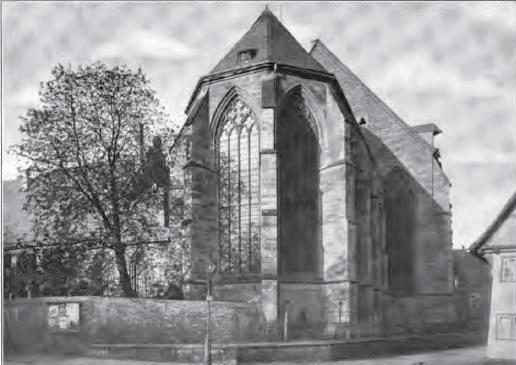
The Franciscan Minorite Monastery in Soest, also known as the “grey monastery” due to the order's habit color, was the first settlement of the Friars Minor in Westphalia. From its founding in 1233 until its secularization in 1814, it shaped the religious and social life of the city. The associated Gothic monastery church Neu St. Thomae now serves as an Evangelical parish church and is a significant testament to medieval architecture.
History+
Location+
The former Franciscan Minorite Monastery is located in the city of Soest in North Rhine-Westphalia, Germany.
On site+
The Gothic monastery church Neu St. Thomae, whose construction began in 1259 and whose choir was consecrated in 1292, is a three-aisled, four-bay hall church with wide pillar spacing and a light-filled interior. Its architectural forms, particularly the tracery windows, show a close connection to Cologne Cathedral. After its destruction in World War II, the church was rebuilt between 1956 and 1966. Since 1851, it has served as the Evangelical parish church for the Thomas community and is increasingly used for cultural events such as concerts and exhibitions. Since 2025, it functions as the Kulturkirche Neu St. Thomä, with events planned and organized by the Soest Art Association. The Schuke organ, installed in 1970, features 37 stops across three manuals and pedal.
Nearby+
- Sassendorf Castle (Bad Sassendorf) (Castle, approx. 4375 m away)
- Broel Manor House (Welver) (Manor and Estate House, approx. 5797 m away)
- Ahse Manor House (Welver) (Manor and Estate House, approx. 8003 m away)
- Nehlen Castle (Berwicke) (Castle, approx. 8633 m away)
Take Mobile History with you
You are reading this text for free. Premium adds what matters on the road: descriptions read aloud, sites found through your camera, whole regions taken offline.
- Every description, including the ~17,700 Premium sites
- Audio guide: have descriptions read to you on location
- AR finder: see sites through your camera, with distance and bearing
- Unlimited saved sites
14 days free, then from €2.99 a month. Cancel anytime.
Location: 51.5692, 8.1128