The remains of the roman village can be visited
Ancient BuildingBesigheim - Ottmarsheim
Roman Mithräum
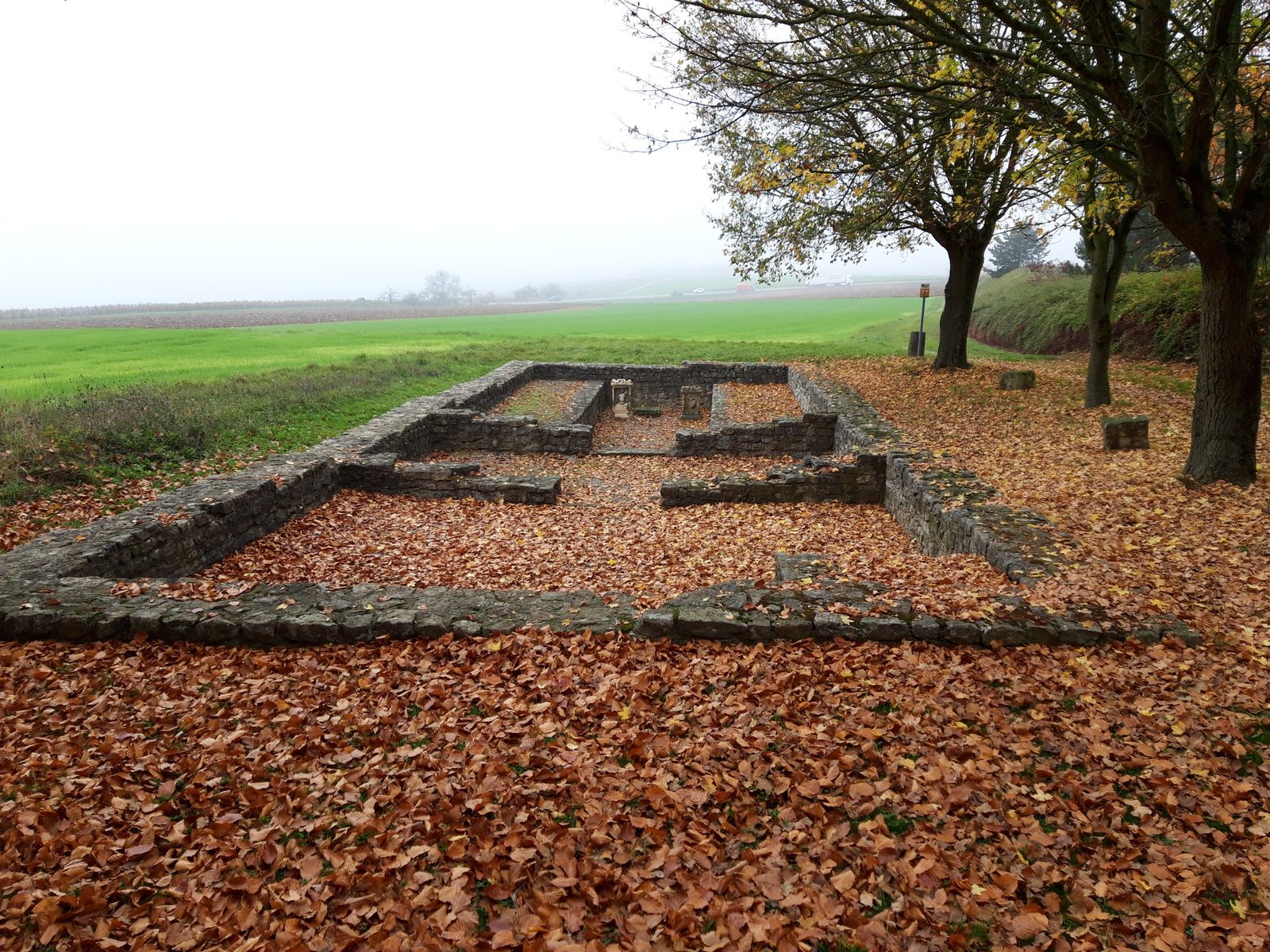
The Mithraeum of Mundelsheim is a Roman sacred building dedicated to the god Mithras from the second half of the second century. The present-day archaeological monument is located in the municipality of Mundelsheim in the Ludwigsburg district of Baden-Württemberg.
Research History+
In June 1989, during the construction of a water pipeline on the southern edge of the development area in the "Steinmäurich" district, the foundations of a 17.6 m long and 7.2 m wide building were uncovered. The find proved to be a Mithraeum, a sanctuary of the Roman god Mithras, who is a personification of the sun and whose origin lies in Persian mythology. The building was archaeologically investigated, documented, and restored in the same year and made accessible to the public the following year.
Archaeological Findings+
The structure presumably dates to the second half of the second century. The building, originally consisting of two rooms, was supplemented by a portico on its eastern entrance side in a second construction phase. One entered the Mithraeum through this portico, in whose northeast corner a square foundation was uncovered, which was identified as a hearth. Through double-leaf doors, whose thresholds could be recovered during the excavations, one first entered an antechamber and from there into the lower-lying cult room. In the cult room, on both sides of the central aisle (cella), there were raised podia, which could be climbed via one step each to the right and left immediately to the side of the entrance. The podia served as seats for the participants of the cult. The entire interior was plastered and showed traces of simple painting. At the front end of the central aisle was the central cult image of Mithras, of which only small remnants remained at the time of excavation. To the right and left of the entrance, next to the steps to the podia, a completely preserved clay vessel was discovered in the undisturbed soil. In the right pot, the right eye area of a cattle skull was found, in the left vessel the counterpart. Another container stood directly in front of the central cult image in the central aisle. It contained animal bones from a young pig and a rooster. A fourth pot in the interior was empty. With high probability, these finds can be assumed to be offerings for the god Mithras, which had been ritually placed in the earth under the wooden floor at prominent locations during the construction of the sanctuary. In the central aisle of the cult room, over 200, some very small, fragments of various divine images were found, which were probably destroyed during the Alamannic invasions of the third century. Of the central cult image, which most likely depicted Mithras slaying the bull, only small remnants could be identified and recovered. Among the better-preserved parts, two pillars up to 0.9 m high depicting the torchbearers Cautes and Cautopates stand out, which were placed to the right and left in the central aisle. The two companions of Mithras, originally personifications of day and night, death and life, became a divine trinity with Mithras. Particularly high quality is the depiction of a Mercurius enthroned on a rock. The god of trade is still 0.7 m high and partially worked in full relief. To the right and left of the cult image stood two altars: a 0.73 m high altar depicting Luna, the personification of the moon, characterized by the illuminable crescent moon, forms the counterpart to the altar with the effigy of Sol, the personification of the sun, recognizable by the also illuminable radiate crown. The symbols of the two deities, which could be illuminated from their reverse side, must have given the already mystical appearance of the grotto-like and dark sanctuary a special character.
Context of the Findings+
The Mithraeum is in the context of the Vicus of Mundelsheim/Ottmarsheim and a Villa rustica, which had already been partially excavated by Oscar Paret. Rescue excavations between 1988 and 2004 then revealed a Roman settlement area totaling 3.5 hectares. The beginning of the settlement is likely to have been in the first half of the second century; dendrochronological examination of well wood dated this to the year 136. Parts of the main building, a well house, and some outbuildings of the Villa rustica have been identified so far. The finds indicate that the villa was inhabited at least from the second half of the second century. Vicus, villa, and sanctuary existed until the first half of the third century, but were probably abandoned at the latest in connection with the events of the Limes fall.
Securing of Findings and Monument Protection+
The foundations of the complex have been preserved on site and are freely accessible. The Mithraeum of Mundelsheim is an archaeological monument in the sense of the Monument Protection Act of the State of Baden-Württemberg (DSchG). Research and targeted collection of finds require permission, and accidental finds must be reported to the monument authorities.
Take Mobile History with you
You are reading this text for free. Premium adds what matters on the road: descriptions read aloud, sites found through your camera, whole regions taken offline.
- Every description, including the ~17,700 Premium sites
- Audio guide: have descriptions read to you on location
- AR finder: see sites through your camera, with distance and bearing
- Unlimited saved sites
14 days free, then from €2.99 a month. Cancel anytime.
Source: Wikipedia · Licence: CC BY-SA 4.0 · Image: Exa · Wikimedia Commons · CC0
This description is a machine translation of an excerpt from the linked Wikipedia article. The source text was written by its authors, the translation is by Mobile History; like the original it is licensed under CC BY-SA 4.0.
Location: 49.0089, 9.2107