Residential and commercial building
MonasteryVolkach
Amtskellerei (former Prince-Bishop's Official Cellar)
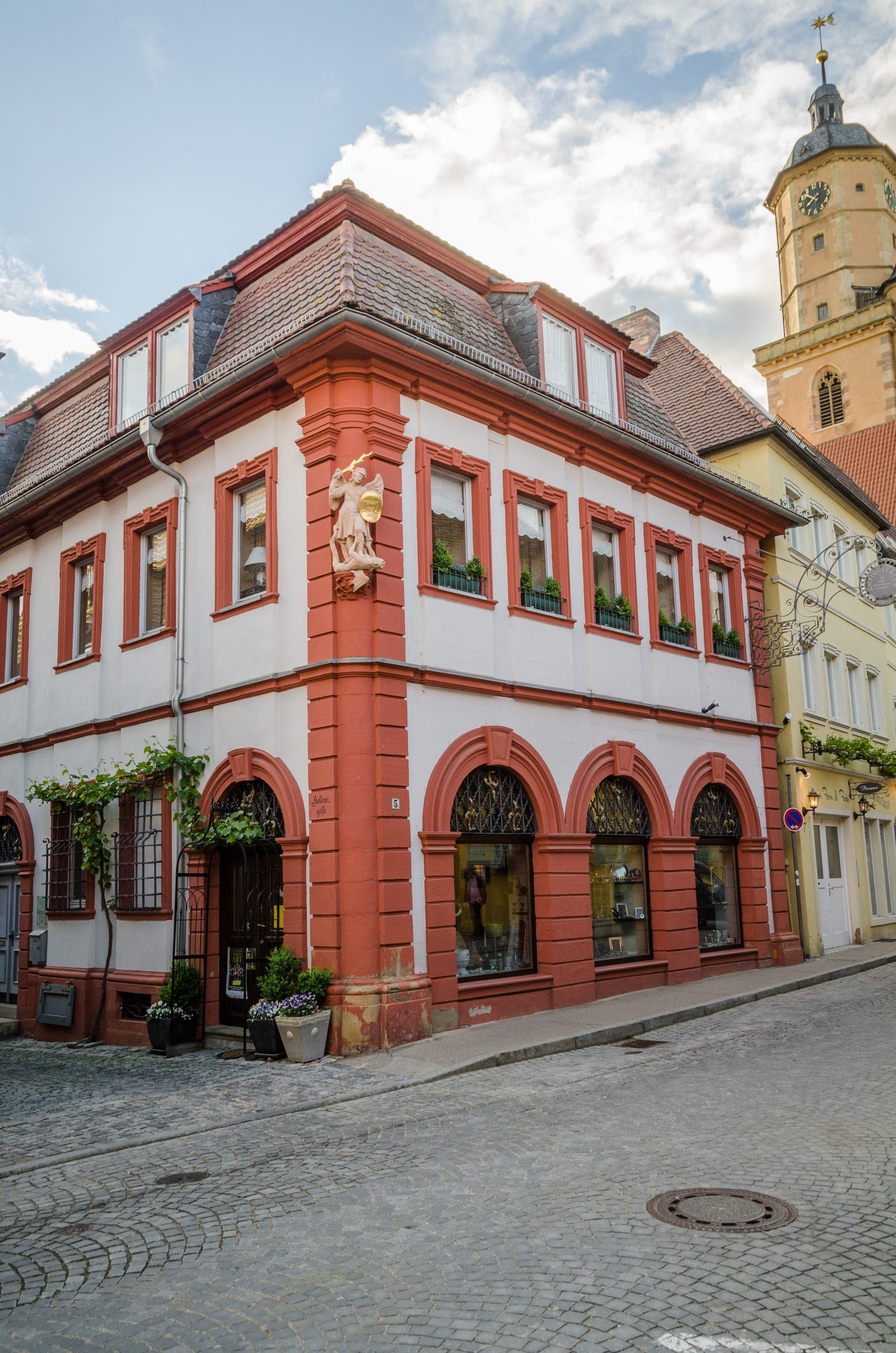
The former Prince-Bishop's Amtskellerei (address Hauptstraße 5, formerly house number 36) is a representative Baroque building in the Lower Franconian town of Volkach. It was initially used as an economic court by the Prince-Bishop of Würzburg before the Volkach post office moved in. Today it has been converted into a residential and commercial building.
In addition to their lordship over Volkach, represented by the Prince-Bishop's Amthaus, the Prince-Bishops of Würzburg also possessed extensive agricultural land in the surrounding area of the town. The vineyards, in particular, yielded significant profits in some years. To store the wine temporarily, the Prince-Bishop required a so-called Amtskellerei with deep cellars. The building had been owned by the landlords since the early days of the town and was subsequently leased to citizens of Volkach repeatedly. In 1689, Hans Östreich resided in the house; he was a cooper, cultivated several vineyards, and kept some grazing animals. Before 1698, he supplemented his business with a cookshop. At that time, the house was located between "Gemeiner Straße and Herrn Georgius." In 1711, the merchant Julig Confortale is documented in the building. Around 1730, the current building was constructed as one of the most magnificent Baroque houses in the town. In 1736, the widow of Hans Michel Wol resided there. From 1743, the Meisner family is documented in the house. They soon rose to become one of the wealthiest families in the town. Initially, Michael Meisner received citizenship, and in 1771, Michael Meisner owned a residential house built over two cellars. In 1776, Nicolaus Joseph Meisner, a merchant, resided there. In 1843, the married couple Franz Caspar Meisner and Barbara, née Erbig, owned the residential house. A garden house belonged to the building at that time. In 1865, the hospital administrator Joseph Meisner inherited the house. From 1885, the Royal Bavarian Post Office was housed in the building. The first postmaster was Andreas Leipold, who handed over the office to his son Karl Leipold. In addition to the postal service, he also ran a hired coach service. In 1911, the Congregation of the Dillingen Franciscan Sisters acquired the house and established a boarding school for girls there (see also: St. Maria Monastery). Later, the boarding school moved to an adjacent building, and businesses moved into the house. In 1999, the nuns sold the house, and since 2002, there has been an antique shop there.
Description+
The Prince-Bishop's Amtskellerei was built around 1730 in the Baroque style. The older houses of this style, Hauptstraße 46 and the Schelfenhaus in the street of the same name, served as models. The Kellerei is a two-story mansard-roofed house with a richly structured facade. The building is framed by rusticated sandstone pilasters, and the floors are separated by string courses. Large arched windows with keystones on the ground floor were enlarged into display windows during a 20th-century renovation. On the upper floor, the smaller rectangular windows have lugged frames and diamond-faceted keystones. The building has two large cellars. The statue of a saint at the corner of Hauptstraße-Kellereigasse, with the inscription "quis ut deus" on the shield, dates from the 18th century.
Take Mobile History with you
You are reading this text for free. Premium adds what matters on the road: descriptions read aloud, sites found through your camera, whole regions taken offline.
- Every description, including the ~17,700 Premium sites
- Audio guide: have descriptions read to you on location
- AR finder: see sites through your camera, with distance and bearing
- Unlimited saved sites
14 days free, then from €2.99 a month. Cancel anytime.
Source: Wikipedia · Licence: CC BY-SA 4.0 · Image: Tilman2007 · Wikimedia Commons · CC BY-SA 3.0
This description is a machine translation of an excerpt from the linked Wikipedia article. The source text was written by its authors, the translation is by Mobile History; like the original it is licensed under CC BY-SA 4.0.
Location: 49.8649, 10.2265