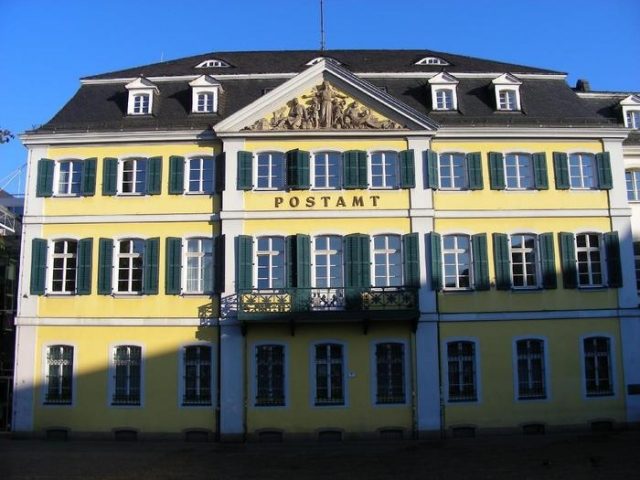
Post office
Fürstenbergisches Palais

The palace was built between 1751 and 1753 as the residence of Caspar Anton Radermacher († 1773), canon and dean of the Archidiaconal Collegiate Church of St. Cassius and Florentius, on the site of the former 13th-century canon's court. The collegiate church granted him permission to build the house on January 21, 1751, in exchange for an annual payment of six Reichstalers. Subsequent owners from this family included Franz Carl Ludwig Radermacher (1756–1827), Imperial Royal Court Councillor and Director of the Secret State, Court, and House Archives in Vienna.
On April 15, 1824, the ophthalmologist and surgeon Philipp Franz von Walther acquired the property for 12,500 Reichstalers. He sold it on February 12, 1830, including the furnishings, for 19,000 Prussian currency talers to Franz Egon von Fürstenberg-Stammheim. Until May 1830, the Bonn university professor and archaeologist Friedrich Gottlieb Welcker also resided in the lower part of the palace. From the balcony of the house, on August 15, 1845, on the occasion of the first Beethoven Festival, King Frederick William IV of Prussia and Queen Victoria of England, as guests, witnessed the unveiling of the Beethoven Monument. After the death of Franz Egon von Fürstenberg-Stammheim, the house was a girls' boarding school until 1876, but remained in his family's possession.
Use as a Post Office
On October 1, 1876, the Post and Telegraph Administration purchased the building from Gisbert Egon von Fürstenberg-Stammheim (1836–1908) for 234,000 Marks, to establish the Bonn Post Office there, which had previously been located (since 1821) in an adjacent house (Münsterplatz 8). After the necessary interior renovation of the building for this purpose, the new post office was opened on December 3, 1877. The Post and Telegraph Office had since been located at this site under joint management and had approximately 250 employees there (as of around 1900). Due to the increasing tasks of the Post and Telegraph Office with the growth of the city of Bonn, initial renovation and expansion measures were carried out on the former palace in 1890 and 1895. In 1898, an extension was built to the northwest towards Bottlerplatz for the parcel room, parcel delivery, and telegraph and telephone operations.
As the post office building in its previous dimensions proved insufficient for handling operations, plans for a fundamental change to the structures were initiated. After the purchase of houses and plots of land on Vivatsgasse, the first of two construction phases for the new parcel post office began in June 1906 between Vivatsgasse and the newly created "Posthof" (post yard) through the rear extensions. The second construction phase involved the demolition of the 1898 extension on Bottlerplatz and was completed by 1908. The parcel post office was a three-story building with a hip roof. The ground floor and 1st floor were executed in ashlar, the upper floor was plastered. The entrance portals in Vivatsgasse were gabled, and the facade received tall arched windows. The building corner towards Münsterplatz received a small, narrow tower, the northern corner towards Bottlerplatz a more powerful tower with an imperial eagle in the string course.
In 1909, a gutting and renovation of the main building followed, during which the facade towards Münsterplatz was altered by a main entrance in the central risalit. The renovation and expansion of the post office cost 700,000 Marks. The main building was reopened on February 21, 1910. During the National Socialist era, an extensive renovation of the post office was also planned as part of the intensification of public building projects. In early 1935, the Reichspost acquired a house located on Münsterplatz, on whose plot, after demolition, a new building was to be constructed and connected to the former palace. Construction began in 1937, during which the current room layout was also created, and by relocating the entrance to the side, the old state of the facade was restored. After the renovation was completed, two new counter halls were put into operation in 1939.
During World War II, the post office building was damaged. After makeshift repairs, postal services could be resumed as early as 1945. The parcel post office was restored in a simplified form, partly plastered, and an additional floor was added in 1951. In the process, the facade with Neo-Romanesque forms, especially on Vivatsgasse, was largely lost, as was the spire at the corner of Vivatsgasse/Bottlerplatz. In 1962, parcel services were relocated from the main post office to newly built premises on Kaiser-Karl-Ring.
In 1996, an architectural competition was announced for the redesign of the "Posthof" (now "Post-Carré"), including the former main post office. The architectural firms Auer+Weber+Assoziierte for the development of the inner courtyard and the internal redesign of the existing building, and Oswald Mathias Ungers for closing a gap at the corner of Windeckstraße/Münsterplatz with a white plastered cube – directly adjacent to the former palace – emerged victorious. The implementation of the competition results for the post office building took place from 1997 to 1998 – combined with the establishment of a new branch type – and was completed in 2001. From 2005, the main post office was again renovated internally to make the rooms brighter and more inviting. In November 2008, due to restructuring measures, the building lost its status as the main post office and has since housed a Postbank financial center, as well as service areas of Deutsche Post and DHL. The upper floors of the property have been rented by the Max Planck Institute for Mathematics since 1999.
Take Mobile History with you
You are reading this text for free. Premium adds what matters on the road: descriptions read aloud, sites found through your camera, whole regions taken offline.
- Every description, including the ~17,700 Premium sites
- Audio guide: have descriptions read to you on location
- AR finder: see sites through your camera, with distance and bearing
- Unlimited saved sites
14 days free, then from €2.99 a month. Cancel anytime.
Location: 50.7345, 7.0988