To be privately owned
Fugger Residence

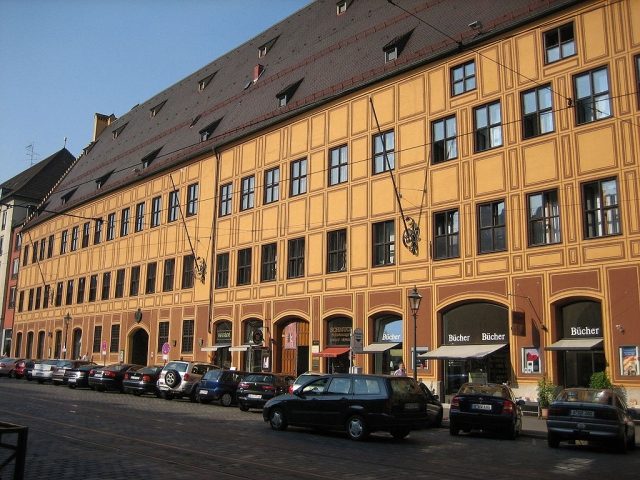
The Fuggerhäuser in Augsburg's Maximilianstraße were built between 1512 and 1515 as the residence of the Fugger family.
From 1512 to 1515, Jakob Fugger the Rich had two adjacent houses, a city residence and a warehouse, built on the then important trade route Via Claudia (today's Maximilianstraße) next to the former wine market. He designed the complex himself based on plans he had noted during his trip to Italy. The secular building is the first structure north of the Alps to be built in the style of the Italian Renaissance. Further adjacent houses were acquired from 1517 onwards and integrated into the complex of this city palace.
The outer facade, one of the longest in the street, testified to the wealth of the Fuggers, as at that time property tax was calculated according to the length of the front facade.
Inside the complex, Jakob Fugger had four courtyards laid out with arcades, mosaics, Tuscan marble, and water basins. The Damenhof (Ladies' Courtyard) with its arcaded walkways supported by Tuscan columns and magnificently painted arches is the most significant and is considered one of the most beautiful courtyards in Germany. It was the garden for the female family members of the Fuggers. The Damenhof is accessed via the so-called small Zofenhof (Maids' Courtyard). The third courtyard is called Serenadenhof (Serenade Courtyard), the rear one Reiterhof (Riders' Courtyard).
Through a high and wide gate – the Adlertor (Eagle Gate) – one could enter the complex even with larger horse-drawn carriages and exit again through the gate in the rear courtyard, the Reiterhof.
Fuggerhäuser Today+
After the destruction in World War II, the building was rebuilt by Carl Prince Fugger-Babenhausen until 1951. The front of the Fuggerhäuser was formerly adorned with a painting by Hans Burgkmair (1473–1531), which was destroyed in World War II and subsequently replaced by a new painting. All war damage was repaired by the Fuggers from 1951 onwards.
Memorial plaques on the house facade commemorate that the Fugger company empire had its headquarters here and that in 1518, the reformer Martin Luther was interrogated by Cardinal Cajetan in the Fuggerhäuser. In the middle of the facade front, one finds the Adlertor, which indicates that the Fuggerhäuser were an imperial quarter. The Adlertor is today the main entrance to the Fürst Fugger Privatbank.
The Fuggerhäuser are not publicly accessible, with the exception of the three courtyards. The Damenhof and the Serenadenhof can be visited. On its north side, one finds the white bay window, behind which were the state rooms of Emperor Charles V.
Also publicly accessible is the three-aisled ground floor hall with groin vaulting north of the Adlertor, where today the rooms of a bookstore are located. In the sales rooms, one looks out onto the adjacent Damenhof.
A Fugger coat of arms adorns the rear portal of these Fuggerhäuser on Zeugplatz. In this area, the former Fugger concert hall was probably located, where Wolfgang Amadeus Mozart gave a legendary concert in 1777.
The complex of the Fuggerhäuser is today owned by the Fugger-Babenhausen family.
Source Text: Wikipedia
Take Mobile History with you
You are reading this text for free. Premium adds what matters on the road: descriptions read aloud, sites found through your camera, whole regions taken offline.
- Every description, including the ~17,700 Premium sites
- Audio guide: have descriptions read to you on location
- AR finder: see sites through your camera, with distance and bearing
- Unlimited saved sites
14 days free, then from €2.99 a month. Cancel anytime.
Source: Wikipedia · Licence: CC BY-SA 4.0
This description draws on the facts documented in the linked Wikipedia article; Wikipedia content is licensed under CC BY-SA 4.0. Wording and editing: Mobile History.
Location: 48.3658, 10.8989