To be privately owned
CastleKirchheim
Kirchheim Castle
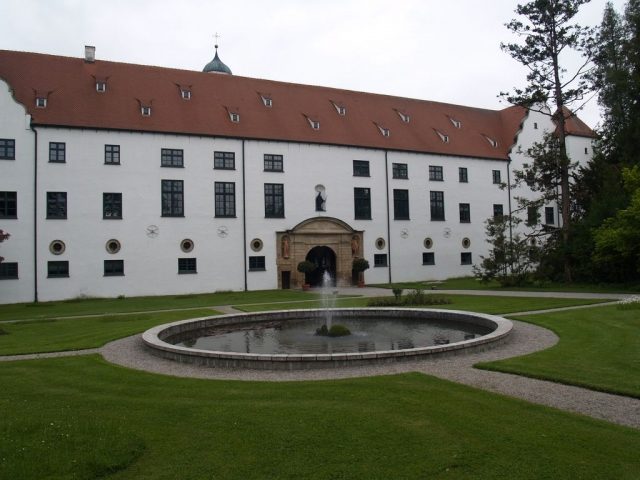
Fugger Castle Kirchheim/Schwaben is a Renaissance castle in Kirchheim in Swabia, built by Jakob Eschay and Wendel Dietrich between 1578 and 1583 for Hans Fugger.
In 1551, Anton Fugger (1493–1560), the nephew and successor of Jakob Fugger the Rich (1449–1525), bought the lordship of Kirchheim in Swabia from the von Hürnheim family for 137,000 guilders (a guilder was then approximately a person's weekly wage).
After Anton Fugger's death in 1560, Kirchheim was temporarily administered jointly by his three sons. To limit potential disputes, the lordship passed to Hans Fugger (1533–1598) by "drawing lots."
Between 1578 and 1582, Kirchheim Castle was built by the Augsburg city architect Jakob Eschay. Since the four wings built around a square inner courtyard strikingly resemble the Escorial near Madrid, it is still known today as the Swabian Escorial. The castle and parish church were also built by Jakob Eschay between 1580 and 1583. During the construction of the castle, several well-known artists worked, such as Carlo Pallago, Hubert Gerhard, and Wendel Dietrich. In 1585, the famous Cedar Hall was furnished. The fireplace was built, and the ceiling and large portals were installed by Wendel Dietrich.
The next major structural change took place in 1852. The demolition of the north wing and the northern part of the west wing significantly altered the castle's appearance. In 1878, Kirchheim fell to the comital line of Fugger von Glött and became their ancestral seat in 1886.
The castle is still inhabited by the Fugger family today and is therefore not accessible to the public. Only the Cedar Hall can be visited. Angela Princess Fugger von Glött received the Bavarian Order of Merit on June 20, 2001, for the overall restoration and preservation of Fugger Castle in Kirchheim.
The Cedar Hall+
The centerpiece is the unique coffered ceiling in the 360 m² Cedar Hall. The cedar wood probably comes from Lebanon and forms the dark background of the ceiling. In addition, over ten other types of wood (including lime, oak, yew, ash, maple, plum, walnut, and Swiss pine) are recognizable.
The Cedar Hall was created by Wendel Dietrich, the most important "Kistlermeister" (cabinet maker) of the late 16th century. Many thousands of figures and ornaments are carved. The depth of the individual relief coffers is approximately 1.80 m. The wooden ceiling is considered the most beautiful German carving of the Renaissance and is characterized by its unsurpassed acoustics. The ceiling was attached to the roof truss by the Augsburg master blacksmith Michael Mezger using an ingenious suspension system with 400 building hooks.
It is divided into three large, square, and recessed coffered fields. Rich scrollwork ornamentation surrounds the coffers, with satyr masks, rosettes, geometric shapes, floral decor, fruit garlands, and the Fugger lilies (the family coat of arms).
Source: Wikipedia · Licence: CC BY-SA 4.0
This description draws on the facts documented in the linked Wikipedia article; Wikipedia content is licensed under CC BY-SA 4.0. Wording and editing: Mobile History.
Location: 48.1721, 10.4745