The remains of the Castle can be visited
CastleDravograd (Unterdrauburg)
Dravograd Castle (Unterdrauburg)
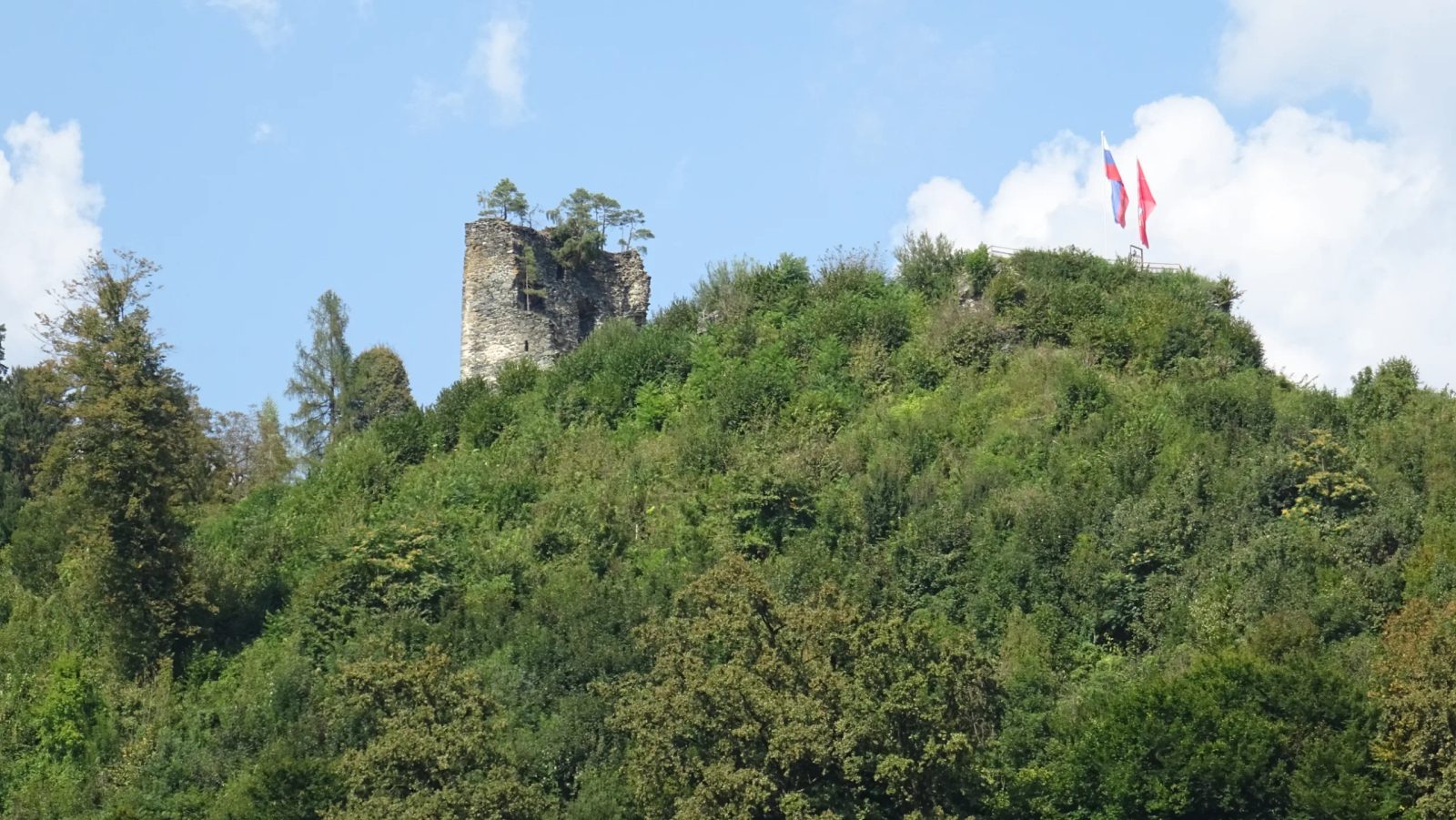
The Unterdrauburg is a medieval castle ruin above the Slovenian municipality of Dravograd (German: Unterdrauburg).
Location+
The ruin of the hilltop castle is located at an altitude of 475 m on the Schlossberg (Slovenian: Grajski hrib), which is situated on the edge of the town and on the northern bank of the Drau. It lies 85 m above the town and offers a wide view into the Drau and Mieß valleys. Thus, in the Middle Ages, it controlled trade on the Drau and Mieß (Slovenian: Meža) as well as the ford across the Drau.
Name+
The castle was first mentioned as castrum Trahburck. Later, the name Unterdrauburg prevailed, as it marked the end of the Drau in the Duchy of Carinthia; in contrast to Oberdrauburg, where the Drau flows into Carinthia. The name Burg Buchenstein was used less frequently. In Slovenian, the castle was called grad Tráberk until 1945, after the Slovenian name for Unterdrauburg. From 1945, the name grad Dravograd was introduced, the basis for the name change being a law from 1948, which provided for the renaming of all religious and German designations for places, squares and streets.
History+
The first written records about the Unterdrauburg report on a legal dispute: The abbot of St. Paul's Abbey in Lavanttal complained to Pope Alexander III on August 9, 1177, that the castrum Trahburck had been unlawfully built on the monastery's land. Cholo I (also: Kolo I) of Trixen, a Styrian ministerialis who was related to the Spanheimers and had the castle built before 1161, was accused. A document from around 1161 reports of an Ortolfus senior de Traberch. The Pope then commissioned the Archbishop of Salzburg Konrad III von Wittelsbach and the Bishop of Gurk, Roman von Leibnitz, with the destruction of the castle. However, because Pope Alexander III was in dispute with Emperor Frederick Barbarossa and the Salzburg episcopal see was disputed, the castle was not demolished. Since Cholo could no longer be driven out, St. Paul's Abbey concluded a settlement with Cholo and his brother Heinrich I von Trixen between 1180 and 1190: The area remained under the suzerainty of the abbey and the Trixeners retained the castle and the surrounding area as a fief. The castle became increasingly important, so that Otto I von Trixen also called himself Otto von Traberch in 1208. His descendants also did this.
In 1261, the Trixen family died out (according to other sources 1278) and Count Heinrich von Pfannberg acquired the Unterdrauburg as a fief of St. Paul's Monastery for a monetary payment. After Heinrich's death in 1282, his eldest son Herrmann, who died in 1286 or 1287, inherited the castle. His wife was Elisabeth von Heunburg, the daughter of Ulrich II von Heunburg, so that from 1286/87 Count Ulrich II was the owner of the castle. In 1303, Elisabeth married Heinrich von Hohenlohe and brought the dominion of Unterdrauburg as a dowry into her second marriage.
In 1304, Duke Heinrich of Carinthia recognized the old feudal rights of St. Paul's Abbey for the castle and dominion. His successor, the Duke of Carinthia and Carniola, Otto III, shortly thereafter acquired the dominion and castle of Unterdrauburg from Abbot Weriand. This temporarily ended the monastery's relationship with the Unterdrauburg. After the purchase, Otto III pledged the castle to his ministerialis Konrad III von Auffenstein. Konrad III had the castle rebuilt until 1328, the costs were credited to the pledge under Duke Heinrich IV of Carinthia. Konrad died in 1368 at the Battle of Bleiburg, when he participated in an uprising against the Habsburg Dukes Albrecht III and Leopold III. Thus, the castle came to the Habsburgs in 1368, who granted the dominion of Unterdrauburg to the Stubenbergers. In 1375, the castle and dominion of Unterdrauburg were granted to Johann von Liechtenstein. Already twelve years later, in 1387, it was given as a fief to Count Hermann II von Cilli. The castle and territory remained with the Counts of Cilli until the last Count of Cilli, Ulrich II, died on November 9, 1456. According to the inheritance contract, the castle and dominion fell back to the Habsburgs, in whose possession it remained until 1613. In that year, the Prince-Bishop of Lavant, Georg III von Palmburg, acquired Unterdrauburg for his diocese. On June 8, 1629, Abbot Hieronymus Marchstaller was able to acquire the castle and dominion of Unterdrauburg again for St. Paul's Abbey for 20,000 guilders. In the second half of the 18th century, a fire destroyed large parts of the castle; however, it was immediately rebuilt. On April 10, 1787, under Emperor Joseph II, St. Paul's Monastery was dissolved as part of the Josephine Church Reform and sold along with its possessions. Thus, Count Alois von Kuenburg came into possession of the area. The Kuenburgs sold the castle in 1838 to David Dumreicher (incorrectly Sumreicher), who abandoned the castle in 1846 and let it fall into disrepair. The castle ruin is currently in poor condition. It has been a protected monument since December 6, 1996.
Description+
The castle was oriented northwest-southeast, so that from the main tower of the core castle one had a view of the confluence of the Mieß into the Drau and of the town lying on the river including the bridge over the Drau. The complex had a size of approximately 66 m in length and 18 m in width. Of the former square keep with an outer length of approx. 7 m, only the foundation walls remain. Of the outer bailey, which adjoined to the southeast, only southern wall remains are preserved. The outer bailey had approximate dimensions of 40 m in length and 20 m in width. The best preserved is still the residential tower, of which three outer walls are still standing, the inner wall to the castle courtyard has collapsed. The tower had outer dimensions of 9 m by 12.5 m. The entire castle grounds are currently (as of 2020) overgrown with trees and thus endangered in their preservation.
Take Mobile History with you
You are reading this text for free. Premium adds what matters on the road: descriptions read aloud, sites found through your camera, whole regions taken offline.
- Every description, including the ~17,700 Premium sites
- Audio guide: have descriptions read to you on location
- AR finder: see sites through your camera, with distance and bearing
- Unlimited saved sites
14 days free, then from €2.99 a month. Cancel anytime.
Source: Wikipedia · Licence: CC BY-SA 4.0 · Image: Foto: Jörg Heldt (Community)
This description is a machine translation of an excerpt from the linked Wikipedia article. The source text was written by its authors, the translation is by Mobile History; like the original it is licensed under CC BY-SA 4.0.
Location: 46.5930, 15.0178