MonasteryBerlin-Mitte

Grey Abbey

Grey Abbey

The remains of the Abbey can be visited

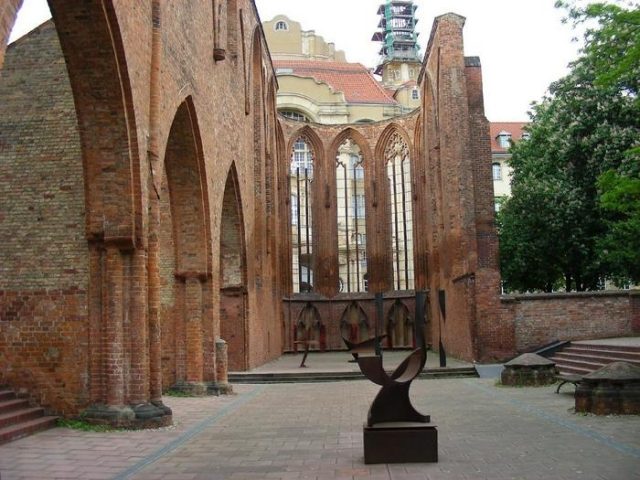
The Franciscan monastery in medieval Berlin was known as the Grey Monastery (Graues Kloster). According to the tradition of the Marchian chronicler Andreas Angelus, the name refers to the grey habit of the Franciscan monks. The Berlin Franciscan monastery was located on today's Klosterstraße. Before its destruction in World War II, the monastery was considered the most important medieval building in the city. Today, the ruins of the Franciscan monastery church represent one of Berlin's last remaining Gothic sights.

The Origins of the Monastery

The mendicant orders played an important role in the German settlement of the areas between the Elbe and Oder rivers. Medieval Central Germany, alongside the Rhineland, is considered one of the classic lands of the mendicant orders. In the Margraviate of Brandenburg, the Ascani rulers used the mendicant orders for the systematic settlement of the land.

In 1250, a Herman Langelis appears in documents as Lectoris in the Grey Monastery in Berlin. He was a spiritual advisor and confessor to the Brandenburg Princess Mechthild. This fact suggests a close connection between the Franciscans and the Brandenburg margravial court.

The Buildings

Further evidence of a Franciscan settlement from 1249 onwards comes from the chronicler Andreas Angelus. According to the chronicler, the original settlement was located on Spandauer Straße (today's house number 49). However, fieldstone remnants of a Romanesque hall church from before 1250, found beneath the monastery church, indicate that the Franciscans were settled in the area from the beginning. This assumption seems to be confirmed by the holding of a provincial chapter as early as 1252, which certainly required suitable premises. The chronicler Angelus transmits the name Grey Monastery as the designation for the Berlin convent. The monastery itself bordered directly on the margravial court (Aula) on Klosterstraße and extended directly to the medieval city wall. In total, the monastery encompassed the area between today's Klosterstraße, Grunerstraße, and Littenstraße. Furthermore, the monastery also had a terminarius house in Spandau.

In addition to the Franciscan monastery in Berlin, there was the Dominican monastery Cölln in the sister city of Cölln. This is only mentioned from 1297 onwards and perhaps arose from the dissolution of a possible Dominican convent in the older city of Spandau.

The Berlin Franciscan convent belonged to the Custody of Brandenburg of the medieval Franciscan province of Saxonia.

An inscription, which was located in the monastery itself until World War II, stated that the Brandenburg Margraves Otto V and Albrecht III gifted the Franciscans the plot of land near the city wall, in direct proximity to the margravial residence (Hohes Haus), in 1271. Furthermore, in 1290, the Franciscans received a brickworks from the knight Jakob von Nybede as a donation, which first made the construction of the actual monastery possible. Remains of this brickworks were found near today's Kreuzbergstraße. The construction of the monastery was probably completed in the 14th century. Numerous burial sites provide insight into the good relationship between the religious order and the citizens of Berlin and the Brandenburg margraves. Among others, Louis the Roman, son of the Roman-German Emperor Louis IV and Margaret of Holland, and as Louis II Margrave and first Elector of Brandenburg, was buried here.

The Berlin Franciscans probably gained great popularity through the spiritual support they gave to the Berlin population during the interdict of 1325–1347. This may also have been decisive for the design of the Dance of Death in St. Marienkirche.

Change of Use Following the Reformation

In the course of the Reformation, which took place in Berlin in 1539, the monastery was dissolved by Elector Joachim II, and its property was secularized. The last Franciscan died in the Grey Monastery in 1571. In 1574, a gymnasium was established in the buildings, named the Berlinisches Gymnasium zum Grauen Kloster. One of the most famous directors of this school was the renowned hymn writer Michael Schirmer (1606–1673). The buildings of the former monastery and the monastery church suffered severe damage in World War II. The hastily secured ruins of the church, refectory, and chapter house suffered further massive damage during the construction of a subway tunnel in 1951. The remains of the other parts of the monastery buildings were cleared between 1959 and 1961, while the refectory and chapter house were to be rebuilt as a wine restaurant. However, in June 1968, they were demolished due to the widening of Grunerstraße. Today, therefore, only the ruins of the monastery church can be seen; the gymnasium has been located in the Schmargendorf district since 1963.

Today, the Franciscans have two establishments in Berlin: the Franciscan monastery in the Pankow district (Wollankstraße 19, since 1921), which maintains a soup kitchen, and the Franciscan monastery in the Wilmersdorf district (Ludwigkirchplatz 10, since 1986), whose main task is parish pastoral care at Ludwigskirche.

Take Mobile History with you

You are reading this text for free. Premium adds what matters on the road: descriptions read aloud, sites found through your camera, whole regions taken offline.

  • Every description, including the ~17,700 Premium sites
  • Audio guide: have descriptions read to you on location
  • AR finder: see sites through your camera, with distance and bearing
  • Unlimited saved sites

14 days free, then from €2.99 a month. Cancel anytime.

Source: Wikipedia · Licence: CC BY-SA 4.0 · Image: http://www.wehrbauten.de/thread.php?threadid=526

This description draws on the facts documented in the linked Wikipedia article; Wikipedia content is licensed under CC BY-SA 4.0. Wording and editing: Mobile History.

Location: 52.5185, 13.4126