To be privately owned
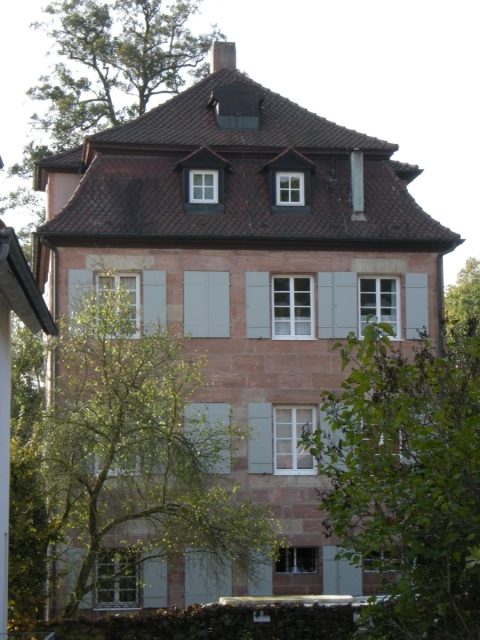
Grolandsche Castle
The Groland Castle is demonstrably one of the older seats, already existing in 1504. The first verifiable owner appears to be Ulrich I Groland, who died in 1373. He was followed by Ulrich II Groland, who died in 1407 and also resided at Oberbürg [cf. Oberbürg]. After the death of Jakob Groland the Elder in 1515, Jakob the Younger took over the seat and granted the Imperial City the right of entry in 1517. The council could now occupy the seat with a military garrison in case of war. However, the Groland family is said to have already experienced the destruction of their property in the First Margrave War in 1449, when the troops of Margrave Albrecht Achilles razed the town of Erlenstegen. It is not known whether Hans Groland's (he was Jakob's brother) 1517 right of entry refers to the same seat.
In 1553, during the Second Margrave War, perhaps only looting and damage to the manor house had to be endured, as only one of five mentioned seats is said to have been burned down. Still in 1553, the Grolands began restoring the castle complex, which seems to have been completed around 1565. Around 1600, Jakob Groland then built an unauthorized new single-story annex directly next to the manor house, which was an ideal typical moated house, "lying in the pond at Erlenstegen".
Wolff Jakob Groland owned the castle until 1632. After the Thirty Years' War, which presumably caused no great damage, two more generations of the old Nuremberg family, Paul Carl, who died in 1685, and Gabriel Paul Groland, held the seat. With the death of the latter in 1720, the family, who called themselves von und zu Erlenstegen und Ödenberg, died out and bequeathed the property to the Imperial City's Losungsrat Philipp Jakob Scheurl von Defersdorf (1648–1725). Subsequently, the name "Scheurl-Schloss" became established.
In 1729, the son initiated a renovation of the residential tower-like manor house, which significantly changed its appearance. Johann Carl Scheurl (1696–1751) wanted to furnish a new representative hall on the top floor. This was approved, as was, a year later in 1730, the addition of bay windows to the southern and northern facades. The old roof structure with its watchtowers was replaced by a baroque mansard roof. This renovation still characterizes the castle today. At that time, the moat was also filled in and a garden was laid out in its place.
In 1751, his son Friedrich Carl Scheurl von Defersdorf inherited the castle estate. He too died in 1794, without male descendants. The Scheurl seat then fell to the sons of his brother-in-law Karl Wilhelm (1720–1793), namely Friedrich Carl Christoph (administrator of the Reicheneck office), Christoph Gottlieb, and Gottlieb Christoph Wilhelm Scheurl. The manor house was still in their hands in the early 19th century. At that time, it consisted of the solidly built manor house, the tenant's dwelling with the stables, a now dilapidated day laborer's house, the barn, and other farm buildings. The property complex later passed to the merchant family Bäumler. In 1938, the widow Maria Bäumler bequeathed the property to the druggist family Kütt.
Take Mobile History with you
You are reading this text for free. Premium adds what matters on the road: descriptions read aloud, sites found through your camera, whole regions taken offline.
- Every description, including the ~17,700 Premium sites
- Audio guide: have descriptions read to you on location
- AR finder: see sites through your camera, with distance and bearing
- Unlimited saved sites
14 days free, then from €2.99 a month. Cancel anytime.
Source: Wikipedia · Licence: CC BY-SA 4.0 · Image: http://schloesserrundschau.de/bayern/schloesser01/nuernberg19.html
This description draws on the facts documented in the linked Wikipedia article; Wikipedia content is licensed under CC BY-SA 4.0. Wording and editing: Mobile History.
Location: 49.4728, 11.1380