CastleHomburg - Jägersburg

Gustavsburg Castle
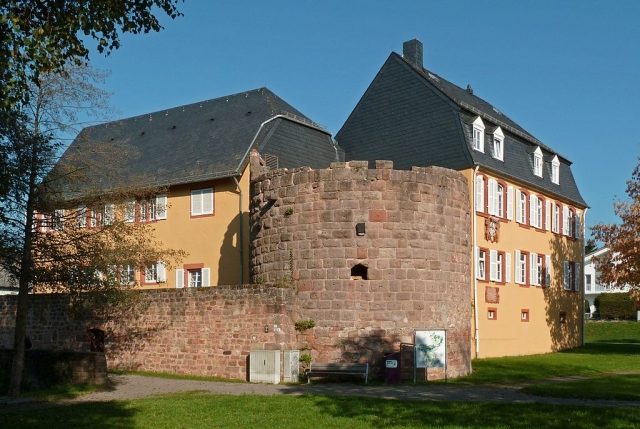
Gustavsburg Castle

Museum

The Gustavsburg is a Baroque building by the Swedish architect Jonas Erikson Sundahl in the Saar-Palatinate town of Jägersburg. The building was once called Hattweiler Castle, was renamed Hansweiler Castle in 1590 and finally Gustavsburg in 1720.

Remains of the building fabric reveal that the complex was originally a Salian border castle, destroyed by Barbarossa around 1168 and then rebuilt as a Staufer castle.

After the decline of the Staufer emperors, the castle (called Hattweiler Castle) fell to the Counts of Zweibrücken. A vassal of the Zweibrücken, a Bartholomäus von Hattweiler, is first mentioned in 1272. His successors were Waitier von Hattweiler (1282) and Thielemann von Hattweiler (1318). In 1402, the castle was pledged to Philip von Nassau-Saarbrücken. Elisabeth von Nassau-Saarbrücken liked the complex so much that in the formerly French minnelied, which she adapted in the Moselle Franconian knight's novel "Sibille", she replaced the original name Hautefeuille with Hattweiler. Other illustrious names such as Hermann Boos von Waldeck, Anselm von Bitsch and Symont Mauchenheimer, Hans Ryten Esel von Ruschenburg, Alheim Eckbrecht von Dürckheim, Albrecht von Morsheim and Philipp Breder von Hohenstein followed as owners of the castle.

During the war between Franz von Sickingen and the Archbishop of Trier Richard von Greiffenklau (1522), the castle fell to the Trierers and the owner von Hohenstein was imprisoned in Wittlich. His sons received the castle back 20 years later (1543) and passed it on to Friedrich von Steinkallenfels. He sold it to Johann von Warsberg, who sold it to Duke Johann I of Pfalz-Zweibrücken, who converted it into a castle in 1590. In 1622, a watchtower was added to the complex. During the Thirty Years' War, the castle burned down. In 1666, Duke Friedrich Ludwig had a residential building with a barn and stable built in its place. In 1720, Duke Gustav Samuel Leopold had the residential building renovated by Sundahl in the Baroque style and a chapel added, naming the complex after himself Gustavsburg. After the French Revolution, Gustavsburg Castle came into the possession of the forester Christian Lindemann, in 1842 into that of the Bavarian Forest Administration, before it was taken over by the municipality of Jägersburg in 1973. From 1978-1981, the city of Homburg had the Gustavsburg restored with subsidies from the Saarland.

Current Use+

Today, the castle is owned by the city of Homburg and houses the Jägersburg Castle and Palace Museum. The hall on the upper floor is available for exhibitions, concerts and festivities. The chapel and the ballroom are popular with bridal couples for weddings.

Take Mobile History with you

You are reading this text for free. Premium adds what matters on the road: descriptions read aloud, sites found through your camera, whole regions taken offline.

  • Every description, including the ~17,700 Premium sites
  • Audio guide: have descriptions read to you on location
  • AR finder: see sites through your camera, with distance and bearing
  • Unlimited saved sites

14 days free, then from €2.99 a month. Cancel anytime.

Source: Wikipedia · Licence: CC BY-SA 4.0 · Image: https://commons.wikimedia.org/wiki/File:Die_Gustavsburg_in_J%C3%A4gersburg.jpg

This description draws on the facts documented in the linked Wikipedia article; Wikipedia content is licensed under CC BY-SA 4.0. Wording and editing: Mobile History.

Location: 49.3706, 7.3215