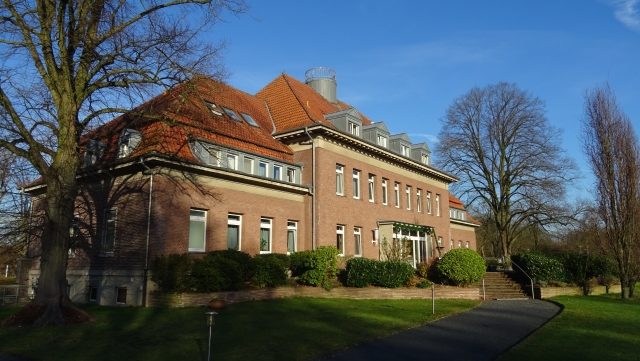
Nursing home
Klausheide Manor
The Klausheide Estate, formerly Gut Clausheide, located in the district of Klausheide near Nordhorn in the County of Bentheim, was founded in 1913 by the German industrialist couple Bertha and Gustav Krupp with the aim of establishing a model agricultural estate.
The estate was named after Claus von Bohlen und Halbach, the third of their eight children, born in 1910. The property, totaling around 15,000 Morgen (3,750 hectares), remained in the family's ownership until 1951, when Bertha Krupp von Bohlen und Halbach sold the estate complex and 1,100 hectares of cultivated land to Saatzuchtgesellschaft Lochow-Petkus GmbH. In 1990, the Nordhorn Arbeiterwohlfahrt acquired the main building and the two adjoining outbuildings, where it has operated a residential home for chronically multiply impaired addiction sufferers since 1996.
From 1933, the Krupp family made a heathland area of approximately 2,200 hectares of the property available to the German Wehrmacht for military use. In 1947, the British Royal Air Force established its Air to Ground Weapon Range, known as Nordhorn Range, there, which was handed over to the German Bundeswehr in 2001 and is now officially called Luft-/Bodenschießplatz Nordhorn (Nordhorn Air/Ground Firing Range).
The buildings and grounds of the estate complex are listed as historical monuments. In November 1978, the eight estate workers' houses standing on the north side of the B 213 were demolished. The houses on the south side are still preserved.
Estate District+
Foundation and Naming
From summer 1913, the industrialist family Krupp von Bohlen und Halbach acquired extensive moor and heathland between Nordhorn and Lingen in the then province of Hanover with the aim of establishing a model agricultural estate. The newspaper report stated:
“Agricultural. Nordhorn, Aug. 5. Large land purchases have recently taken place in the adjacent communities of Bakelde, Altendorf and Hesepe, as well as in the communities of Lohne and Elbergen located in the district of Lingen. It concerns about 12,000 Morgen of moor and heathland, which now almost form a closed whole. It is intended to cultivate these areas and establish a large agricultural enterprise there. The main focus will then be on vegetable cultivation. The vegetables grown are to be shipped elsewhere. Nordhorn is likely to be the shipping location. The entrepreneur intends to form two estate districts from the acquired areas, one in the district of Bentheim and one in the district of Lingen, so that no burdens will arise for the communities in which the properties were previously located. Enclosed on three sides by these areas is the Nordhorn Moor, which is for the most part owned by Nordhorn citizens. Since these properties have brought almost no benefit to their owners for years, it would be desirable if these were also purchased for the intended purpose. As reported by informed sources, there is probably an inclination among interested parties to acquire these parcels as well, if the demands are reasonable.”
– Reprint of a newspaper clipping (unfortunately without the name of the newspaper) in Nordhorn.de: Das Gut Klausheide. Presentation by Arbeiterwohlfahrt Grafschaft Bentheim from 2010. P. 4
Named after Claus von Bohlen und Halbach, the third of the eight Krupp children, the area and estate were initially called "die Claus-Heide," but soon "Clausheide."
Incorporation
Effective July 1, 1929, parts of the communities of Altendorf and Bakelde were incorporated into Nordhorn. In the process, the areas of the two communities belonging to the estate, as well as uninhabited parts of Bakelde, were separated and formed the remaining community of Bakelde. This community applied in December 1930 for renaming to Clausheide. However, due to the spelling reform of 1901 to standardize German spelling, the remaining community of Bakelde was renamed Klausheide. The municipal council applied to retain the spelling "Clausheide," as the naming was after Claus von Bohlen und Halbach; the Minister of the Interior, however, refused this application with the justification: "...community and place names of Slavic and German origin are to be written with K at the beginning." The new spelling only slowly gained acceptance.
Location
Klausheide Estate The Klausheide Estate in Lower Saxony.
The originally acquired lands extended over several communities in the districts of Grafschaft Bentheim and Lingen, namely Altendorf, Bakelde, Lohne, Herzford, Elbergen, Engden, and Hesepe. The manor house and the later residential settlement were located in the area of the community of Bakelde, from 1931 the community of Klausheide, and since 1974 the city of Nordhorn. The manor house is located about seven kilometers north-east of Nordhorn and about 13 kilometers south-west of Lingen.
The estate district was traversed by both the Ems-Vechte Canal and the road connection between Lingen and Nordhorn, each running from south-west to north-east. This road connection was the precursor of the B 213, which, due to its importance, had already been upgraded to a chaussée in 1824 as the first land connection in the County of Bentheim. The Ems-Vechte Canal, opened in 1879 and running almost parallel to the road about five kilometers to the south as part of the Left-Ems Canal network, served not only to drain the area intended for cultivation but also represented an important transport route.
Large parts of this area consisted of heath or moor landscapes, in the middle of which lay the Nordhorn Moor. Through the cultivation measures begun after the acquisition of the properties, extensive agricultural areas were created in the northern part of the estate district, around the erected estate. Not far from the estate, located south-west, a workers' settlement was built, which originally consisted of 20 semi-detached houses on both sides of the chaussée and offered space for 40 families. From the extensive areas south of the settlement, young forest was planted on a large scale. South-east of the estate, Klausheide Airfield was built.
The estate complex itself resembles a huge four-sided farm with a closed inner area. Together with the approximately 500-meter-long access road to the manor house and other lateral areas, the estate covers an area of about 13 hectares, which was additionally enclosed by a low brick wall.
In the southern part of the properties surrounding the estate, located north and south of the canal, large coniferous forest areas were planted, but many moor and heath areas, such as the Heseper Moor, were only partially drained and largely left natural. The least cultivated area south of the Ems-Vechte Canal was used by the German Wehrmacht as a ground firing range from 1933.
Later, the workers' houses belonging to the estate complex developed into the village of Klausheide, which expanded southwards over time and displaced parts of the forest.
Model Estate+
Reclamation and First Cultivation
Through cultivation and utilization for agricultural purposes, a model estate was established in approximately the northern third of the property, where vegetable and grain cultivation was primarily planned. The southern part of the area, located both south and north of the Ems-Vechte Canal, was to be extensively reforested with coniferous trees. The owners hired an estate manager named Schiwinski from East Prussia.
On April 5, 1914, initial cultivation work began with steam plows from the Ottomeyer company. A farmstead on the nearby Kiefernweg had been purchased to accommodate the first workers and the necessary draft animals. Subsequently, the areas were worked by draft horses and cattle, and experiments were conducted with green manure for soil improvement. A narrow-gauge railway was built from the planned estate complex and put into operation in July 1914.
On April 27, 1914, Bertha and Gustav Krupp von Bohlen und Halbach inspected the grounds and the progress of the work. On this day, they announced their intention to name the area Claus-Heide after their son Claus von Bohlen und Halbach. Architect Herrmann was commissioned with the planning for the estate buildings.
The First World War, which broke out shortly thereafter, significantly hindered the further progress of construction projects and cultivation measures, especially since the administrator was also called up for military service. Nevertheless, the groundbreaking ceremony for the manor house took place on June 9, 1915. Prisoners of war were also used for the construction work. The main building was erected on the northern side of the Nordhorn-Lingen chaussée, set back several hundred meters from the road and connected to it by an avenue driveway. To the right and left of the manor house, and also to the north, the other buildings and areas followed, which received further access roads on the west and east sides. The entire estate complex was enclosed by varying heights of clinker brick masonry.
From 1916, potatoes, rye, and lupins were planted, and the first harvest was brought in the same year. At the same time, extensive reforestation work began on large forest areas, which were laid out south of the estate up to the Ems-Vechte Canal. For this purpose, a tree nursery was established in the area of today's Elbergen forest district, where the plants for reforestation were grown. In "spring 1936 alone, around 1.8 million saplings were planted on an area of 600 Morgen of land."
In November 1917, the main buildings of the estate were completed to such an extent that the administrator could move in provisionally. However, the complete completion of the manor house was delayed until 1919 due to the war, when construction of houses for the workers could also begin. In 1919, the first estate and forest ranger, Hermann Meinecke, was hired. In September 1919, construction began on 18 semi-detached houses for estate workers on both sides of the chaussée, which were ready for occupancy in autumn 1920.
By 1922, all estate workers' houses were occupied. The schoolchildren were driven to school in Nordhorn by school wagon. From 1927, due to the increasing number of children, teacher Fritz Strothmann was hired, who took up residence in one of the farm laborers' houses and taught in his private room. In 1933, under the subsequent teacher Fritz Kreft, 50 children attended classes, which exceeded the capacity of the room, which could accommodate a maximum of 33 places, so that shift teaching had to be provided due to lack of space. Due to the lack of space, the Krupp administration provided a former locomotive shed in 1933, which was converted into a small schoolhouse.
On the cultivated areas of the estate, mainly rye and potatoes were grown. In addition, pastures for cattle and horses, as well as meadows for hay harvesting, were sown. While hay harvests were usually good, there were severe setbacks in the yields of potato and rye harvests in the early years.
Great Depression and World War II
Due to crop failures and lack of cultivation success in the early days, the estate required enormous subsidies from the owners, which became increasingly difficult due to the Great Depression. Initially, a sale was sought, but this proved almost impossible due to the poor economic conditions in Germany. So, a long-term lease was planned. The Klausheide estate was advertised for lease nationwide with coded advertisements:
“Estate Lease Estate, Province of Hanover, located directly on a provincial chaussée, with complete excellent dead and living inventory, some of which can be taken over as iron inventory, newly built farmstead with sufficient utility rooms, modern and practically furnished, beautiful large manor house, 40 new spacious workers' dwellings, own electrical system for light and power. 1,650 Morgen of utilized land, of which 404 Morgen grassland and 1,178 Morgen arable land, to be leased for 18 years with an upcoming good harvest. Favorable lease conditions, essentially the obligation to cultivate approx. 1,000 additional Morgen during the 18-year lease period, the use of which also accrues to the lessee. Pre-drainage is completely carried out. Required working capital approx. 170,000 Marks, which must be proven as own capital. Only experienced, capable farmers with best recommendations will be considered.”
– Reprint of an advertisement. In: Nordhorn.de: Das Gut Klausheide. Presentation by Arbeiterwohlfahrt Grafschaft Bentheim from 2010. (PDF; 6.5 MB)
Egbert Hayessen from Hammer near Liebenwalde on the Finow Canal visited the estate on July 27, 1925, and August 6 with his two brothers. In that year, the grain was good, and the potato fields and pastures had also thrived splendidly, making a good impression on the interested parties. A lease agreement was concluded from July 1, 1925, to June 30, 1945. The lessee took over the entire living and dead inventory as an iron stock, did not have to pay any rent, but had to commit to reclaiming 900 Morgen of heathland as pasture or arable land in the first ten years.
By 1935, 5,500 Morgen of the 15,000 Morgen of heathland belonging to the estate had been cultivated. Of this, 3,000 Morgen were used for forestry and 2,500 Morgen for agriculture. The estate was managed with up to 40 permanent workers and their families. In addition, there were auxiliary workers and day laborers, as well as harvest helpers during harvest time. 10 horse teams were available for working the arable land. Harvest yields could be increased annually, although setbacks continued to occur. In 1935, 20 fattening cattle went to the slaughterhouses, over 200,000 liters of fresh milk were produced, 16,000 hundredweight of potatoes and about 3,600 hundredweight of grain were supplied to the market. In addition, there was the estate's own consumption.
In 1937, the estate tenant Hayessen reported in an annual publication about the year 1937:
“2,300 Morgen of land are used for agriculture, 3,300 for forestry... The yield included 1,000 fattening sheep, 30 fat cattle, 80 calves, 300,000 liters of whole milk, 70 hundredweight of sheep's wool... On the new chaussée Nordhorn–Wietmarschen, the best cultivated land was already given up for settlements. Four farming families were able to establish their own ... homesteads there.”
– Egbert Hayessen: Das Gut Clausheide. Bentheimer Heimatkalender 1938, pp. 56–57
To make economic use of the still large heathland areas, they were grazed by a flock of 2,500 sheep. This flock of sheep may have been the largest in Germany.
Irmgard Eilenstein, then Baroness Raitz von Frentz, née von Bohlen und Halbach, moved with her three children Rudger, Siegbert, and Adelheid to the forester's lodge belonging to the estate during the turmoil of war and after her husband had fallen. She lived there until the summer of 1952, when she moved to Dortmund, where she married her second husband, the farmer Robert Eilenstein, in June 1952.
Post-war period
From the end of the war until 1947, a supply unit of Polish soldiers was stationed at the estate.
In 1948, the Klausheide estate was converted and used until 1951 as a hospital for tuberculosis patients from the district hospital. The chief physician was the Nordhorn internist Dr. in der Stroot.
Facilities+
Narrow-gauge railway
From the estate complex, a narrow-gauge railway with a track width of 60 centimeters and various loading ramps led to the Ems-Vechte Canal, on the one hand to transport the material required for cultivation and construction of the estate complex, and later, in the opposite direction, the estate products. The railway was put into operation in July 1914.
In 1920, the railway was extended to Elbergen station, where it connected to the Münster—Emden railway line. In 1929, it was shut down and dismantled.
Airfield
After cultivation, local glider pilots, who had previously only been able to fly in the Wilsumer Berge, became aware of the ideal terrain east of the estate. Since the Krupp family themselves enjoyed traveling to the estate by plane, a small airfield was established.
In 1927, Klausheide Airfield was included as an emergency landing strip in the developing civilian scheduled flight network and integrated into the Hannover—Amsterdam night flight route. In these early days of night flight, pilots oriented themselves by beacons. Emergency landing strips had to be set up in all directions near the rotating beacons. In addition to Klausheide, these were located in Plantlünne, Vörden, and Metelen. During the Second World War, the site was expanded by the Luftwaffe into the so-called Klausheide operational airfield.
Estate tenant Hayessen reported in 1938:
“But whoever visited the Klausheide airfield now, at the end of June 1937, during the Deutschlandflug, could convince themselves of the enormous activity... Almost every pilot today knows the... Klausheide airfield.”
Hunting
With the cultivation and reforestation, a progressively rich wildlife population developed around the Klausheide estate after only a few years. Initially, rabbits in particular multiplied so numerous that they became a plague and had to be hunted extensively. Over time, all types of small game developed. The estate owners traditionally invited prominent hunting parties from politics and business to large driven hunts in autumn and winter.
School
Initially, the children of Klausheide's workers attended various Nordhorn schools, namely the Altendorf School, the Burgschule, and the Mittelschule. Until 1926, the estate administration provided transportation for the children. When this was questioned, furthermore the axle of the wagon broke and it became apparent that further transportation would be difficult, the decision was made to establish a school on the estate grounds. A teacher named Strotmann was hired, who took up residence on the estate, where initially the lessons of the Klausheide elementary school, established as a community school, took place and where 32 students were taught in 1927. By 1933, the number of students had grown to 50. Since the classroom, still set up in the teacher's apartment, only had 32 seats, shift teaching had to be provided. As Strotmann's successor, teacher Fritz Kreft began his service on April 1, 1933. In 1936, a school building was erected by converting a locomotive shed of the narrow-gauge railway line, where lessons could take place from June 1936.
In 1945, at the end of the war, the school building and its furnishings were largely destroyed by passing troops. From 1948, the school resumed its work with 61 students, and a year later there were already 73 students. In April 1950, a second teacher was hired. Since no second classroom was available, shift teaching had to be provided again. From 1953 to 1956, Klausheide's population increased sharply due to the influx of refugees and new settlements: while Klausheide still had 250 inhabitants in 1950, there were already 800 in 1962 and 1,000 in 1964. From 1954, a school building was erected in the new development area (south of the B 213), which was used for teaching from May 1956.
This school developed into today's Maria Montessori School.
Fire Department
The Klausheide estate had its own fire department. Almost all firefighters worked on the estate or lived in Klausheide. Their area of operation included not only the protection of the estate and its facilities but also the combating of heath and forest fires.
Estate Chapel
The estate workers also founded their own estate chapel. The chapel also played for dances in the nearby Harmsen inn, today Hotel Rammelkamp.
Later Use+
Nordhorn Air/Ground Firing Range
The cultivation of the part of the Krupp property located south of the Ems-Vechte Canal progressed comparatively slowly. In 1933, the family made a heathland area of approximately 2,200 hectares, with an east-west extension of about ten and a north-south extension of about nine kilometers, available to the German Wehrmacht for military use. From 1935, firing exercises by light artillery troops took place in the area. In 1939, the artillery firing range was expanded into an air force training ground for airborne weapon deployment and bomb dropping.
In 1945, British troops occupied the training ground; in 1947, the British Royal Air Force began operations as an "Air To Ground Weapon Range" and named the site Nordhorn Range. In 2001, the Nordhorn Range was handed over to the Bundeswehr for use by the Luftwaffe.
Today, the former heathland is more than 65% covered with forest.
Lochow Seed Company
In 1951, Bertha Krupp von Bohlen und Halbach sold the Klausheide estate, including 1,100 hectares of cultivated land, for 900,000 DM to Saatzuchtgesellschaft Lochow-Petkus GmbH. With the acquisition of the estate, livestock farming and breeding were abandoned, and the focus shifted to plant breeding and seed production. This was accompanied by the cultivation of further wasteland. The company also established a research station for method development and breeding of new seed varieties.
From 1955, combine harvesters were used for harvesting. Until then, grain was manually mown with sickles, scythes, or reapers and tied into sheaves, which were initially left in the field to dry further, before being transported later by horse or ox carts to the threshing floor on the estate complex, where the grain was threshed with flails and finally stored in the granaries. The two large farm buildings were used as granaries for wheat and rye.
The main building and part of the outbuildings of the estate complex were used as a kitchen and staff canteen, as well as a guesthouse, until 1990.
Arbeiterwohlfahrt
In 1990, the owners began selling the property. The Arbeiterwohlfahrt (AWO) acquired the main building and the two adjoining outbuildings, as well as the plot of land from the main building to the federal highway, in 1990. The storage buildings were sold to a real estate company in the following years.
From 1991 to 1994, the city of Nordhorn rented apartments on the estate from the Arbeiterwohlfahrt to temporarily accommodate up to 70 asylum seekers from various crisis areas.
Since November 1, 1996, the AWO district association Grafschaft Bentheim has operated a socio-therapeutic residential home for integration assistance according to §§ 53 ff. SGB XII with 56 places for chronically multiply impaired addiction sufferers on the estate.
Large parts of the property, especially farm buildings and the former granaries, are vacant. These buildings do not belong to the Arbeiterwohlfahrt.
Take Mobile History with you
You are reading this text for free. Premium adds what matters on the road: descriptions read aloud, sites found through your camera, whole regions taken offline.
- Every description, including the ~17,700 Premium sites
- Audio guide: have descriptions read to you on location
- AR finder: see sites through your camera, with distance and bearing
- Unlimited saved sites
14 days free, then from €2.99 a month. Cancel anytime.
Location: 52.4678, 7.1600