Cultural Events
Behrenshagen Maror
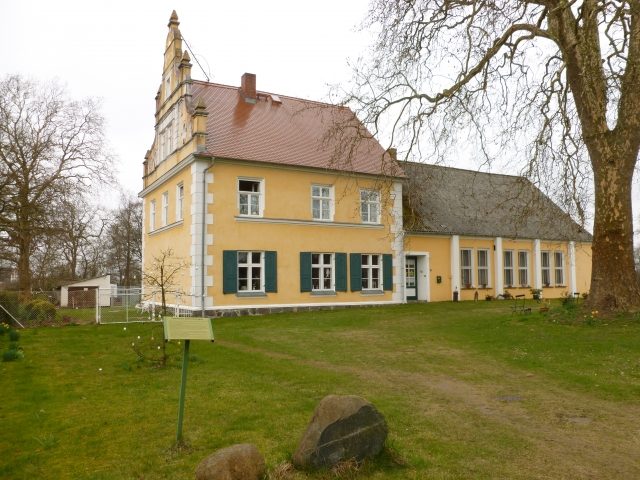
Behrenshagen was first mentioned in a document in 1289 and was owned by the knightly noble family von Mörder. In 1702, the Daskow line of the von Mörder family died out. The Daskow estate, which once included the Behrenshagen manor, thus passed to the Mützkow family von Mörder. This branch died out in 1730. After inheritance disputes between the von Bülow and von Plüschow heirs, the estate passed to the von Kahlden family in 1755 and finally to the von Lilienanker family around 1779.
In 1842, Karl Wilhelm von Stumpfeldt acquired the Daskow estates through an inheritance and committed himself to his childless aunt by inheritance to henceforth bear the name von Stumpfeldt-Lilienanker. The von Stumpfeldt-Lilienanker family was also patron of the church in Pantlitz. The Behrenshagen manor house was used as the main residence by the von Stumpfeldt-Lilienanker family until the new house in Daskow was built in 1908. The designation as a manor house would be more appropriate, as it was the residence of the lord of the manor, which was closely connected to the economic complex of the estate. The older part of the Behrenshagen manor house was presumably extended and raised by Karl Wilhelm von Stumpfeldt-Lilienanker around 1850. The idiosyncratic architectural style can be attributed to financial bottlenecks. The original building - a half-timbered building with dormers - was only raised on the left side and received the imposing Neo-Renaissance gable on the south-west side. Since then, the external appearance of the Behrenshagen manor house has been characterized by two different building structures. The difference in height was not changed. The younger part of the house was demolished around 1960 and built as a cultural hall for the former LPG.
The Behrenshagen estate was owned by the von Stumpfeldt-Lilienanker family until the forced expropriation in 1945 and leased to the Büchsel family. Until the 20th century, estate complexes formed an important economic and cultural factor in the country. The formation of new farms and the parcelling out of estate land led to a renewed change in the settlement structure after World War II. The old manor houses and stately homes with their park and garden complexes were also strongly affected by the social, economic and social changes. They were often divided among new settlers, used for agriculture and forestry, or converted into garden land. After the end of World War II, 9 refugee families lived in the Behrenshagen manor house. The families were accommodated with 2 to 6 people in one room or chamber. The house was not equipped for so many people; there was a lack of kitchens and toilets. Thus, various sheds were built in the park. Gardens were created directly in the park for the residents of the manor house.
Until the 1980s, gardens and sheds were used by individual tenants and were left to themselves until our arrival. The part of the park that could not be "cultivated" was used as an illegal landfill until our purchase. Given the goals declared from 1945 onwards to break up the manorial structures and the continued threat to manor houses from decay, demolition and misuse even after the political change in 1989, it is astonishing that the historical cultural landscape in Vorpommern has nevertheless been so comprehensively preserved in its form from before World War II. Until the 19th century, the Hanseatic messenger route led through Behrenshagen. In Behrenshagen-Sandberg, the most important horse-changing station between Damgarten and Stralsund was located.
Take Mobile History with you
You are reading this text for free. Premium adds what matters on the road: descriptions read aloud, sites found through your camera, whole regions taken offline.
- Every description, including the ~17,700 Premium sites
- Audio guide: have descriptions read to you on location
- AR finder: see sites through your camera, with distance and bearing
- Unlimited saved sites
14 days free, then from €2.99 a month. Cancel anytime.
Source: Wikipedia · Licence: CC BY-SA 4.0 · Image: Katja Wächtler
This description draws on the facts documented in the linked Wikipedia article; Wikipedia content is licensed under CC BY-SA 4.0. Wording and editing: Mobile History.
Location: 54.2547, 12.5257