ManorKrakow am See-Bossow

Bossow Manor

Bossow Manor

To be privately owned

The tenant's house was built in 1773, and the shepherd's house with the barn in 1777. By 1790, in addition to the tenant's house, the estate already included a stable, a barn, a cattle shed, and a sheepfold. The barn promised by the monastery office had been approved but was still not built by 1779. The large barn with the wagon shed, built before 1818, was located somewhat away from the bakehouse due to the high risk of fire. In 1859, repair work was carried out on the old sheepfold, the cattle shed, the stable, and the barn.

In 1867, the new cattle shed was built, and in 1882, the sheepfold with a machine shed was added to the barn. On August 12, 1903, the barn and two stable buildings for horses, pigs, chickens, and wood burned down on the farm due to a lightning strike. Due to the poor condition of the buildings, the compensation amount from the fire insurance was very low. Already in 1904, the three-story granary and the barn were rebuilt. By 1924, the estate again had 13 horses, 50 cows, 40 pigs, and 200 sheep. After a fire in the cattle shed on October 1, 1924, in which 29 sheep also burned, the wooden stable was used as an emergency horse stable. The new horse and sheep stable was only completed in August 1925.

The granary built in 1904 is now used as residential accommodation and bears a sandstone tablet on its gable with the initials of the Dobbertin Monastery Office (K. L. A.D.) and the year of construction (1904). The later converted cattle shed currently houses a large kitchen for Volkssolidarität.

The tenants of the estate were subsequently:

  • 1802 H. Düssle
  • 1804 Johann Wilhelm Leopoldi with heirs
  • 1847 Johann Christoph Besecke, assessed in 1861 as a quiet, orderly man and a good farmer, but in 1878 the farm was taken from him.
  • 1879 Oeconom Georg Kleber from Lübz, bankruptcy proceedings in 1891, had 102,253 Marks in debt.
  • 1891 Oeconom August Pieritz from Stralsund, due to health reasons, the lease was transferred.
  • 1897 Baller from Bölkow, was unable to continue managing the farm after a severe illness.
  • 1900 Heinrich Zenker from Dobbertin
  • 1914 Johannes Evers from Wismar
  • 1928 Son Karl Ludwig Evers, due to economic collapse, the farm was taken away in 1931 and managed by the state for a short time.
  • 1931 Rudolf Pentzlin, was already 74 years old in 1943, livestock neglected...
  • 1944 Nephew Ulrich Pentzlin from Schmachtenhagen was appointed as trustee and operations manager. The allocation certificate was withdrawn by the Minister of State in January 1945. Appointed as economic manager by Güstrow District Administrator Bauch on July 27, 1945.

Around 1805, the monastery office planned "to remove the 5 outer fields of the Bossow estate, which together comprise about 117 ha, from the lease and to have them entirely sown with fir trees, because the largest part of this field would be shifting sand, which would often be driven over the good field by wind and storm, causing greater damage to it." At the same time, the "not inconsiderable lake belonging to the Bossow estate," which the forest warden had previously used, was to be leased to the "pensioner," the estate tenant. However, in 1807, the fir seeds were still missing. Despite the rather moderate soil, tenant Zenker had agreed in 1912 to pay 5000 Marks annual rent instead of the previous 4650 Marks and was subsequently awarded the contract.

In 1920, the estate had an area of 248 hectares. However, one-fifth of these areas were water, of which Lake Bossow accounted for the largest part. In 1941, tenant Wilhelm Leplow from Spendin was willing to take over management with a care contract but failed due to the release of fuel for his car. In 1942, the accommodation of civilian Russians on the domain was rejected due to lack of space. The last building inspection took place in 1943.

In May 1997, a aftercare facility for addicts was established on the grounds of the former estate by Volkssolidarität.

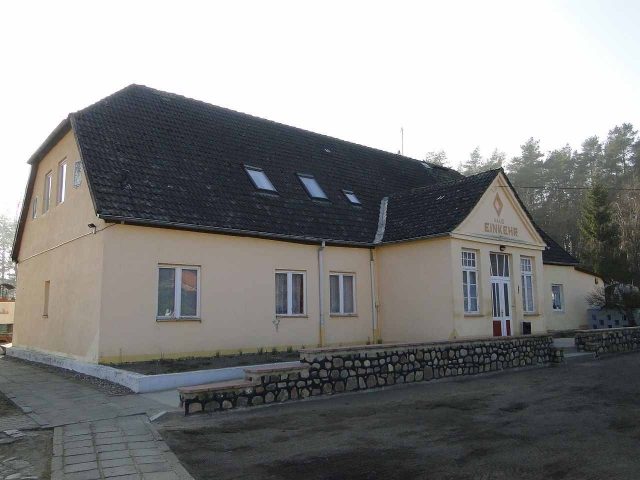
Manor House

The simple tenant's house with a central risalit likely dates from the time the farm was established around 1780 and was rebuilt in 1820. In 1920, the outhouse extension was added, and in 1923, the vestibule. The original brick building is now plastered and, with an annex, also serves the aftercare facility of Volkssolidarität. The tenant's house did not have an elaborately designed manor park, but only an orchard and utility garden typical for that time. The horse chestnut in the middle of today's chicken yard was probably planted in the 19th century.

Take Mobile History with you

You are reading this text for free. Premium adds what matters on the road: descriptions read aloud, sites found through your camera, whole regions taken offline.

  • Every description, including the ~17,700 Premium sites
  • Audio guide: have descriptions read to you on location
  • AR finder: see sites through your camera, with distance and bearing
  • Unlimited saved sites

14 days free, then from €2.99 a month. Cancel anytime.

Source: Wikipedia · Licence: CC BY-SA 4.0 · Image: http://de.wikipedia.org/wiki/Datei:Bossow_Gutshaus_2011-03-03_162.JPG

This description draws on the facts documented in the linked Wikipedia article; Wikipedia content is licensed under CC BY-SA 4.0. Wording and editing: Mobile History.

Location: 53.6144, 12.2525