To be privately owned
Bülowssiege Manor

Bülowssiege is a district of the municipality Nordwestuckermark in the district Uckermark in Brandenburg.
The Bülowssiege outpost is located in the hilly terminal moraine landscape of the northwestern Uckermark, not far from Lake Dammsee and the agricultural town of Fürstenwerder.
After the Thirty Years' War, the then Brandenburg Chief President, Imperial Baron Otto von Schwerin, acquired the rights of a landlord in Fürstenwerder in 1670. These manorial rights, especially lease payments, were only redeemed in 1854 by the Brandenburg Rentenbank.
In the course of the separation, his great-great-grandson, Imperial Count Johann Christoph Hermann von Schwerin (1776–1858), began purchasing agricultural land in Fürstenwerder from 1826 onwards. For better management, these were consolidated into an outpost of his knight's estate Wolfshagen, located to the north.
Shortly thereafter, Imperial Count Hermann von Schwerin had a small estate built on the hitherto uninhabited farmland for the outpost, which was initially named "Frieden" (Peace). This honored the hard-won peace achieved through the Wars of Liberation and the fall of Napoleon. In 1834, however, he renamed the outpost "Bülowssiege" in honor of the Prussian general of the Wars of Liberation, Friedrich Wilhelm Freiherr von Bülow, Count of Dennewitz (1755–1816).
Art Historical Significance+
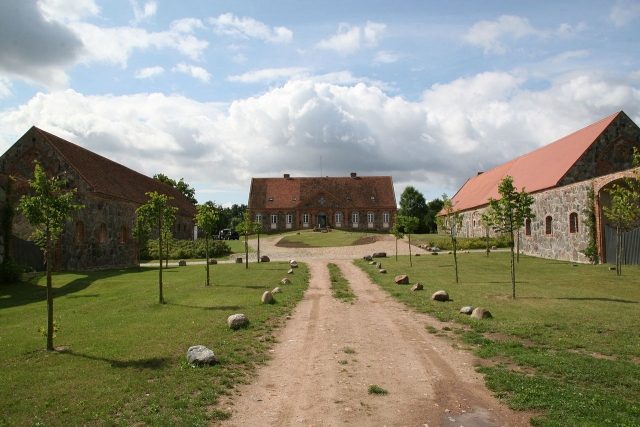
The complex, built in 1829/30, is conceived axially symmetrically on a U-shaped floor plan. The southwestern end is formed by the manor house, situated on a slight elevation. To the northeast, the axis is flanked by two elongated stable and barn buildings, whose alignment is extended by two smaller buildings (former sheepfolds) and two farmworker houses. In the course of the land reform, two new farmer's houses were built north of the outpost in 1949.
The Bülowssiege outpost is a listed complex of particular cultural-historical character and significance from the time of the Wars of Liberation (1813/15). The Bülowssiege outpost, as well as the church, the King's Column, and other monuments and buildings in Wolfshagen, were built by Imperial Count Hermann von Schwerin. Wolfshagen, Bülowssiege, and seven other outposts built by Hermann Schwerin in the immediate vicinity of Wolfshagen, as well as the Kiecker forester's lodge, were part of an overall complex that, in addition to its economic importance, aimed at beautifying the open fields in the sense of Lenné. With the exception of the church in Wolfshagen, these buildings bear the same remarkable architectural signature of the typical combination of fieldstones with Gothicizing brick pilasters. Of the outposts, only Bülowssiege has been preserved as a complete complex.
The Bülowssiege outpost is part of the overall ensemble of Wolfshagen, which has been classified by the Federal Ministry of the Interior as a cultural monument "of particular national cultural significance." Among the surviving rural buildings from the first half of the 19th century, the Bülowssiege outpost holds a special position. The complex impresses above all with its still tangible coherence and its high-quality architectural design. The economical, purpose- and material-oriented construction method and its harmonious integration into the surrounding landscape clearly demonstrate a connection to essential design principles of Prussian rural architecture of the Romantic architectural movement. In this context, the rural building school of the Berlin senior building councilor David Gilly (1748–1808) should be mentioned. The confident handling of the Gothicizing decorative forms is striking and not often found in rural architecture of this period.
As a testament to the history of the Wolfshagen knight's estate, but also as a landscape-defining architectural ensemble, the Bülowssiege outpost has important regional significance. Due to its unusual architecture and the associated art-historical value, the site of Bülowssiege also represents a monument area whose preservation is of supra-regional interest.
Bülowssiege in the 20th Century+
Since 1997, the complex has been back in the ownership of the Counts von Schwerin through repurchase. Ulrich-Wilhelm Graf von Schwerin von Schwanenfeld, the father of the current owner, was dispossessed and executed by the National Socialists in 1944 as a result of his involvement in the German resistance. The SED upheld the expropriation of its National Socialist predecessor government and distributed buildings and agricultural land in the course of the land reform in 1945/46. Due to the Nazi expropriation, the family was partially restituted in 1992.
The development of modern agricultural technology today precludes further use of the barn buildings for agricultural purposes. However, the classification of the entire estate as a protected monument makes its preservation mandatory. Since December 1997, barns and the manor house have been renovated, among other things, with the support of public funds, the German Foundation for Monument Protection, and the Rudolf-August-Oetker Foundation. The renovation of the manor house was completed in 2000. The large barn is approved for public use.
Take Mobile History with you
You are reading this text for free. Premium adds what matters on the road: descriptions read aloud, sites found through your camera, whole regions taken offline.
- Every description, including the ~17,700 Premium sites
- Audio guide: have descriptions read to you on location
- AR finder: see sites through your camera, with distance and bearing
- Unlimited saved sites
14 days free, then from €2.99 a month. Cancel anytime.
Source: Wikipedia · Licence: CC BY-SA 4.0 · Image: http://de.wikipedia.org/w/index.php?title=Datei:Gutshof_B%C3%BClowssiege.jpg&filetimestamp=20130426095046&
This description draws on the facts documented in the linked Wikipedia article; Wikipedia content is licensed under CC BY-SA 4.0. Wording and editing: Mobile History.
Location: 53.4010, 13.6223