To be privately owned
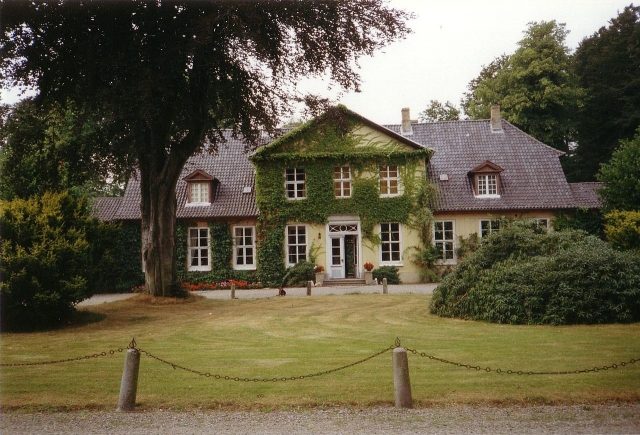
Falkenberg Manor

Falkenberg Estate belongs to the municipality of Lürschau in the district of Schleswig-Flensburg. The estate is said to have received this name because falcons living in the area were said to have flown south from there in autumn and north in spring.
The Royal Danish Chamberlain and Major General Count Heinrich von Reventlou (1763–1848, also called Reventlow), married to Countess Sophie von Baudissin (1778–1853), had bought the area around the former freehold "Ruhekrug" at the end of the 18th century to build his new estate there, which he now named "Falkenberg". The "Ruhekrug" was, as its name suggests, an old resting station on the edge of the old Oxen Road, where traders with their oxen had stopped for centuries.
Between 1796 and 1804, Count Reventlou had the Neoclassical manor house built on the ruins of the neighboring moated castle "Alt-Gottorp" (old name: "Waterborg"), an oval rampart with a crescent-shaped outer bailey, a complex of the Bishops of Schleswig. This castle was built in the mid-10th century after an agreement between the German Emperor Otto the Great (912–973) and the Danish King Harald Bluetooth (c. 910–987) to establish the Diocese of Schleswig, but was abandoned by 1161 at the latest (see: Gottorf Castle) and subsequently fell into disrepair.
The architect of the representative Falkenberg manor house, adorned with valuable stucco work, was Carl Gottlob Horn (1734–1807), experienced in the construction of Holstein manor houses and castles. He was exclusively in the service of the merchant Heinrich Carl Count von Schimmelmann and his family, "the richest man in Europe". The elaborate wall paintings in the interiors, which are still preserved today, were executed by the Italian painter Giuseppe Anselmo Pellicia, known for his Pompeian style, who was also in Schimmelmann's service and at that time also painted the manor houses Emkendorf, Knoop, and Ahrensburg.
Reventlou's successor as lord of Falkenberg was his son-in-law Adolph Baron von Blome (1798–1875). In 1823, he had married Fanny Countess von Reventlou (1803–1856) in Wittenberg, who was born in 1803 in the newly completed manor house in Falkenberg.
During the German-Danish War (1848–1851), fighting also raged in the Falkenberg area, as the important north-south road ran between the park and the manor house, dividing the estate. The enclosed grave of a fallen Danish soldier can still be seen here today.
After 1851, the Danish King Frederick VII (1808–1863) became the owner of the estate. He had the manor house converted into a small hunting lodge and entertained his hunting guests in the 12-meter-long and 6-meter-wide ballroom. The former estate entrance was closed by the wrought-iron gate with the king's initials F. R. (Friedricus Rex), which today stands restored directly in front of the manor house.
Present Day+
Today, the Nordic simple and well-proportioned manor house is plastered, has 9 axes and a two-story, triangular gabled central risalit. The roof is covered with tiles. Since 1971, the owner was the farmer Claudius von Samson-Himmelstjerna (1930–2001), who had managed Falkenberg since 1958.
In 1975, the estate and manor house were the filming locations for the TV three-part series "Der Stechlin" based on the novel by Theodor Fontane, starring, among others, Arno Assmann, Diana Körner, Willi Rose, and Ulrich von Dobschütz. For this purpose, the manor house was renovated at the expense of the production company, and the owners lived in an outbuilding for months.
Between 1999 and 2006, restoration and repurposing measures were carried out. Among other things, the former pigsty was converted into holiday apartments.
Already during the filming of the TV movie "Stechlin" (1975), there had been indications of further wall paintings, which were not pursued at the time. It was not until August 2010, during restoration work in the manor house, carried out after the change of ownership to the son, lawyer Armin von Samson-Himmelstjerna (* 1970), that Neoclassical wall paintings in a relatively good state of preservation were rediscovered. These – like those discovered earlier (see above) – are also attributed to the Italian painter Giuseppe Anselmo Pellicia. These paintings in the garden hall and an adjacent cabinet show scenes from Greek mythology with flatly arranged ornaments and large figures.
Take Mobile History with you
You are reading this text for free. Premium adds what matters on the road: descriptions read aloud, sites found through your camera, whole regions taken offline.
- Every description, including the ~17,700 Premium sites
- Audio guide: have descriptions read to you on location
- AR finder: see sites through your camera, with distance and bearing
- Unlimited saved sites
14 days free, then from €2.99 a month. Cancel anytime.
Source: Wikipedia · Licence: CC BY-SA 4.0 · Image: http://de.wikipedia.org/wiki/Datei:Gut-Falkenberg-2.JPG
This description draws on the facts documented in the linked Wikipedia article; Wikipedia content is licensed under CC BY-SA 4.0. Wording and editing: Mobile History.
Location: 54.5404, 9.5150