To be privately owned
Garßenhof Manor

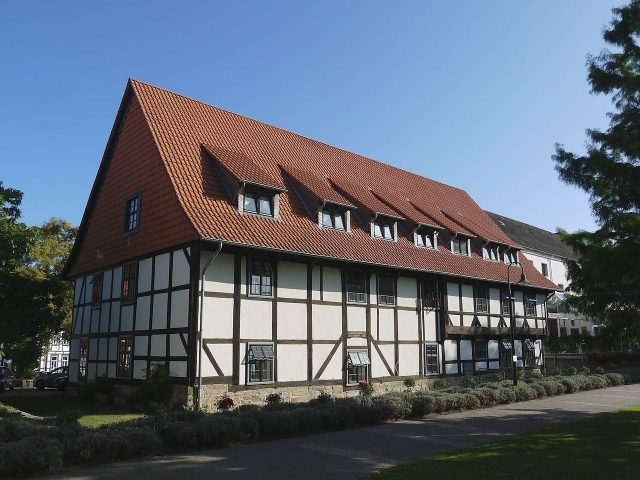
The Garßenhof is the residential building of a former farm in Salzgitter-Gitter. It was built in 1557 and is, after the Kniestedter Manor House, the second oldest half-timbered building still preserved in the city of Salzgitter. From 1980, the Garßenhof was relocated to Salzgitter-Bad and now stands between the Ratskeller and the Kniestedter Manor House.
The grounds of the Garßenhof, often also referred to as "Ritterhof" (Knight's Court), lay between today's streets Am Ritterhof, Friedhofsweg, and Garßenhof. The construction of the farm, named after its later owners, the Garßen family, began in 1557. The residential building, the oldest, now eastern part of the building, was erected in an almost square shape over an old vaulted cellar, probably the remains of an earlier residential complex. It was a two-story half-timbered post construction; the compartments were mostly filled with wooden latticework and clay plaster, partly also with hand-formed clay bricks. The builder was the farmer Lüdeke Dedeke. The inscription in the sill plate of the upper floor reads "Wer Gott vertrawet / hat wohl gebawet / Den wo der Herr das Haus nicht bawet / So arbeiten umbsonst die daran bawen. BEATI OMNES / QUI CONFIDENT IN EO" (Eng. All happy ones who confess to him).
Between 1597 and 1602, the Liebenburg bailiff Peter Drögemüller was named as owner. In 1616, a member of the Garßen family was first listed as the new owner, and the farm remained in the possession of this family until 1881. During the Thirty Years' War, the farm was severely damaged and was only expanded after 1700: the residential building received an extension, and a two-story gatehouse was erected at the entrance, to which several stables were attached. Towards the street, a sandstone wall separated the courtyard, which was accessed through a portal standing next to the gatehouse. A fire insurance register from 1766 lists the buildings belonging to the Garßenhof at that time: a residential building; a barn with a wagon shed; next to the gate a barn with a horse stable, foal stable, pigsty, sheepfold, goose house, and wood shed; another sheepfold along with a carriage shed, chicken house, and a building and bakehouse.
In a major fire in 1857, which destroyed the northwestern part of the village of Gitter, the Garßenhof was also affected and lost part of its farm buildings. In 1881, the Garßen family then sold the farm. In 1934, the building was converted into a residential house. The entrance gate to the Garßenhof was relocated in 1941 to today's Vöppstedter Cemetery in Salzgitter-Bad, as it was in danger of collapsing due to the increasing traffic caused by the construction of the Hermann Göring Reichswerke. After the war, the farm fell into disrepair, the gatehouse was demolished in 1958, the wall standing on the street in 1963, and the residential building had been vacant since 1977.
In March 1979, the City Council of Salzgitter, which had by then taken over ownership of the Garßenhof, decided to dismantle the residential building and relocate it to Salzgitter-Bad. There, it was rebuilt by 1982 next to the historic Ratskeller on the edge of today's Rosengarten and, together with the Kniestedter Manor House, the Tillyhaus, and the Gradierpavillon, forms the "Traditionsinsel" (Tradition Island) of Salzgitter-Bad.
Take Mobile History with you
You are reading this text for free. Premium adds what matters on the road: descriptions read aloud, sites found through your camera, whole regions taken offline.
- Every description, including the ~17,700 Premium sites
- Audio guide: have descriptions read to you on location
- AR finder: see sites through your camera, with distance and bearing
- Unlimited saved sites
14 days free, then from €2.99 a month. Cancel anytime.
Location: 52.0467, 10.3708