Holiday homes
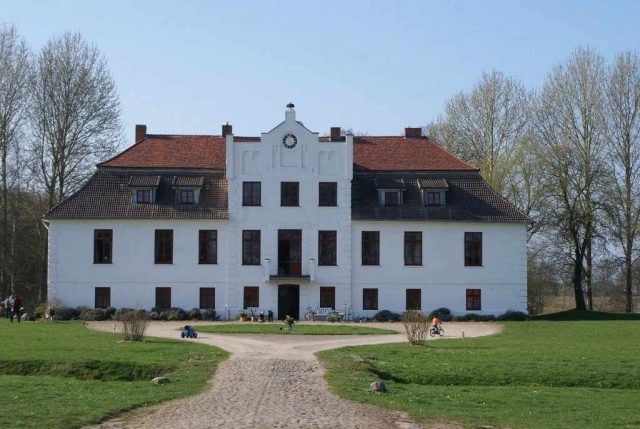
Gerdshagen Manor

Gerdshagen Estate is a listed former country estate in Gerdshagen, a district of Satow in Mecklenburg-Vorpommern, and is located directly on rural road 11 between Kröpelin and Bützow.
Gerdshagen was first mentioned in a document in 1224. The background was a confirmation by Bishop Brunward to Amelungsborn Monastery regarding the size of the parish of Satow. The village was a typical "Hagendorf" for the region, meaning a forest clearing village. The settlers were predominantly Westphalian farmers. The estate was owned by the von Rehschinkel family. In 1459, Gerdshagen was pledged by Duke Heinrich of Mecklenburg to Sievert von Oertzen. The manor house was built in 1555 by Vicke von Oertzen in the Renaissance style. He had previously lived with his brother Jürgen in Gorow. The two divided the estates, and Vicke von Oertzen made Gerdshagen his main estate. After the bankruptcy of Gerdshagen Estate in 1660, there were several changes of ownership. By a court ruling, the estate initially went to the heir of Vieregge in Rossewitz, who sold the estate to Matthaus Sassenhagen, the owner of Steinhagen. He, in turn, sold Gerdshagen in 1694 to Julius von Veltheim. The following year, Jochim von Oertzen reacquired the estate for his family. In 1718, Duke Karl Leopold took over the estate, but already in 1719, Helmut Friedrich, another Oertzen, was the lord of Gerdshagen. Investments were made in the estate, including the construction of a glassworks. Subsequently, however, the economic situation of the von Oetzen family deteriorated noticeably. On June 10, 1772, Gerdshagen, along with the Charlottental dairy farm, was sold for 26,500 thalers to Jacob Christoph Schröder from Rostock.
At the beginning of the 19th century, Caspar Friedrich Mühlenbruch acquired the estate. In addition to his work as a conductor and composer as music director at the Schwerin court, he was also successful in sheep breeding. During this time, Felix Mendelssohn Bartholdy and his sister Fanny were guests at Gerdshagen. During this period, the manor house was converted in the Neo-Gothic style. In 1906, the Hamburg merchant Otto Wiskott became the owner of the estate. The property at that time comprised about 450 hectares. Several workers' cottages were built, and the horse stable was extended with a granary.
Gerdshagen was located in the Soviet occupation zone, where after 1945 all landowners with more than 100 hectares of land were expropriated. The estate's land was transferred to 64 settlers. The manor house was used for various purposes in the following decades. Immediately after the war, refugees moved in. Later, the building was also used as a school, doctor's office, and dance hall. Until 1989, renovations were carried out, but these significantly altered the historical character of the manor house. Since 1998, the estate complex has been back in private ownership and has been extensively renovated since then. At the request of the owner family, the manor house, horse stable, and the six-hectare park were placed under monument protection in 2000. The former horse stable can be rented for celebrations, and four holiday apartments have been set up in the manor house.
Take Mobile History with you
You are reading this text for free. Premium adds what matters on the road: descriptions read aloud, sites found through your camera, whole regions taken offline.
- Every description, including the ~17,700 Premium sites
- Audio guide: have descriptions read to you on location
- AR finder: see sites through your camera, with distance and bearing
- Unlimited saved sites
14 days free, then from €2.99 a month. Cancel anytime.
Source: Wikipedia · Licence: CC BY-SA 4.0 · Image: Roland Neubert, Halle (Saale)
This description draws on the facts documented in the linked Wikipedia article; Wikipedia content is licensed under CC BY-SA 4.0. Wording and editing: Mobile History.
Location: 53.9954, 11.8389