To be privately owned
Glüsig Manor

The Glüsig estate in the Magdeburg Börde was an outwork of the former Cistercian convent in Althaldensleben. After various changes of ownership, the agricultural operation has been managed by the Caritas Association of the Diocese of Magdeburg since 1992, which combines the ecological management of the farm with social employment projects. Products produced in Glüsig are processed and marketed according to Bioland guidelines.
The village of Glüsig today belongs to the district of Ackendorf in the municipality of Hohe Börde in the Börde district in Saxony-Anhalt.
The settlement of Glüsing emerged in the area originally inhabited by Suevi. Between 1270 and 1300, Konrad von Wudenswegen donated the first land ownership near Glüsing to the Althaldensleben monastery. In 1310, the monastery acquired additional land there. The then abbess Jutta I incorporated Glüsing into the monastery territory, alongside Wedringen and Vahldorf. After a plague epidemic around 1450, Glüsing was deserted. Around 1460, the Glüsig outwork was then built by the monastery to the east of the old village.
During the Thirty Years' War, the outwork and the associated St. Anna Chapel were destroyed. From 1648, the estate and the nearby chapel were rebuilt.
Around 1700, the entire property of the former village of Glüsing belonged to the monastery in Althaldensleben. In 1757, the then abbess Gräber had the main building of the farm, which is still preserved today, built. In 1806, the outwork and the chapel were plundered by French troops as part of the Fourth Coalition War.
Johann Gottlob Nathusius
In 1810, the Magdeburg merchant and tobacco producer Johann Gottlob Nathusius bought the monastery, which had been dissolved under Napoleon, including the outwork in Glüsig, from the Westphalian government.
Under Nathusius, the formerly agricultural use of the estate receded, because soon after the acquisition, nurseries were established in Glüsig as part of the commercial nursery in Althaldensleben. Essentially, commercial goods (mallow bushes for dye production) were cultivated, and fruit trees were also grown here. In addition to the more economically efficient use of the land, the re-purposing as a nursery also met Nathusius' aesthetic ideas. The formerly barren hills of the outwork, planted with fruit trees and shrubs, became park-like landscapes. A pond with swans was even stocked in a valley.
After his father's death, Philipp von Nathusius initially took over the estates in Althaldensleben and Glüsig in 1835. In 1849, he sold the Althaldensleben property to his younger brother Heinrich von Nathusius; the Glüsig outwork initially remained in Philipp's ownership, only being co-managed by his brother. Around 1866, Heinrich von Nathusius maintained a private hospital in Glüsig for the wounded of the German War. A hospital was also set up there again during the Franco-Prussian War of 1870/71.
In 1883 or 1884, the outwork was sold to the sugar factory of Jenrich, Druckenbrodt u. Co in Ackendorf.
In 1934, Glüsig, which until then belonged to Althaldensleben, was incorporated into Ackendorf. In 1938, a new farming settlement was built in Glüsig. After World War II, the former outwork was forcibly expropriated by the communists and became a state-owned farm with a focus on animal production, which was operated in cooperation with the also expropriated farm at Hundisburg Castle. It existed in this form until 1990.
Caritas
The Caritas Association took over the estate with 32 hectares of arable land in 1992 from the Treuhandanstalt and began setting up a social work and employment project "St. Franziskus" there. In addition to converting to ecological land management, a slaughter and processing house was built on the premises in 1998 and Gut Glüsig GmbH was founded as a social commercial enterprise.
Architecture+
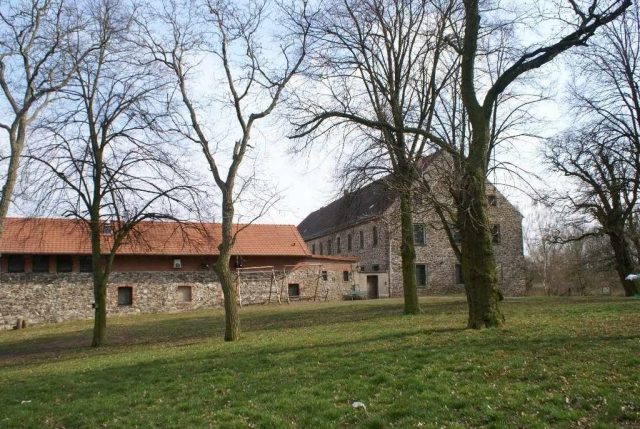
The manor house in Glüsig is a two-story Baroque rubble stone building with 13 axes and was built around 1750. On the asymmetrically arranged portal there is a segmental pediment and an inscription. Other buildings of the farm date from the 18th century. The entire farm complex is a listed building.
Pilgrimage Chapel of St. Anna+
The nearby Pilgrimage Chapel of St. Anna, originally belonging to the estate, is a small, single-nave, Romanesque rubble stone building from the 13th century. Archbishop Wilbrand of Magdeburg transferred the chapel to the Cistercian convent in Althaldensleben in 1236.
The chapel, partially destroyed in the Thirty Years' War, was renovated in 1658. The portal, the windows, as well as a half-timbered choir gable and a hexagonal roof turret are witnesses to the renovation that took place at that time. The chancel of the Romanesque building, of whose old masonry only little remains, opens in a round arch to the Baroque altar with a statue of Saint Anna. In the chapel is the only bell in the region that bears a chronostichon. It results in the year 1711.
Here, in 1812, the last abbess of the Althaldensleben monastery, secularized in 1810, "Domina and Mater" Ludovica Dederich, was buried. Her tombstone stands on the outer wall of the chapel. In 1934, the building was restored. Today, the chapel belongs to the parish of St. Christophorus, based in Haldensleben. The chapel is still the destination of the annual St. Anna pilgrimage.
St. Anna Pilgrimage
A veneration of Anna at this location has been documented since the 13th century. After devastating medieval plague epidemics, the Althaldensleben monastery established an annual procession to Glüsig in the 16th century. It is still carried out once a year as a foot pilgrimage. Every first Sunday in August, pilgrims gather in the parishes of St. Johannes Baptist in Althaldensleben and St. Peter and Paul in Groß Ammensleben and walk to Glüsig. A joint service takes place on the Kapellenberg. The figure of the chapel patron saint shown in the procession today comes from the collections of the Diocesan Museum in Paderborn.
Current Use+
Support Association
Under the patronage of Magdeburg Bishop Gerhard Feige, the Förderverein Gut Glüsig e.V. (Friends of Gut Glüsig Association) was founded on August 3, 2000. The aims of the association are the preservation of the outwork as a monument of architectural and art history and a testimony to history, the use of the facility for church services and other cultural events, and cooperation with various institutions of the Catholic Church. It is planned to convert the former manor house into a guesthouse and educational center, in addition to the already established agricultural operation. This requires further exterior and interior renovation.
Agricultural Operation of Caritasverband Magdeburg e. V.
The agricultural operation currently manages 136 hectares (90 hectares of arable land and 46 hectares of permanent grassland). Vegetables and fodder crops are grown, and orchard meadows are operated. The main business area is pig breeding and slaughter. Here, 500 to 600 animals are fattened per year. In addition, about 50 cows and cattle (German Angus) are kept. There is also a small flock of sheep and horse keeping (own and boarding). Gut Glüsig is a member of the network of organic farming demonstration farms.
Gut Glüsig GmbH
The Gut Glüsig GmbH, another subsidiary of Caritas, also belongs to the Gut Glüsig special purpose association. It processes the slaughter products of the estate, markets the organic sausage and meat products, and takes care of the sale of self-produced fruit and vegetables. Eleven employees and three apprentices belong to the company, which is designed as a social commercial enterprise: At least ten people, especially older long-term unemployed, are to be guaranteed a permanent job. For this, the company receives financial grants from Caritas, the employment office, the state of Saxony-Anhalt, and the European Union.
Gut Glüsig is the largest organic slaughterhouse in Saxony-Anhalt.
Take Mobile History with you
You are reading this text for free. Premium adds what matters on the road: descriptions read aloud, sites found through your camera, whole regions taken offline.
- Every description, including the ~17,700 Premium sites
- Audio guide: have descriptions read to you on location
- AR finder: see sites through your camera, with distance and bearing
- Unlimited saved sites
14 days free, then from €2.99 a month. Cancel anytime.
Source: Wikipedia · Licence: CC BY-SA 4.0 · Image: Roland Neubert, Halle (Saale)
This description draws on the facts documented in the linked Wikipedia article; Wikipedia content is licensed under CC BY-SA 4.0. Wording and editing: Mobile History.
Location: 52.2453, 11.4506