ManorGresse

Gresse Manor

Gresse Manor

Uninhabited

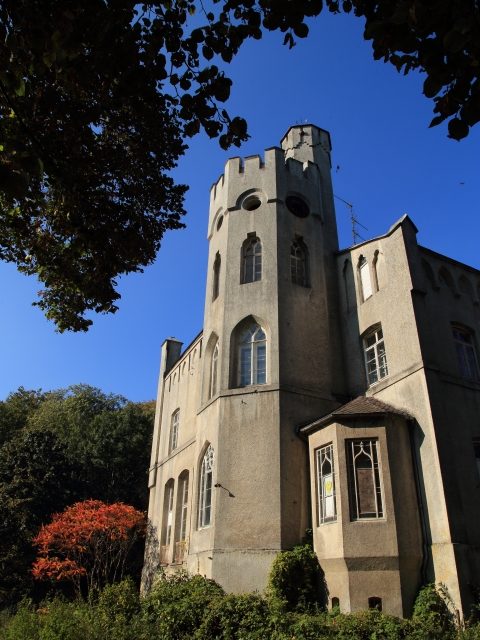
The Gresse Estate was a manor complex in Gresse in the district of Ludwigslust-Parchim in Mecklenburg-Vorpommern. Spatially separated by a road, the property included, on one side, the representative manor house with park and the stables, built in the Neo-Gothic style according to plans by Heinrich Thormann by 1860, and on the other side, the farmstead with stables and the estate manager's house. Many of the buildings are vacant and in a desolate condition.

Location+

The linear village of Gresse is located in the westernmost part of Mecklenburg-Vorpommern, about five kilometers north of Boizenburg/Elbe. The residential buildings of the village are mainly on both sides of Zarrentiner Straße (Federal Highway 195) and along a few side streets. The manor house with its park is located about 200 meters west of the federal highway on an island-like plot. Directly behind the building runs the Boize river, and in front of it is the Schlossteich (castle pond), which is connected to the Boize. Directly on Zarrentiner Straße stands the decaying former stables, fenced off for safety. A school and a kindergarten are in the immediate vicinity.

East of Zarrentiner Straße is the former farmstead with stables, the distillery, and remnants of the courtyard wall, the burnt-out ruin of the estate manager's house, and the baroque village church.

Manor House+

The Neo-Gothic, two-story, and irregularly structured plastered building was constructed in 1849/50 according to plans by architect Heinrich Thormann, after a predecessor building at another location had been demolished in 1849 under Georg von Drenckhahn. In the east facade, the building has two raised, stepped gables that partially conceal the shallow hip roof. The eaves are decorated with pointed arch arcades and ornamented friezes. Raised pilasters structure various wall surfaces. At the southeast end, an octagonal, crenellated observation tower is integrated into the building, next to which another, narrower tower with a weather vane adjoins on the roof. On the east facade, there is a terrace with a two-flight open staircase in front. On the rear facade, an open staircase also adjoins the conservatory. A special feature is the romanticizing octagonal ceiling painting in the tower room.

In 1945, the owners were dispossessed and expelled by the communists. After the Second World War, the manor house was used as a retirement home until spring 1997. In 1998, a community of heirs living in the USA owned it. The building has been vacant and decaying ever since. Ceiling coverings, ceiling paintings, and the conservatory are severely damaged. A fire in 2008 caused damage to the roof truss and the wooden joist ceiling. As of December 2010, the manor house is being offered for sale by a real estate company.

Farmstead+

The horse stable of the complex, used until 1990, is decorated with two horse head sculptures and a coat of arms. In addition to cast-iron columns, the interior walls were decorated with stucco and tiles. The year 1875 can be seen on the building. A large part of the buildings are vacant.

Estate Manager's House+

The plastered building, once standing directly on the main road, was at the same height as the manor house. A fire in October 2009 caused considerable property damage. The burnt-out ruin was already vacant before and was demolished between 2011 and 2012. At the beginning of 2013, a private home was under construction at the site.

Ownership of the Estate+

Count Nikolaus von Schwerin donated two Hufen of land in Gresse to the Boizenburg church on June 9, 1297. From August 1, 1328, the estate was owned by four Giese brothers, Heinrich, Werner, and Segeband von Sprengel. In 1625, the main estate was pledged to Hartwig von Schack. Thereafter, ownership changed frequently. In 1872, the estate passed to Albertus Ohlendorff, who was ennobled in 1873. After 1998, a community of heirs from the USA.

Succession of Owners

  • 1577 Franz von Sprengel
  • 1601 Heinrich von Sprengel
  • 1625 Hartwig von Schack auf Müssen (Lauenburg)
  • 1651 Georg Friedrich von Thun
  • 1681 Ernst Wilhelm von dem Knesebeck
  • 1784 Danish Chamberlain A. Friedrich von Witzendorf
  • 1792 Otto Freiherr von Hahn
  • 1795 Amtsmann Gebser
  • 1797 Chief Equerry Franz Ferdinand von Rantzau
  • 1804 August von Schilden
  • 1817 Rittmeister Hans von Klitzing
  • 1837 Regierungsrath Ludwig von Lützow
  • 1845 Wilhelm Heerlein
  • 1849 Kammerjunker Georg von Drenckhahn
  • 1860 Kammerherr Friedrich von Meyenn
  • 1872 Albertus von Ohlendorff
  • 1913 Eduard Freiherr von Ohlendorff
  • 1924 Carl Lothar Freiherr von Ohlendorff
  • 1929 F. Hagen

Take Mobile History with you

You are reading this text for free. Premium adds what matters on the road: descriptions read aloud, sites found through your camera, whole regions taken offline.

  • Every description, including the ~17,700 Premium sites
  • Audio guide: have descriptions read to you on location
  • AR finder: see sites through your camera, with distance and bearing
  • Unlimited saved sites

14 days free, then from €2.99 a month. Cancel anytime.

Source: Wikipedia · Licence: CC BY-SA 4.0 · Image: Jens Rasim

This description draws on the facts documented in the linked Wikipedia article; Wikipedia content is licensed under CC BY-SA 4.0. Wording and editing: Mobile History.

Location: 53.4281, 10.7433