Holiday homes
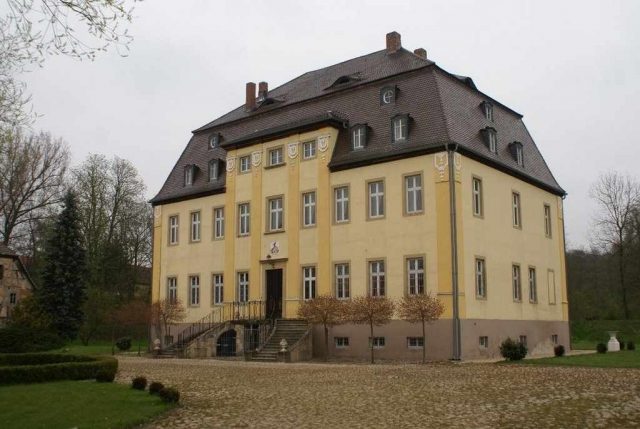
Großgestewitz Manor

The locality of Großgestewitz is first mentioned in a document in 1040 in a deed of gift from Emperor Henry III. In this deed, he transferred, among other things, the 'villi gostici' to the Bishop of Naumburg. In this village, there was a fortified residential tower and several stone houses. The fortified residential tower, as a precursor to the present castle-like building, was already located in the midst of a Slavic rampart, which must have been erected between the 8th and 10th centuries. In 1196, an Enricus de Gostic is mentioned, who had settled in Großgestewitz and inhabited the residential tower, next to which stood the Nikolaikapelle (St. Nicholas Chapel).
This chapel had fallen into disrepair in the 15th century and was renewed by Alexius von Frankleben as part of an atonement for slaying another knight in a knightly feud. Since the entire atonement reached the value of the knight's estate, the owners became impoverished and had to sell the estate in 1497. Around 1500, Hans von Landwüst took over the estate and by 1530, by assuming the debts, the entire village.
The estate bore the burden of equipping a knight. This included not only the equipment of a man capable of bearing arms with a horse. In addition, the families had to be of knightly birth, i.e., they had to prove 16 ancestors to be admitted into the society of knightly estates. The obligations to the church and the family were also part of the philosophy, as evidenced today by the altar and the inscription in the entrance area. As a unit of economic management and social behavior, the lords of the manor were responsible for the entire social life in the village.
The Thirty Years' War had devastating effects in Großgestewitz in 1637 and 1645. In 1637, the soldiery invaded the village, plundering and burning it. In 1645, Großgestewitz was shelled. As a result of the shelling, the castle also burned down, but was rebuilt by 1660. Until the end of the 18th century, the estate remained the property of the von Landwüst family. After the line died out, there was a period of frequent changes of ownership until the von Barby family took over the estate in 1840. Around 1900, the interior of the manor house was fundamentally adapted to the taste of the time and renovated.
As a result of World War II, in the course of the land reform in the Soviet occupation zone, the von Barby family was forcibly expropriated and expelled. Subsequently, the building served residential purposes and was used by the LPG (Agricultural Production Cooperative). These uses, also through additions and alterations, led to the steady decay of the building. After 1990, the municipality, with considerable public subsidies, renovated the roof, the exterior facade, and the exterior stairs. In 1998, the building was acquired by the current owner as part of an auction conducted by the Federal Republic of Germany.
Take Mobile History with you
You are reading this text for free. Premium adds what matters on the road: descriptions read aloud, sites found through your camera, whole regions taken offline.
- Every description, including the ~17,700 Premium sites
- Audio guide: have descriptions read to you on location
- AR finder: see sites through your camera, with distance and bearing
- Unlimited saved sites
14 days free, then from €2.99 a month. Cancel anytime.
Source: Wikipedia · Licence: CC BY-SA 4.0 · Image: Roland Neubert, Halle (Saale)
This description draws on the facts documented in the linked Wikipedia article; Wikipedia content is licensed under CC BY-SA 4.0. Wording and editing: Mobile History.
Location: 51.0820, 11.8590