To be privately owned
Knoop Manor

Gut Knoop is the name of an estate located today west of Kiel-Holtenau, near the former Eider Canal, in the municipality of Altenholz on the Kiel Canal.
The estate was first mentioned in a document in 1322. The name means knob or hump in Low German. The founder of the estate may have been Lupus de Knope (Wulf / Wolf von Knoop), mentioned in 1322, who had acquired the corresponding land shortly before. The name Wulf / Wolf is still found today in the coat of arms of the municipality of Altenholz: a wolf leaping up a tree.
Knoop was successively owned by the families von Knoop, von der Wisch, von Rantzau, and von Buchwaldt. The estate was thus in the possession of Saxon nobility, although it was located north of the Levensau and therefore in the Duchy of Schleswig.
In 1776, Heinrich Schimmelmann (1724–1782) bought Gut Knoop from the impoverished Baudissin family to give it to his daughter Caroline Adelheid Cornelia von Baudissin (1759–1826) as a dowry for her marriage to Heinrich Friedrich Graf von Baudissin (1753–1818). Together with Gut Emkendorf, which Caroline's sister Julia von Reventlow inhabited with her husband Friedrich, Knoop was one of the cultural centers of Schleswig-Holstein around 1800.
In 1869, the estate was sold by the Baudissins to the Danish merchant Ingward Martin Clausen († 1902 at Gut Knoop). In 1903, it passed to the Bremen tobacco merchant Heinrich Gerhard Richard Hirschfeld. The Hirschfeld family still lives at Gut Knoop today.
Buildings+
The (no longer existing) old moated castle Knoop ("Arx Cnopia"), built in the 16th century by the Rantzaus, was surrounded by moats fed by the Levensau. The house had a windowless ground or "water floor", two upper floors, and three bay windows on each side of the gabled roof. It was demolished around 1800 after the completion of the new building, and the moat was filled in.
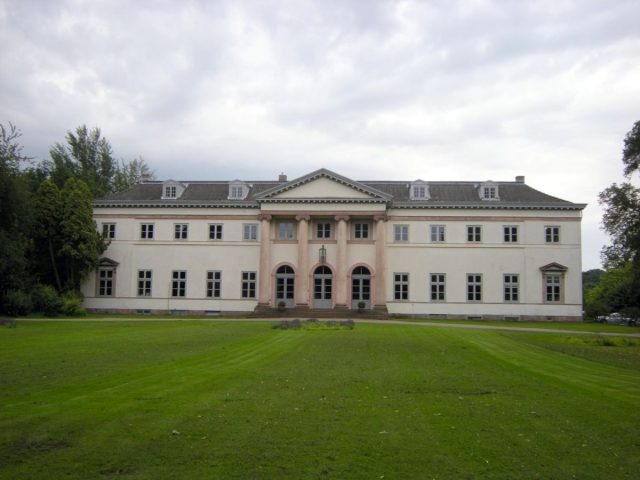
The manor house of the estate was built from 1792 to 1796 according to the plans of the Danish architect Axel Bundsen in the Neoclassical style, with its facade oriented towards the Eider Canal, which opened in 1784, and surrounded by a landscape park designed by Carl Gottlob Horn, which included the bank of the Eider Canal. Thanks to the Schimmelmann fortune, it was richly furnished by artists such as Ludwig Philipp Strack and the Italians Giuseppe Anselmo Pellicia and Francesco Antonio Tadey, who also worked at Emkendorf. The building with its mighty portico is one of the outstanding works of Neoclassicism in Schleswig-Holstein. The landscape park was largely destroyed during the construction of the Kiel Canal in 1895. The interior furnishings largely remained.
The so-called Tea House also stands on the estate grounds. It was built in 1910 by the artist and architect Rudolf Alexander Schröder from Bremen on a site where a wooden pavilion had previously stood. The building, also known as the Doric Temple, is 20 m² in size and was renovated in 2008 for 60,000 Euros.
The manor house is privately owned; however, it can be visited by appointment. Cultural events are regularly held in some rooms. The Tea House is accessible to the public and can also be used for civil weddings.
Knoop Lock+
East of Gut Knoop ran the Eider Canal with the Knoop Lock − the second lock after the first one in Holtenau − including a drawbridge built in the Dutch style. Approximately 3 km as the crow flies from the estate, to the northwest, is the renovated structure of the former Rathmannsdorf Lock, which, unlike the Knoop Lock, had no bridge.
Take Mobile History with you
You are reading this text for free. Premium adds what matters on the road: descriptions read aloud, sites found through your camera, whole regions taken offline.
- Every description, including the ~17,700 Premium sites
- Audio guide: have descriptions read to you on location
- AR finder: see sites through your camera, with distance and bearing
- Unlimited saved sites
14 days free, then from €2.99 a month. Cancel anytime.
Source: Wikipedia · Licence: CC BY-SA 4.0 · Image: http://schloesserrundschau.de/schleswig/schloesser/rendsburg02.html
This description draws on the facts documented in the linked Wikipedia article; Wikipedia content is licensed under CC BY-SA 4.0. Wording and editing: Mobile History.
Location: 54.3735, 10.1025