Cultural center
To be privately owned
Ludwigsburg Manor

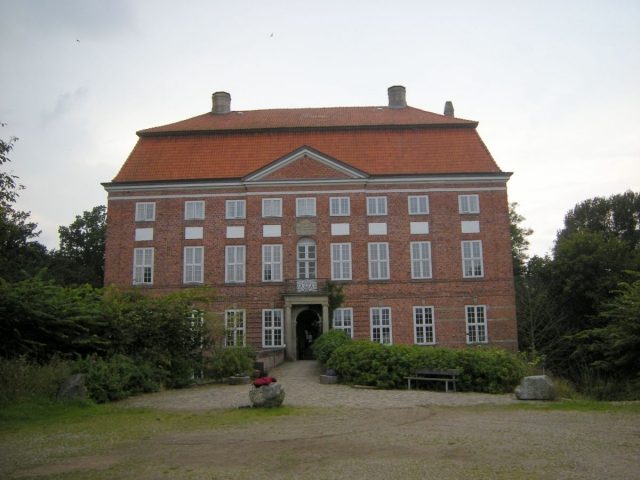
The Ludwigsburg Estate in the municipality of Waabs in northeastern Schleswig-Holstein originated from a medieval moated castle. Originally known as Kohøved (Danish: "Cow Farm"), this noble estate near Eckernförde came into the possession of Count Friedrich Ludwig von Dehn in the 18th century. Under the royal governor in Schleswig-Holstein, the current baroque manor house was built.
The estate was founded in the 14th century by the long-established Sehestedt family, who built a curia here; that is, a farmstead and a small moated castle. The name Kohøved has been documented since the 15th century. Through inheritance, Kohøved passed to a branch of the Rantzau family in 1564. Under Paul Rantzau, who, with his wife Beate (née Sehestedt), also resided in the so-called Ritterburg in Eckernförde, a new manor house was built in place of the old moated castle, and the property was later expanded to include the estates of Bienebek and Bothkamp.
From the 17th century onwards, ownership of Kohøved changed several times. In 1670, the estate briefly passed to the Ahlefeld family, and as early as 1672 to Baron Kielmannsegg, and subsequently to the Temming family, whose heads served as royal chancellors in Copenhagen. The Temmings, who went bankrupt in 1722, were followed by changing owners until the property was acquired in 1729 by Friedrich Ludwig von Dehn. From 1740, he had the current manor house built. In 1762, Dehn was appointed governor in Schleswig-Holstein by the Danish king, and in 1768, he gave the estate, where he also died in 1771, the new name Ludwigsburg. Through inheritance, Ludwigsburg later returned to the Ahlefeldt family, who remained here with various Holstein and Danish branches until 1950. The property was then sold to the Carl community of heirs, whose descendants still manage the estate today.
Present Day
The courtyard and garden area at Gut Ludwigsburg are largely accessible to visitors. The estate is still actively farmed today, in addition to horse breeding (Trakehner, Arabians, Holsteiner, and ponies) and riding operations with a riding hall and stables for own and guest horses. Associated with this are more tourist-oriented offerings such as pony riding and wagon rides. Holiday apartments are rented at Ludwigsburg, and a café and a farm shop are located in the farmstead. The manor house can be visited by prior arrangement, and the large halls are also rented for celebrations.
Buildings+
The Manor House
The manor house developed from a series of previous buildings. A 14th-century moated castle was followed from 1590 by a regional double house, which was largely demolished or redesigned into the current Baroque building between 1730 and 1740. The foundations and the cellar of the previous building are still preserved today, which is also evident in the exterior, where the typical arrangement of brick layers and horizontal sandstone bands characteristic of the Nordic Renaissance is still preserved in various places in the masonry. Ludwigsburg is one of the largest Baroque manor houses in the former Duchy of Schleswig. The manor house from 1740 rises as a large, cuboid building directly from its moat. It has four floors; two full and two half-floors, and is covered by a mighty mansard roof. The house is built entirely of brick, and the facades are simply modeled in Baroque forms. The garden and courtyard facades have nine window axes, and the narrow sides of the building have four window axes.
The two-part floor plan of the manor house still refers to the double house of the 16th century. In accordance with the later redesign of the building, the interiors of the manor house are also kept in the Baroque style of the 18th century. However, the fixed wall decoration of the rooms is not completely preserved, as a fire in the 20th century destroyed parts of the original furnishings, especially on the upper floors. The largest room in the building is the festively designed Golden Hall in the Louis-seize style, which, together with the adjacent Small Hall on the bel étage, forms the representative center of the house. A special feature at Ludwigsburg is the so-called Bunte Kammer (Colorful Chamber), whose furnishings date back to the second half of the 17th century. It is a paneled room decorated with 145 small portraits, emblems, and aphorisms. The small-format paintings partly depict the listed quotes, but also images of the old Kohøved manor house or the Gottorfer Neuwerkgarten can be found. The Bunte Kammer is unique in this form in Schleswig-Holstein; only at Gut Gaarz near Oldenburg is there a similar, albeit more simply designed, room.
Courtyard, Gatehouse, and Garden
To the east of the manor house is a large farmstead, which received its current form in the mid-20th century. Until 1967, the square was bordered by the so-called Krummhaus, a large, semicircular building from the 18th century, which, together with the manor house, formed a large architectural unit in the Baroque style. The house, presumably built by Johann Gottfried Rosenberg from 1740, served as a farm building; its demolition took place because its dimensions no longer met the requirements of modern agriculture. In its place, a round courtyard remained, and sober functional buildings were erected on the area behind it; only the end pavilions remained. Other outbuildings adjoined the Krummhaus, which today form the southern boundary of the courtyard. The most significant of these buildings is the old gatehouse of the estate, which dates back to the 16th century but was redesigned several times in later periods. Its field side is adorned with nine cross-shaped sandstone tablets, which show, among other things, the coats of arms of the Rantzaus and the Sehestedt.
To the west of the manor house, a Baroque garden existed since the 18th century. The once strictly French-inspired layout was redesigned in the style of English landscape gardens from 1845, although the basic structure formed by moats and Baroque avenues has been preserved to the present day.
Take Mobile History with you
You are reading this text for free. Premium adds what matters on the road: descriptions read aloud, sites found through your camera, whole regions taken offline.
- Every description, including the ~17,700 Premium sites
- Audio guide: have descriptions read to you on location
- AR finder: see sites through your camera, with distance and bearing
- Unlimited saved sites
14 days free, then from €2.99 a month. Cancel anytime.
Source: Wikipedia · Licence: CC BY-SA 4.0 · Image: http://schloesserrundschau.de/schleswig/schloesser/rendsburg06.html
This description draws on the facts documented in the linked Wikipedia article; Wikipedia content is licensed under CC BY-SA 4.0. Wording and editing: Mobile History.
Location: 54.5132, 9.9316