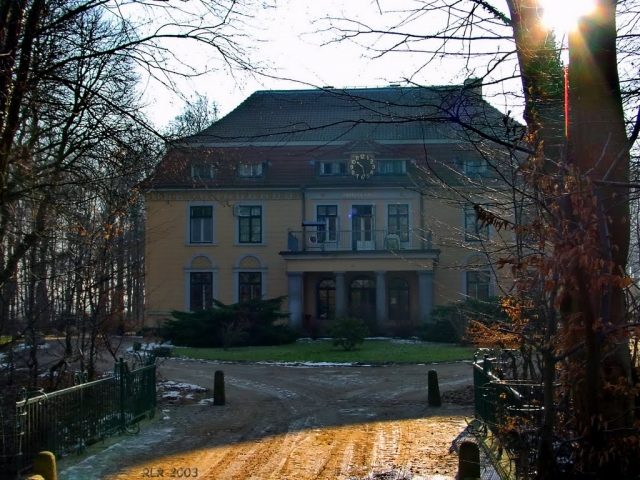
ManorWittendörp-Tessin

Tessin Manor

Tessin Manor

Nursing home

The Wendish settlement of Tessin (Old Slavic: "place of Têša") was first mentioned in a document in 1230 in the Ratzeburg Tithe Register and belonged to the Diocese of Ratzeburg at that time. The villages, organized according to German law, whether inhabited by Slavs or German settlers called into the country, had to pay land taxes, the so-called "tithe", to the bishop in Ratzeburg. The bishop, in turn, enfeoffed this tithe to his vassals. The enfeoffed tithes were then recorded in the register. Bishop Gottschalk had granted the tithe of 5 of the total of 10 full peasant holdings in Tessin to the Slavic nobleman Herrmannus de Bluchere, i.e., Herrmann von Blücher. The village belonged to the von Blücher family until 1616.

From 1567 to 1759, the Tessin manor changed hands five times, after which it was owned by the von Husan family, from 1779 by the von Lützow family until 1888, who also owned the estates of Dreilützow, Groß Salitz, and Schönwolde and bought the lands of Raguth in 1789.

In 1835, the Tessin Manor House, with its imposing observation tower, the Katzenturm (Cat Tower), and a landscaped castle park, was built by the von Bülow family.

In 1921, the manor passed into the possession of Count Isenberg, until it was sold in 1938 to the Reich Resettlement Company. From them, the surrounding lands were divided for the resettlement of German farmers. Tessin Castle became the residence of Mr. von Kumrowski, a shipowner from Hamburg. After expropriation by the communists in 1945, Tessin Castle was used as a hospital until 1954. From 1954 to 1971, the property belonged to the Archdiocese of Breslau and was managed by the Sisters of St. Elisabeth. After nationalization in 1971, Tessin Castle housed a nursing home for the mentally ill and an old people's home until 1990.

After this eventful history, the entire building was reconstructed and fundamentally renovated between 1991 and 1995 with considerable effort, in accordance with monument preservation requirements. It is now used as a specialized clinic for drug addicts.

Take Mobile History with you

You are reading this text for free. Premium adds what matters on the road: descriptions read aloud, sites found through your camera, whole regions taken offline.

  • Every description, including the ~17,700 Premium sites
  • Audio guide: have descriptions read to you on location
  • AR finder: see sites through your camera, with distance and bearing
  • Unlimited saved sites

14 days free, then from €2.99 a month. Cancel anytime.

Source: Wikipedia · Licence: CC BY-SA 4.0 · Image: Rainer Gindele

This description draws on the facts documented in the linked Wikipedia article; Wikipedia content is licensed under CC BY-SA 4.0. Wording and editing: Mobile History.

Location: 53.5626, 11.0254