ManorWelle

Welle Manor

Welle Manor

Cultural Events

To be privately owned

History of the Estate+

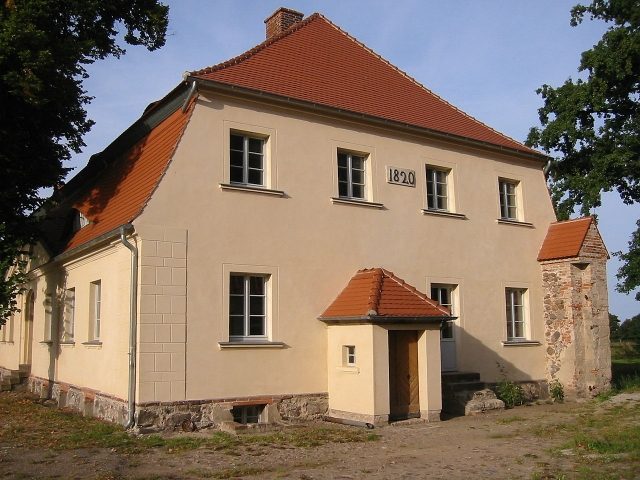
Georg Wilhelm von Bismarck-Briest acquired land and estates in Welle in 1780, thus laying the foundation for the estate complex that still exists today. Levin Friedrich von Bismarck-Briest, son of Georg Wilhelm, then consolidated the properties into a large estate and had the manor house built in 1820. The manor house is located at the eastern end of the estate, west of the house lies the estate courtyard enclosed by large farm buildings. The estate then became the main seat of the family. The estate also included the Welle estate church, which dates back to the 12th century.

At the beginning of the 20th century, Ludolf August von Bismarck divided the estate into the estates of Welle and Briest. His son Bernhard Ludolf took over the Welle estate. He laid out a park to the east of the manor house and rebuilt the manor house. His son Adalbert von Bismarck took over the farm and managed it until its expropriation in 1945.

In the post-war period, refugees were initially accommodated in the manor house. Later, a grocery store (Konsum) and kindergarten were established on the estate.

After the political change of 1989, the estate courtyard and the estate land were finally separated. The estate fell into disrepair. In 1998, descendants of the former estate owners reacquired the courtyard, including the park and church. The manor house was renovated. With a regularly held garden festival and the Landkultur Welle project, an attempt is being made to give the property a partially tourist use.

Manor House+

The manor house was built in 1820 as a single-story classical plastered building in the typical style of Prussian country houses. It features a mansard hip roof and a three-axis central risalit, which is further emphasized by pilasters and a curved flat gable adorned with stucco ornaments.

With the creation of the park on the east side of the building at the beginning of the 20th century, an access from the house to the park and a terrace with six Tuscan columns were created.

Take Mobile History with you

You are reading this text for free. Premium adds what matters on the road: descriptions read aloud, sites found through your camera, whole regions taken offline.

  • Every description, including the ~17,700 Premium sites
  • Audio guide: have descriptions read to you on location
  • AR finder: see sites through your camera, with distance and bearing
  • Unlimited saved sites

14 days free, then from €2.99 a month. Cancel anytime.

Source: Wikipedia · Licence: CC BY-SA 4.0

This description draws on the facts documented in the linked Wikipedia article; Wikipedia content is licensed under CC BY-SA 4.0. Wording and editing: Mobile History.

Location: 52.5369, 11.8503