Uninhabited
CastleLangenleuba-Niederhain
Halbes Castle
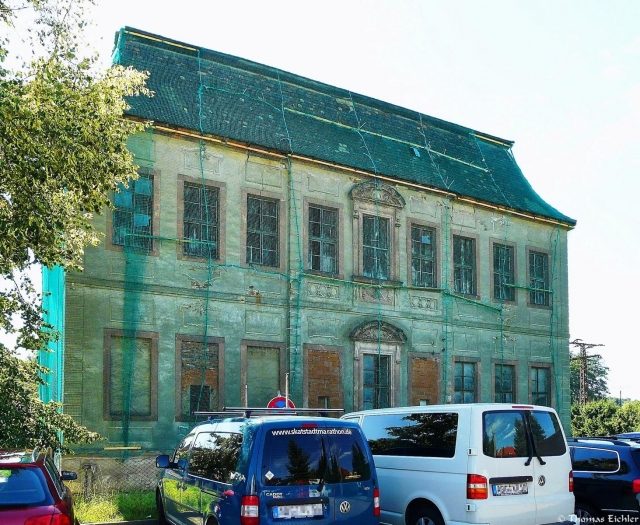
In Langenleuba-Niederhain, Halbes Schloss, a former manorial estate in the Altenburger Land region of Thuringia, Germany, was once a four-wing complex.
History+
The estate's origins date back to 1290 when it was owned by the Burgraves of Altenburg. In 1329, the Margraves of Meissen acquired feudal sovereignty over the estate, which then existed as a medieval moated castle. The feudal lords changed, including the Burgraves of Leisnig and the families von Creutzen, von Zschadras, and von Schauroth. In the 17th century, the von Brand family and later the von Kuntsch family managed the estate. Under Johann von Kuntsch, the castle underwent a renovation between 1707 and 1711, transforming it into a Baroque four-wing complex that retained elements of the Late Renaissance. In 1712, he stipulated in his will the conversion into a family entail and the establishment of a foundation to support students, apprentices, and provide dowries for brides. In 1714, Dr. Christoph von Kuntsch inherited the property. By 1805, the castle was still surrounded by water. In 1838, the south wing was demolished, after which the building acquired the name “Halbes Schloss” (Half Castle). After the entail was abolished in 1926, the foundation continued its work.
Source: Wikipedia · Licence: CC BY-SA 4.0 · Image: Thomas Eichler
This description draws on the facts documented in the linked Wikipedia article; Wikipedia content is licensed under CC BY-SA 4.0. Wording and editing: Mobile History.
Location: 50.9609, 12.5889