CathedralHalle (Saale)

Halle Cathedral

Halle Cathedral

The church can be visited

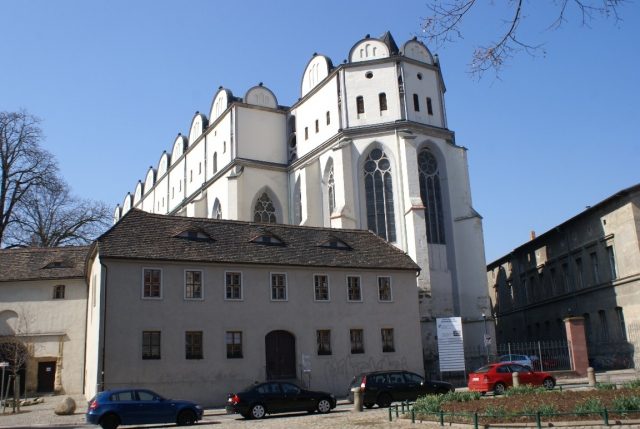
Halle Cathedral is the oldest surviving church building in the old town of Halle. Although the city was never the seat of a bishopric, the church has been called a cathedral since its construction, because the Archbishops of Magdeburg resided here for a long time as the city's rulers, and the church, together with the New Residence built next door, was intended by Cardinal Albrecht of Brandenburg to become part of the most influential, powerful, and representative collegiate church north of the Alps, including all the Cranach paintings now located in the Collegiate Church of St. Peter and Alexander in Aschaffenburg.

The church was originally a monastery church of St. Paul to the Holy Cross, founded by the mendicant order of the Dominicans in 1271 and completed around 1330. According to their rules, the monks dispensed with a tower and transept in their simple, three-aisled hall church.

From about 1520, the Archbishop of Magdeburg, Cardinal Albrecht of Brandenburg, had the church externally redesigned by the Bastian Binder workshop (gable crown in front of the roof) and finally rededicated in 1523 as the collegiate church of the Archdiocese of Magdeburg. Probably since then, the church has been called "Dom" (cathedral), initially only colloquially. Albrecht, who feared for his peace of mind in heaven, collected up to 20,000 relics. This precious treasure (no longer extant today) became known as the "Hallesches Heilthum" (Halle Sanctuary), and the indulgence trade indirectly associated with it effectively triggered the Reformation. A magnificent interior, almost unimaginable today, was created from 1523 onwards by, among others, Matthias Grünewald (Erasmus-Mauritius panel), Lucas Cranach the Elder (the altars), and Peter Schro (stone sculptures). All these changes to the old monastery church resulted in a total work of art in the style of late Gothic and early Renaissance. The round-gabled cathedral was then one of the most important sacred buildings in Central Germany. As an opponent of Luther, Cardinal Albrecht was forced to leave Halle and the heartland of the Reformation in 1541. He had the movable furnishings transported to Aschaffenburg, where they remain to this day.

His secular successors in the government of the former bishopric used the church as a court and castle church. The last of these administrators, Duke August of Saxe-Weissenfels, gave the cathedral an early Baroque appearance from the mid-17th century with galleries and a large show altar. After 1680, the Great Elector, Frederick William of Brandenburg, assigned the now-owned house of God to the Evangelical Reformed for an unlimited period as a parish church. The young Georg Friedrich Händel was employed there as an organist "for a trial year" in 1702/1703.

In 1851, the congregation replaced the Baroque organ with a new instrument from the firm Friedrich Wilhelm and August Ferdinand Wäldner. From 1883 to 1896, the interior was renovated in the then-common style of a Regothification. From 1957 to 1959, the Institute for Monument Preservation undertook a renovation of the exterior walls and interior, marked by great material scarcity. In 1996, the Domstiftung Sachsen-Anhalt (Cathedral Foundation of Saxony-Anhalt), on behalf of the state, began to thoroughly renovate the church and adjacent buildings. These structural works were largely completed in 2005.

Description+

The cathedral is located on an arm of the Saale, on the western edge of the old town. The church, along with the New Residence and Moritzburg, forms the center of the Saale front and significantly shapes the Domplatz (Cathedral Square). The Gothic church building is 68 meters long, 20 meters wide, and 18 meters high.

The architecture is characterized by strict regularity and an emphatically simple design in its profiling and tracery. Only remnants of a Gothic cloister remain from the northern monastery. The Italianate gables, which have given the building its external appearance since 1526, were originally decorated with lily frescoes. The motif of the round gable, as found in Italian sacred and secular buildings, appears here for the first time north of the Alps.

The interior is characterized by smooth, capital-less octagonal pillars and simple tracery in large pointed-arch windows. A rood screen once divided the eight-bay nave. The cycle of pillar statues by Peter Schro, from the school of Hans Backoffen, is considered one of the most important works of German sculpture of the 16th century. The 17 larger-than-life figures, completed in 1525, depict Christ and the Apostles (including Paul), the patron saint of the diocese Mauritius, and Saint Mary Magdalene. The figure of Saint Erasmus is completely obscured from view after the installation of the Baroque organ. An eighteenth figure (presumably Saint Ursula) has been completely lost. Also noteworthy are the Renaissance portals: the southeastern entrance portal to the church, the portal to the sacristy, and the torso in the west of the interior. The pulpit dates from 1526. It shows the Church Fathers on the stair cheek and the letter writers from the New Testament on the pulpit basket. Below them, Moses with the tablets of the law is depicted on an equal footing with the four Evangelists and their attributes. The large show altar in the choir and all the galleries are witnesses of the time when the cathedral was used as a court or castle church. They were installed in the 1660s. However, the south gallery is accessible via a spiral staircase that still dates from the Renaissance period and may have led to an elevated choir or musician's gallery at that time.

Furthermore, the interior decoration includes valuable tombstones and epitaphs, including a full-figure tombstone of a mother with child from around 1380 and an epitaph from 1620 by a Magdeburg master. Two elaborately designed consecration tablets report on the reconstruction of the church by Cardinal Albrecht. Both date from 1523.

Organs+

Main Organ

The first cathedral organ from 1667 was replaced between 1847 and 1851 by a new instrument built by the organ building company Friedrich Wäldner (Halle). The instrument has been modified and rebuilt several times over time. It is to undergo a comprehensive restoration and reconstruction.

Choir Organ

Furthermore, the cathedral houses a choir organ, built in 1799 by Johannes Stephani with 11 stops on one manual and pedal. The instrument is purely mechanical and has slider chests.

Take Mobile History with you

You are reading this text for free. Premium adds what matters on the road: descriptions read aloud, sites found through your camera, whole regions taken offline.

  • Every description, including the ~17,700 Premium sites
  • Audio guide: have descriptions read to you on location
  • AR finder: see sites through your camera, with distance and bearing
  • Unlimited saved sites

14 days free, then from €2.99 a month. Cancel anytime.

Source: Wikipedia · Licence: CC BY-SA 4.0 · Image: Roland Neubert, Halle (Saale)

This description draws on the facts documented in the linked Wikipedia article; Wikipedia content is licensed under CC BY-SA 4.0. Wording and editing: Mobile History.

Location: 51.4843, 11.9644