To be privately owned
CastleErbendorf - Grötschenreuth
Grötschenreuth Castle
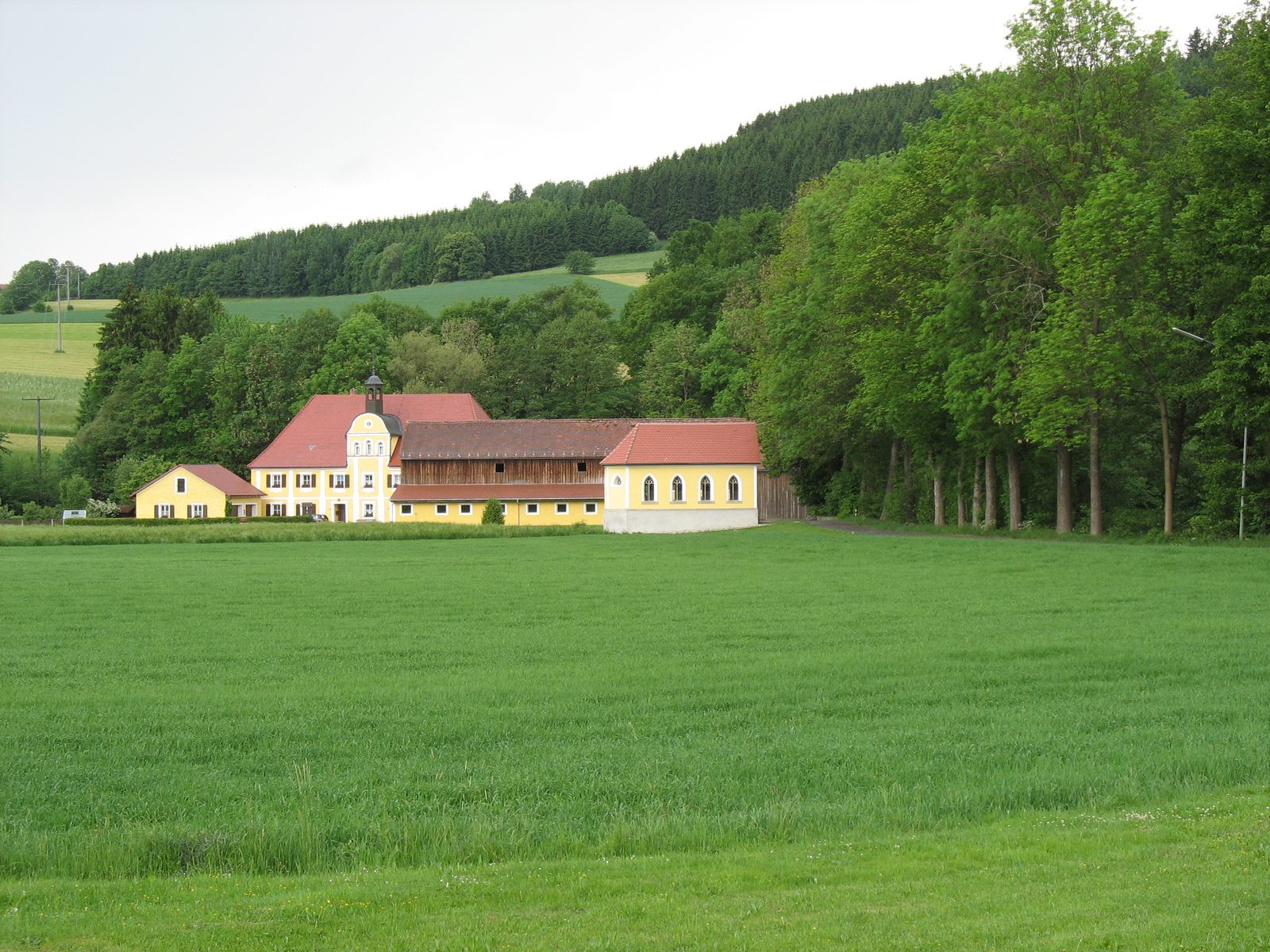
The listed Hammerschloss Grötschenreuth (also called Drahthammer Grötschenreuth) is located in the eponymous district of Grötschenreuth in the Upper Palatinate town of Erbendorf in the district of Tirschenreuth. The complex is listed under file number D-3-77-116-25 as a listed building monument of Grötschenreuth. It is also listed as an archaeological monument under file number D-3-6138-0117 in the Bayernatlas as "archaeological findings of the early modern period in the area of Grötschenreuth Castle".
History+
In the 14th century, a hammer mill was first mentioned in Grötschenreuth. Grötschenreuth and the hammer mill located there was a Leuchtenberg fief in 1362. In 1387, the Grötschenreuth hammer lord Otto Heyden, together with several other hammer lords, founded the first hammer union. In the 14th and 15th centuries, a Schienhammer (i.e., a hammer mill that produced its own iron by smelting ore) was in operation in Grötschenreuth, which was later replaced by a wire hammer. In 1400, Grötschenreuth was mentioned as an accessory to the knight's fief of Siegritz with two hammer mills (Hammer Hopfau and Hammer Grötschenreuth). In 1467, Landgrave Friedrich V granted the village and the hammer mill to Nikolaus Pfreimdner. The hammer mill at Grötschenreuth was sold in 1579 to Christoph von Rotschütz, a margravial Brandenburg bailiff at Hohnberg. Hans Georg Steinhauser acquired the village of Grötschenreuth and the hammer mill in 1605, which was described as "lying desolate". This was also the last mention of the Grötschenreuth hammer mill. On February 16, 1637, Margareta Salome von Steinhauser, the only daughter of Hans Georg, who died in 1636, married Johann Paul Weikmann, son of the Erbendorf town clerk Justus Paul Weickmann. The Hammerschloss remained in the Weikmann family until the 19th century. A document from 1849 states: namely in Gretschenreuth a wire hammer, namely the most famous in Bavaria with 27 works.
Hammerschloss Grötschenreuth today+
The manor house of the former wire hammer is a two-winged, two-story, plastered solid building with a hip roof, a dormer, and a roof turret. The core of the building dates from the 17th and 18th centuries. It was renovated in 1804. The plaster articulation with pilasters on high plinths with strip rustication and belt courses was restored between 1991 and 1993. The ensemble includes the Chapel of Our Lady (the so-called Loreto or Drahthammer Chapel). The chapel was built between 1745 and 1750 by Pastor Johann Michael Pfreimbter and the squire Johann Christoph von Weickmann on Grötschenreuth. In 1771 and 1796, the chapel was destroyed by fire and redesigned in the Gothic style between 1844 and 1856. Today, it is a plastered and three-sided closed solid building with a saddle roof and a pointed arch, neo-Gothic jamb portal from 1858. It is unusual that the chapel does not have a tower. The castle is privately owned and cannot be visited.
Take Mobile History with you
You are reading this text for free. Premium adds what matters on the road: descriptions read aloud, sites found through your camera, whole regions taken offline.
- Every description, including the ~17,700 Premium sites
- Audio guide: have descriptions read to you on location
- AR finder: see sites through your camera, with distance and bearing
- Unlimited saved sites
14 days free, then from €2.99 a month. Cancel anytime.
Source: Wikipedia · Licence: CC BY-SA 4.0 · Image: Gjust57 · Wikimedia Commons · CC BY-SA 4.0
This description is a machine translation of an excerpt from the linked Wikipedia article. The source text was written by its authors, the translation is by Mobile History; like the original it is licensed under CC BY-SA 4.0.
Location: 49.8542, 12.0230