ResidenceHannover - Herrenhausen

Hardenbergsches Palais
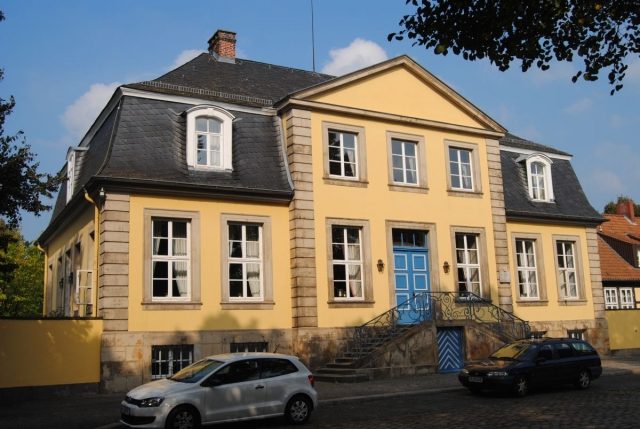
Hardenbergsches Palais

Commercial building

The Hardenbergsche Haus (also: Hardenberg'sches Palais or Hardenberg'sches Haus) in Hanover is a villa that has been inhabited by the highest international personalities. Since its renovation in 2000, the building has served as a guesthouse and for special celebrations and conferences. The listed villa is located at Alte Herrenhäuser Straße 10 at the end of the western Graft-Allee of the Großer Garten in the Herrenhausen district.

Previously, the Electorate of Hanover's garden artist Martin Charbonnier had his residence on the site of the Hardenberg'sches Haus. From 1749 to 1751, Johann Paul Heumann then erected a new "Court Building and Garden Director's Official Residence" for Friedrich Karl von Hardenberg, the head of court building and gardening, at this location, along with "wintering rooms for frost-sensitive plants."

At the beginning of the 10-year foreign rule, the so-called French period, when the French General Édouard Adolphe Mortier marched into Hanover with his troops on June 5, 1803, the commander chose the Hardenbergsche Haus as his own quarters. His successor, the French Minister of War and later King of Sweden and Norway, Jean Baptiste Jules Bernadotte, also apparently found the former service villa of the garden director "commod" - he lived here from 1803 to 1804.

When the Kingdom of Hanover ended in 1866 after the Battle of Langensalza, the Welfs moved their family Welfenmuseum into the Hardenbergsche Haus (see also Fürstenhaus Herrenhausen-Museum).

During the National Socialist era, the city of Hanover acquired the building and renovated the house until 1939 to establish the registry office here. At the same time, the garden was reduced in size to relocate the central section of Herrenhäuser Straße. The historic main street of the old village of Herrenhausen was then renamed Alte Herrenhäuser Straße in the middle of World War II.

From 1952, the Hardenbergsche Haus was the seat of the Heimatbund of Hanover's partner city Glogau, while the upper floor was temporarily inhabited by Eduard Pestel.

In the late 1950s and early 1960s, the sculptor Kurt Lehmann lived in the Hardenberg'sches Palais and received guests such as Martin Buber, Alexander Calder, Werner Gilles, Alfred Hentzen, the art patron Bernhard Sprengel, the stage designer Rudolf Schulz, and Kurt Ehrhardt.

In 1998, the Sparkassen-Finanzgruppe acquired the building and had it extensively renovated and converted by the architects Schweger + Partner in the following two years. Since the year of Expo 2000, the building was prepared for conferences, receptions, and celebrations, especially since the architects Irene Lohaus and Peter Carl redesigned the garden areas in the same year. A new garden parterre was created on the north side of the house.

Construction Description and Features+

Johann Paul Heumann erected the palace-like building, influenced by French Classicism, as a massive, late Baroque plastered building on a high plinth and with articulation by ashlar. The symmetrical building under a high hip-mansard roof is emphasized by a two-story central risalit with a double-flight open staircase. On the ground floor, representative rooms with open staircases on all sides were originally furnished. The private rooms, however, were located on the mansard floor.

Oil paintings are found in the wall paneling in the garden hall.

Since its renovation in 2000, the Hardenbergsche Haus has housed a library on garden art.

Take Mobile History with you

You are reading this text for free. Premium adds what matters on the road: descriptions read aloud, sites found through your camera, whole regions taken offline.

  • Every description, including the ~17,700 Premium sites
  • Audio guide: have descriptions read to you on location
  • AR finder: see sites through your camera, with distance and bearing
  • Unlimited saved sites

14 days free, then from €2.99 a month. Cancel anytime.

Source: Wikipedia · Licence: CC BY-SA 4.0 · Image: http://schloesserrundschau.de/nsachsen/schloesser/hannover03.html

This description draws on the facts documented in the linked Wikipedia article; Wikipedia content is licensed under CC BY-SA 4.0. Wording and editing: Mobile History.

Location: 52.3918, 9.6949