To be privately owned
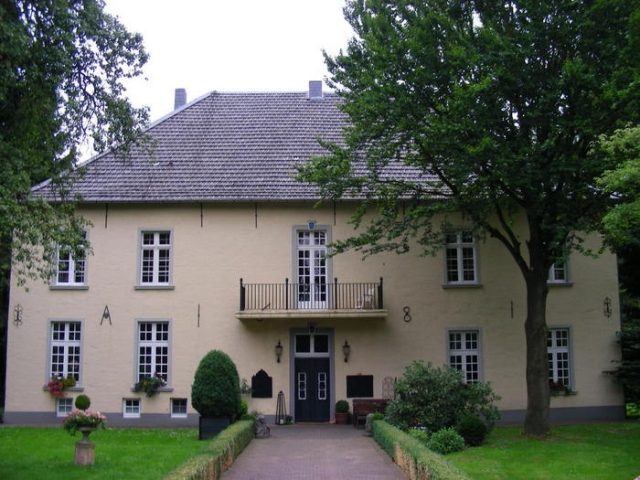
Eyll Castle

In 1432, Haus Eyll was referred to simply as Meyersdonck en nyenhoff when it was transferred to Gerhard von Eyll and his wife Elisabeth von Bocholtz in an inheritance contract. Gerhard was a judge for the Duke of Geldern in the Geldrian district of Straelen, to which the house belonged. His descendants, to whom the house owes its current name, which has only been recorded since the 16th century, owned it until the beginning of the 17th century.
By 1539 at the latest, Eyll belonged to the extensive feudal estate of Haus Vlassrath, located about one kilometer downstream. After somewhat convoluted ownership circumstances, in 1646, Arnold von Crümmel, the governor of the Straelen fortress, and his wife Anna Margaretha von Spicker bought half of Haus Eyll. In 1650, the widow married Jacques Simon von Varo, who was from France, in her second marriage. By 1660 at the latest, they left Eyll and moved into the newly built Haus Caen, visible upstream. Eyll passed to their daughter Philippine in 1675, who married Johann Josef de Permiliack, who was in Spanish service, in her second marriage in 1680. A year later - in 1681, as evidenced by the wall anchors - they rebuilt the house from the ground up.
Around 1700, Eyll came into the possession of Baron Johan Adolph von Horst von Heimerzheim, who came from a Cologne electoral official family. The Baron made a name for himself through a large and lengthy lawsuit concerning fishing rights in the Niers, which he conducted with the Siegburg Abbey as the lord of Straelen. When a messenger from the Abbey delivered the news to Haus Eyll at the beginning of the 18th century that his fishing lease had been terminated, he is said to have struck the messenger in the neck with a hop pole so severely that he died from the injuries! This is the stuff of legends and ghost stories. A son of the Baron, Alexander Wilhelm Franziskus - born at Haus Eyll in 1739 - took a completely different path. He first became a monk in the Clarholz monastery in Westphalia and was abbot of the Hamborn monastery near Duisburg between 1782 and 1790.
In 1765, Gottlieb Ludwig Plesman, the Geldrian War and Domain Councillor, bought Haus Eyll. He was ennobled in 1786 for his services. Plesman presumably used the house only as a country seat. After his death in 1793, Gerhard Friedrich von Ammon appears as the owner, who sold the house around 1818 to the Elberfeld industrialist Heinrich Kamp. From 1855, the Neuss merchant Jacob Le Hanne is documented as the owner, whose son sold the house in 1896 to the Imperial Baron Rudolph Adolph von Geyr-Schweppenburg, who lived at Haus Caen. He died in 1907, and after the division of the property in 1947, his daughter Anita, married von Kempis, received the house, who passed it on to her daughter Mariagnes in 1949, who married Bruno Frankewitz from East Prussia in 1949.
We do not know what the house of the von Eyll family looked like in the 15th and 16th centuries. However, a description from 1539 states that there was a "Berg" here, which is to be understood as a wooden tower, and that the property was secured with fences, ramparts, and moats. For 1666, the existence of a doefhuys, a dovecote, is recorded at Eyll, an indication of pigeon keeping in the 17th century.
In 1681, the house was rebuilt in its current form as a two-story, rectangular brick building with a hip roof. Traces of construction show that a tower was originally intended to be placed in the center of the front of the house. Whether this tower was only planned or actually existed and was later demolished is not known. Originally, the house, which includes a hall on the ground floor on the south side, could be heated by eight fireplaces. In 1991, the house received new plaster.
An architectural peculiarity is the dovecote at Haus Eyll, which was built after 1855 in historicizing forms of the industrial age. The tower possibly replaced an older dovecote. The two-story brick building with pointed arch windows and various friezes, as well as a flat pyramid roof, was carefully converted for residential purposes in 1995. The weather vane on the roof, dated 1954, commemorates Bruno Frankewitz and his wife Mariagnes von Kempis. - Until 1924, there was a second, similar dovecote on the opposite side of the courtyard.
About 200 meters in front of the house, on the avenue, stands a former bakehouse, against which leans a small shrine with a figure of Mary, dating from around 1900 and re-consecrated in 1996.
The 400-meter-long avenue, which leads straight to the house, probably dates from the construction period of the house. It crosses the old moat by means of a stone bridge with two reclining lions. The axis of the avenue continues in an imaginary form through the house to the eastern side of the Niers, where it meets another avenue.
Take Mobile History with you
You are reading this text for free. Premium adds what matters on the road: descriptions read aloud, sites found through your camera, whole regions taken offline.
- Every description, including the ~17,700 Premium sites
- Audio guide: have descriptions read to you on location
- AR finder: see sites through your camera, with distance and bearing
- Unlimited saved sites
14 days free, then from €2.99 a month. Cancel anytime.
Source: Wikipedia · Licence: CC BY-SA 4.0 · Image: http://www.wehrbauten.de/thread.php?threadid=566&hilight=Borghees
This description draws on the facts documented in the linked Wikipedia article; Wikipedia content is licensed under CC BY-SA 4.0. Wording and editing: Mobile History.
Location: 51.4548, 6.3019