Private ownership
ManorLangen - Grumsmühlen
Grumsmühlen Manor
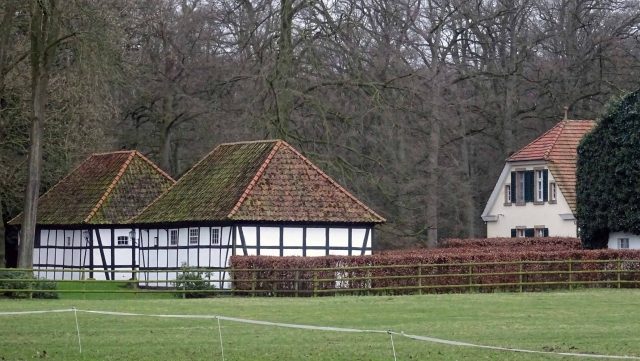
Grumsmühlen was a former knightly estate near Langen in Emsland, which has been owned by the Dukes of Croÿ since 1923.
History+
The name Grumsmühlen (old: Grumsmeulen 1516) is derived from an oil mill that stood on the site. According to Schriever, the determinant grummen = to make noise could mean. In the 16th century, the then manager of the farm, Albert Göding, was still referred to as Grumsmöller. A second mill, the Puttken Mill, which still exists today, was later built on the site. The name may be derived from Low German puttken = to walk along slurping. Grumsmühlen has a very eventful history with many ups and downs. Around 1300, the farm was a tax-free, half inheritance with a mill privilege, owned by the Count of Tecklenburg. In the first half of the 16th century, the Fraterhaus zum Springhorn in Münster was the owner of the property. Grumsmühlen was sold by the Fratres in 1562 to the Lingen rent master Adolf van Limborch (also Limborg), who developed the estate into a stately home with a tower and moat. After van Limborch's murder, Grumsmühlen was sold in 1572 to the Lingen Droste Ernst Mulert. He came from the old Dutch noble family Mulert, which was based, among other places, on the Laar estate near Ommen. Grumsmühlen was not very large at that time. Around 1550, Grumsmühlen had 4 Maltersaat of arable land, 30 Fuder of hay growth, enough (oak) wood to fatten 30 pigs, and a garden of 4 Scheffel of flaxseed for the oil mill.
Source: Wikipedia · Licence: CC BY-SA 4.0 · Image: Jörg Heldt
This description is a machine translation of an excerpt from the linked Wikipedia article. The source text was written by its authors, the translation is by Mobile History; like the original it is licensed under CC BY-SA 4.0.
Location: 52.5425, 7.4272