ManorErkelenz

Hohenbusch Manor

Hohenbusch Manor

Cultural Events
Museum

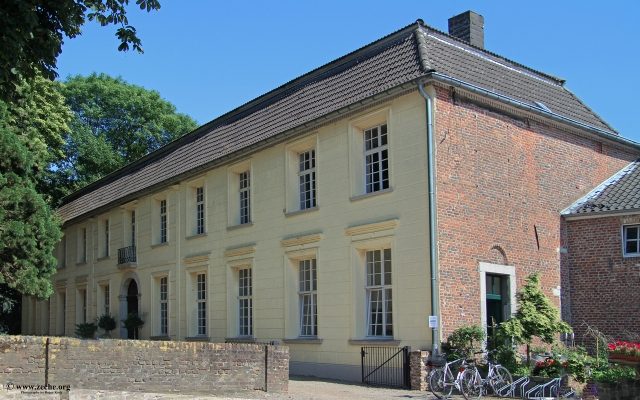
Haus Hohenbusch (Latin: in alto busco, Hohenbusch, or Conventus Altinenmoris, Hohenbusch Monastery) is a former monastery of the Canons Regular of the Holy Cross (Ordo sanctae crucis - O.S.C) and is located southwest of the city of Erkelenz (Heinsberg district) on the road between Matzerath and Hetzerath. The A46 motorway runs north of the complex. A high wall encloses Haus Hohenbusch with its buildings, former gardens, meadows, and orchards. The former monastery is now owned by the city of Erkelenz. A support association looks after the complex, especially the manor house.

Neighboring monasteries of the Canons Regular of the Holy Cross were located in Aachen, Brüggen, Dülken, Düsseldorf, Cologne, Maaseik (NL), Maastricht (NL), Roermond (NL), Schwarzenbroich Monastery near Gürzenich (Düren), Venlo (NL), Wegberg, and Wickrath.

In 1147, the ministerial Rudolphus and his wife Emertrudis donated the allod Hoenbusc to the Marienstift Aachen. In 1226, Emperor Frederick II confirmed the foundation's possession of Hoimbuchs. In 1302, the Order of the Holy Cross founded a monastery in Hohenbusch. The clerics of the order were later called Canons Regular of the Holy Cross. In 1305, the dean and chapter of the Aachen foundation transferred Hohenbusch to the order against payment of an annual rent of 4 Aachen guilders. In 1560, eight priests and eight lay brothers lived in the monastery.

In 1634, the Bishop of Roermond consecrated a new church, which was built parallel to the manor house. In 1677, a novitiate was established. In 1707, the order erected the so-called central building in the courtyard, and in 1716, the west wing was built. In 1720, the monastery completed the south wing.

In 1795, the monastery's ledger listed the following monastic possessions: 12 Morgen near Lövenich, 252 Morgen near Matzerath, 580 Morgen near Doveren, the Hetzerather Hof with 60 Morgen, 207 Morgen near Baal, 140 Morgen of forest near Hetzerath, a mill in Doveren, the tithe from Matzerath (480 Morgen) and from Beeck (220 Morgen). In 1798, 13 religious lived in the monastery.

On August 8, 1802, the monastery was dissolved due to the secularization by the French. At that time, nine religious were still there, among them the last prior, Conrad Ohoven. The church and two wings of the monastery buildings were demolished.

Between 1802 and 1983, the former monastery was used as an agricultural estate. This is also when the name "Haus Hohenbusch" emerged. In 1983, the city of Erkelenz bought Haus Hohenbusch and the associated farmland, approximately 70 hectares. In 1990, the North Rhine-Westphalia State Cultural Days were held. At the same time, the former monastery was presented to the general public for the first time.

Library

The monastery possessed a large library with manuscripts and early prints from the 14th and 15th centuries. The manuscripts were produced in the monastery's scriptoria on parchment. The names of some scribes are known.

Most of the collection was lost in the turmoil after the secularization. However, some books have been preserved and are located in the Archbishopric Diocesan and Cathedral Library in Cologne.

Other Monastery Inventory

After the dissolution, the inventory was sold, given away, and "squandered" (the current location of some items is known): the organ, the pulpit, and the choir stalls are now in the Reformed Church of Linnich, the confessional is in the church of Gerderath, the statue of Saint Odilia in Wockerath, and the Madonna in Golkrath.

Buildings+

Today, the following buildings of the monastery are still preserved. In the so-called manor house, a long two-story residential building, there is still a richly decorated stucco ceiling and a fireplace in stucco marble (both in one room).

  • The farm buildings
    • The south wing, a large barn, also called the tithe barn.
    • The west wing with the courtyard gate; the upper floor is now called the Prior's Hall.
    • The east wing is located directly next to the manor house but is no longer completely preserved.
    • An elongated building in the courtyard (central building), now called the Lay Brothers' House.

Meanwhile, the foundations of the demolished monastery church have also been located.

3 chronograms are embedded in the walls of the buildings. On the north side of the central building: IN TE CONFIDO, NON ERUBES CAM. This yields the year 1707. Translated: In You I trust, I will not blush. The chronogram is shown as a photo next to it.

The following chronogram is also shown here as a photo. On the south side of the central building: IN CRUCE FIDAM. This yields the year 1707. Translated: In the cross I will trust.

In the gable of the south wing: CUSTODI ILLAM QUIA IPSA EST VITA. This yields the year 1720. Translated: Guard her, for she is life.

Current Use+

The Erkelenz Riding and Driving Club uses the tithe barn as a riding stable. A "Rider's Snug" with a view into the barn is used for gastronomy. In the neighboring west wing, there are some horse stables on the ground floor. The large meadow behind the manor house and east wing serves as a riding and tournament ground.

The Hohenbusch Summer Art Academy uses the idyllic monastery in July and August to offer its course program in painting and sculptural design. Course participants from Germany and neighboring countries come here to attend the courses. The highlight is always an exhibition where the participants show their works. The west wing, on the upper floor, the Prior's Hall, has renovated rooms that are used for private celebrations, cultural events, and exhibition purposes.

The rooms of the Lay Brothers' House in the courtyard also serve as event rooms. In the manor house, "Museum Cells" (since 2009) provide information about the history of the monastery. The east wing was converted by members of the support association and has housed a small cafe with a view of the riding arena since July 2006.

Regular events include: Hohenbusch Summer Art Academy, art exhibitions, autumn farmers' market, summer holiday games of the Erkelenz Youth Welfare Office, riding and show jumping tournament, breeding and foal show, carriage meetings, and various concerts.

Take Mobile History with you

You are reading this text for free. Premium adds what matters on the road: descriptions read aloud, sites found through your camera, whole regions taken offline.

  • Every description, including the ~17,700 Premium sites
  • Audio guide: have descriptions read to you on location
  • AR finder: see sites through your camera, with distance and bearing
  • Unlimited saved sites

14 days free, then from €2.99 a month. Cancel anytime.

Source: Wikipedia · Licence: CC BY-SA 4.0 · Image: http://www.zeche.org/

This description draws on the facts documented in the linked Wikipedia article; Wikipedia content is licensed under CC BY-SA 4.0. Wording and editing: Mobile History.

Location: 51.0682, 6.2782