Apartments
CastleHilden
Horst Castle
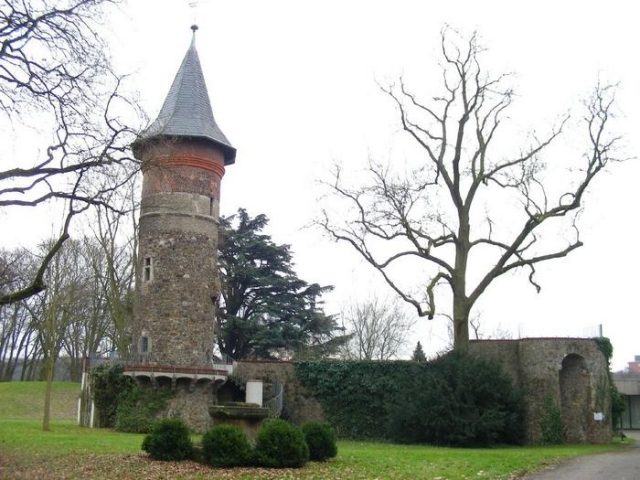
Originally, Haus Horst was a knight's estate and moated castle, built at the end of the 11th or beginning of the 12th century.
Like the Honschaften of Hilden and Haan, it belonged to the sphere of influence of the Archbishops of Cologne. Since the Counts and later Dukes of Berg also claimed this area of the right Rhineland as their sovereign territory, disputes repeatedly arose between Berg and the Archbishop. These primarily concerned Hilden and Haan, but at times also Haus Horst. The residents of the two Honschaften were particularly affected, as both authorities frequently demanded services and taxes from them.
One of the first documented records of a noble family von Horst dates from 1224. In a document of the Cologne Archbishop Engelbert I, a Theodericus de Horst is mentioned as a witness. Further evidence for members of the noble family von Horst is documented for:
- 1296 Knight Heinrich von Horst, parish administrator of Hilden
- 1367 Knight Balduin von der Horst, forest count of the Richrath Gemark
- 1372 Junker Konrad von der Horst (the Elder)
In 1372, the then Archbishop Friedrich III of Cologne granted Haan and Hilden to Kraft von Elverfeldt as a fief. His daughter Ida was the wife of Konrad von der Horst. The latter died in 1403.
- 1404 after Kraft's death, the Cologne Archdiocese granted Haan and Hilden to Konrad von der Horst (the Younger) as a fief. In return, Konrad had to confirm for Haus Horst that it was a fief of Cologne and thus clearly belonged to the possession of the Archbishop of Cologne from then on.
- 1501 the last Konrad von der Horst died. Through his daughter Adriane, it passed as a fief to her husband Betram von Plettenberg.
This female inheritance triggered a long legal dispute. Haus Horst was originally a male fief, but was now inherited in the female line like a distaff fief. Successors from various noble families followed as feudal tenants, such as: von Quade (towards the end of the 16th century), Schenk von Nideggen (documented 1636 and 1718), von Reven, von Lemmen (bought around 1740) and von Rupertz (were owners from 1776 to 1810). The succession was repeatedly challenged for several centuries via the Imperial Chamber Court. Various interim judgments were not accepted. Only in 1796 was the legal process concluded without a final judgment.
Source: Wikipedia · Licence: CC BY-SA 4.0 · Image: http://www.wehrbauten.de/thread.php?threadid=583
This description draws on the facts documented in the linked Wikipedia article; Wikipedia content is licensed under CC BY-SA 4.0. Wording and editing: Mobile History.
Location: 51.1564, 6.9074