Restaurant
Nierenhof Manor

The Nierenhof estate is located in the Velbert district of Nierenhof, which formerly belonged to Westphalia. It was once known as "Rittergut Nederhofe". Gut Nierenhof, after which an entire district is named today, is located at the crossing of the prehistoric trade route Hilinciweg (mentioned in a document in 875 as the boundary of the Werden tithe district) over the Deilbach. The Deilbach is the historical border between Franks and Saxons, until 1354 between the Lordship of Hardenberg and the County of Mark, later between the Duchy of Berg and Prussia, and to this day between the Rhineland and Westphalia. Since the trade route was of considerable importance, the Isenburg, once the largest hilltop castle in Westphalia, was built at the "Cologne Ford" over the Ruhr. It is probable that the Deilbach crossing was also controlled by a knight's seat. The confluence of the Deilbach, Heiersberger Bach, and Felderbach with their wide fertile valleys also appears favorable for the construction of a fortified house. While the streams were used for the construction of various mills, Nierenhof developed into a traffic hub up to the present day. Even in the "Topographical Charte der Grafschaft Marck von 1777", Nierenhof is marked as "a noble estate".
Not far from the knight's seat on the Hattingen Homberg, in Nierenhof (since 1971 a district of Langenberg, today Velbert) lay the noble seat of the von Nederhove family. Until the extinction of the lineage in the 15th century, the Lords of Nederhove were Isenberg-Limburg ministerials. Their residence was on the southwestern spur of the Isenberg. In 1172, Hellwich v. Nederhove was a ministerial of the church in Cologne. Later, the name Slugh auf dem Nederhove appears. In 1360, Gudeke Slugh von Nederhove was enfeoffed by Count Dietrich. Bearers of the same name also held the office of judge in Hattingen in the 15th century. In 1757, the merchant Johann Peter Bachmann from Langenberg bought the land belonging to the estate and erected extensive residential and commercial buildings on it along the main road.
Current Building Ensemble and Monument Value+
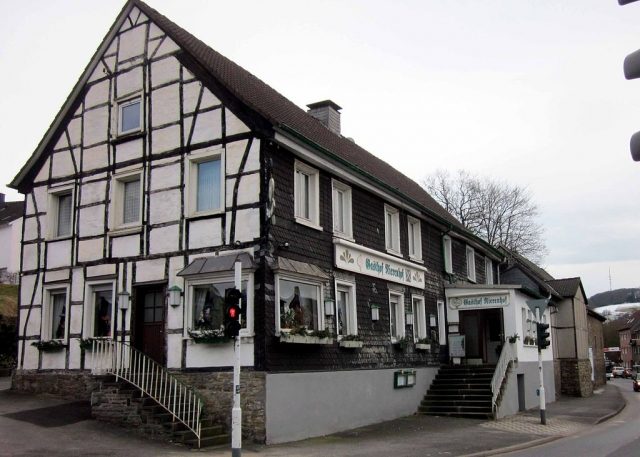
The current country inn consists of a two-story half-timbered building on a rubble stone plinth. The corner design was subsequently re-windowed after the demolition of an entrance pavilion. The street side (west side) is slated. The outbuilding is constructed of Ruhr sandstone. A younger connecting building in half-timbered construction has been placed between the two main buildings. The ensemble is completed by a courtyard driveway with a long retaining wall and a striking rock formation of an interesting geological outcrop, against which the buildings lean.
The building ensemble was not listed in the monument register of the city of Velbert when the owner submitted a demolition application in 2013. Due to media reports and citizen engagement, the Landschaftsverband Rheinland is currently examining the monument value of the building, as well as any potential archaeological finds in connection with the knight's estate.
Take Mobile History with you
You are reading this text for free. Premium adds what matters on the road: descriptions read aloud, sites found through your camera, whole regions taken offline.
- Every description, including the ~17,700 Premium sites
- Audio guide: have descriptions read to you on location
- AR finder: see sites through your camera, with distance and bearing
- Unlimited saved sites
14 days free, then from €2.99 a month. Cancel anytime.
Source: Wikipedia · Licence: CC BY-SA 4.0 · Image: http://de.wikipedia.org/wiki/Datei:Nierenhof_1.jpg
This description draws on the facts documented in the linked Wikipedia article; Wikipedia content is licensed under CC BY-SA 4.0. Wording and editing: Mobile History.
Location: 51.3723, 7.1377