Educational center
Obereimer Castle

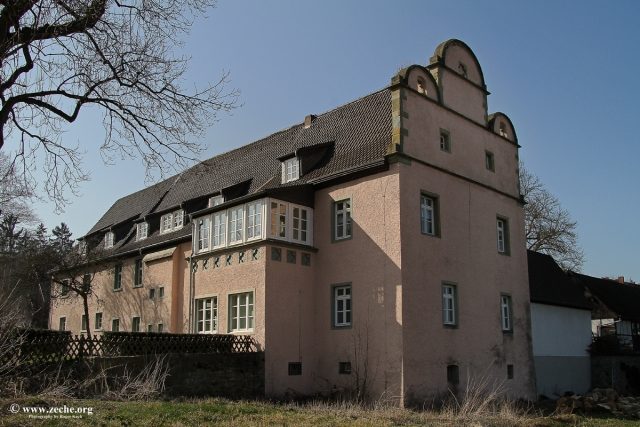
Haus Obereimer was a manor house owned by the Electors of Cologne and the center of the princely game park in Arnsberg. Since the 19th century, the state forestry office of Arnsberg has been located there. The surrounding city quarter is also named Obereimer after the manor.
In the area of today's city quarter, there were several farms in the Middle Ages, which were subject to various lords. The Elector's chief steward Hermann (von) Dücker succeeded in buying up various lands and manorial rights to the farms since 1627 and transforming them into a knight's estate, exempt from taxes and contributions, and eligible for the Landtag.
During his first visit to Arnsberg, Elector Maximilian Heinrich of Bavaria took a liking to the estate, which was clearly visible from Arnsberg Castle. Dücker could not resist the Elector's wish for the establishment and sold the estate to Maximilian Heinrich for 12,000 Reichstaler. With this money, among other things, Dücker had the Dückersche Hof, one of the largest buildings in Arnsberg's old town, built.
Electoral Projects+
The Elector subsequently acquired further property. Various facilities were built on the estate grounds. Intensive livestock farming for the needs of the castle and for sale was introduced. The Elector had a tree and pleasure garden built, large fish ponds were created, a powder mill was built, and a new country road towards Hüsten was constructed. A new bridge over the Ruhr, passable by carriages and wagons, facilitated the connection with the city. Water power was generated by a diversion channel on the Ruhr, which was needed for the operation of a hammer mill. In addition, a large stud farm was established. By 1660, this already comprised over 60 horses. The stud farm reached its greatest importance under Elector Clemens August. In 1741, it had 110 horses. Due to the high costs, it was abandoned in 1748. Instead, a dairy farm, meaning cattle farming managed by a Swiss expert, was established. However, this was also abandoned again.
Game Park+
Maximilian Heinrich's largest project in terms of area was the electoral game park. A huge area of the adjacent forests was fenced off, later with ramparts and abatis (similar to a Landwehr) that enclosed entire mountains and valleys. The game kept there was intended to satisfy the hunting passion of the Electors and their guests. The enclosure had become necessary because the game population had sharply declined during the Thirty Years' War. The hunter's house was built in the game park. From the 19th century until the mid-20th century, a narrow-gauge railway station was located there. For the Elector and his guests, a shooting range in the form of a rondel, still visible today, was laid out at the highest point of the game park for hunting.
Buildings+
Significant construction measures also fall into the time of Maximilian Heinrich. The current forester's house was built as a gatehouse. It has a characteristic "Welsch" northeast gable. The core of the former manor house dates back at least to the 15th century, but could well be older. Its large slate-covered half-hipped roof is characteristic. A representative Baroque portal with the electoral coat of arms has disappeared over time. The large horse stable from the 17th century, 65 m long, was demolished in the second half of the 20th century.
Forestry Office+
During the period when the Duchy of Westphalia belonged to Hesse-Darmstadt, parts of the estate were sold. In the manor itself, a new authority was established in 1804 with the creation of a chief forestry office for the administration of state forest property, which continued as the Obereimer Forestry Office in Prussian times from 1816. Bernhard Danckelmann, the later long-time head of the Eberswalde Forestry Academy, was born in the Obereimer forester's house as the son of a chief forester serving there.
To this day, a forestry office is located there. A few years ago, a forest gene bank was established in a new building, and a youth forest home also belongs to the institution. Due to the restructuring of the state enterprise Wald und Holz in recent years under the government of Jürgen Rüttgers, the forestry office lost its actual district responsibility. Instead, a teaching and experimental forestry office was established in 2007. The forest gene bank was upgraded by the ecological silviculture department. In addition, there is a research center for hunting science and game damage prevention. Also affiliated is the former forest worker school in the Neheim district, which today operates under the name "Forestry Education Center for Forest Work and Forest Technology."
City Quarter+
The current city quarter around the former Obereimer estate largely developed in the 20th century through the expansion of the urban area. In this area, in addition to residential buildings, there are numerous commercial enterprises. Among others, the wood processing company Sauerländer Spanplatte has its headquarters here.
Take Mobile History with you
You are reading this text for free. Premium adds what matters on the road: descriptions read aloud, sites found through your camera, whole regions taken offline.
- Every description, including the ~17,700 Premium sites
- Audio guide: have descriptions read to you on location
- AR finder: see sites through your camera, with distance and bearing
- Unlimited saved sites
14 days free, then from €2.99 a month. Cancel anytime.
Source: Wikipedia · Licence: CC BY-SA 4.0 · Image: http://www.zeche.org/
This description draws on the facts documented in the linked Wikipedia article; Wikipedia content is licensed under CC BY-SA 4.0. Wording and editing: Mobile History.
Location: 51.4068, 8.0520