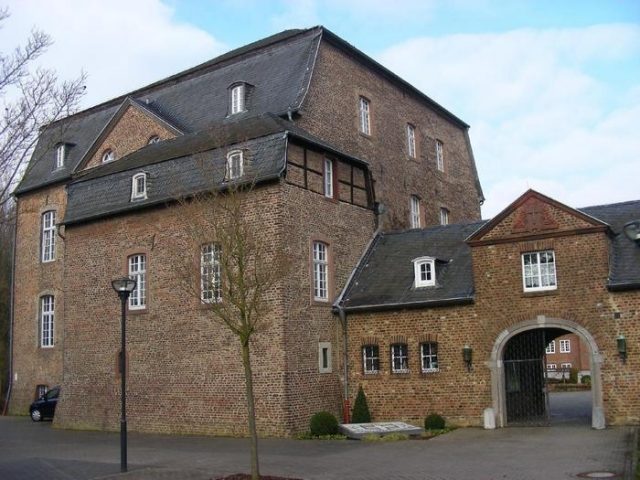
ManorJülich - Barmen

Overbach Manor

Overbach Manor

To be privately owned

Gymnasium Haus Overbach in the Jülich district of Barmen is a state-recognized grammar school under the independent sponsorship of the German Province of the Oblates of St. Francis de Sales. Currently, approximately 850 students attend the grammar school, which is a member of the MINT-EC association.

Other grammar schools in Jülich, about 5 km away, are the Mädchengymnasium Jülich and the Gymnasium Zitadelle.

The school was founded in 1918 and was a boys' school until 1981. The symphony orchestra, the Overbach wind orchestra, the choirs of the Overbach singing school, and numerous sports groups are very well known. Music, languages, and natural sciences are focal points in the school's profile. The Overbach Advent singing by the wind orchestra and the Overbach choirs is also locally renowned.

Haus Overbach, Manor House and Moated Castle+

The first documented mention of Haus Overbach as a knight's seat is found in 1341 in a document by Johannes de Overbach. As early as 1334, a Heinrich von Overbach was documented as the steward of Count Wilhelm von Jülich. In 1415, the Overbach estate owned a total of 61 Morgen of land. Around 1450, the Greyn family owned the estate. The cellar vaults in the manor house date from this period. Between approximately 1480 and approximately 1730, ownership changed frequently. Owners included the Reuschenberg zu Severich family, von Cortenbach, von Hoensbroech-Overbach, von Hatzfeldt, and Hens.

Haus Overbach was first mentioned on a Dutch map in 1635. However, the oldest surviving view from 1733 is in the Codex Welser.

It is documented that Baron Reiner von Overschie had the manor house renovated around 1792. It was only at this time that the manor house acquired its current appearance.

History of School Operations+

On November 16, 1918, Imperial Count von und zu Hoensbroech sold Haus Overbach to the Oblates of St. Francis de Sales, who then developed it into a grammar school. On April 24, 1919, the Missionary Study Institute Overbach began operations under headmaster Father Franz Xaver Bogenberger, who was succeeded in 1923 by Father Albert Filchner as the new headmaster.

On January 30, 1921, the first Overbach chapel was consecrated, and in 1923, the boarding school building was completed. The boarding school will be closed by 2012 at the latest.

In 1939, however, the Overbach missionary school had to close and served as quarters for around 600 Westwall workers. In 1941, Haus Overbach became quarters for 400 Cologne orphans. After 1944, however, Overbach was severely damaged by the effects of World War II, as many parts of the building were destroyed. The buildings newly erected after the war were, however, intended to retain the flight of the economic wings of the old castle. Of the original medieval moated castle, only the manor house, which today houses the grammar school's library (see image above), and the water-filled northern and eastern parts of the moats remain.

On September 19, 1946, the private secondary school Overbach was reopened by headmaster Father Peter Thull, who was succeeded on April 27, 1948, by Father Johannes Weindorf as the new headmaster. During this time, Overbach was provisionally state-recognized as the classical progymnasium Haus Overbach. In 1953, Father Dr. theol. et phil. Hubert Pauels became the new headmaster, and almost 2 years later, the new construction of the auditorium and (old) tower hall was inaugurated on October 23, 1955. In 1960, it was renamed classical grammar school Haus Overbach, and on April 30, 1960, it received permanent recognition as a progymnasium. In the following year, on January 12, 1961, construction work began on the new school wing I to the east of the existing buildings. On April 13, 1961, the official title was Gymnasium i.E. Haus Overbach. In this year, there was a "Obersekunda" (upper secondary class) in Overbach for the first time, so that on March 10, 1964, the first classical Abitur examination was taken at GHO. Six years later, on June 22, 1970, the first Abitur of the modern languages branch followed. At the beginning of the 1970s, the upper secondary level was reformed. The first Abitur after the reform of the upper secondary level was awarded on June 18, 1974. Just under two months later, Erwin Hoffmann became the new headmaster at GHO on August 1, 1974.

On September 7, 1981, coeducation finally began at GHO. One year later, on September 7, 1982, the new gymnasium was inaugurated, and another year later, on August 22, 1983, the new school wing IV was finally inaugurated.

Today, Heinz Lingen is the headmaster of Gymnasium Haus Overbach.

Music+

Music is a focal point in the profile of Gymnasium Haus Overbach. Students have numerous opportunities to gain musical experience in a total of four orchestras (Junges Orchester Overbach, Symphony Orchestra, Wind Orchestra, and Chamber Orchestra) and four choirs (Singkreis, Children's Choir, Young Choir, Chamber Choir). In the upper secondary level, there is also the option to include orchestra or choir work (instrumental/vocal practical course) in the Abitur.

The Children's Choir, the Young Choir, and the Wind Orchestra annually organize an Advent singing in the monastery church of Overbach, and the Chamber Orchestra and the Chamber Choir annually perform J. S. Bach's Christmas Oratorio.

The grammar school provides rooms for afternoon individual instrumental lessons, which are given by external music teachers. These teachers are in contact with the school and the orchestras and complement the musical education offerings of the Jülich region (e.g., the Jülich Music School), as not only students of the grammar school are taught here.

Astronomy+

Gymnasium Haus Overbach has several telescopes with apertures ranging from 7 cm to 32 cm. The optical systems range from simple refractors to Newton reflecting telescopes and Schmidt-Cassegrains. With these telescopes, astronomical events such as eclipses or transits can be transmitted live to the school and into lessons. As part of working groups, students from other schools also use the opportunity to work with these telescopes.

New Lunar Society+

Science evenings of the New Lunar Society aim to awaken students' interest in natural sciences.

For this purpose, scientists from universities, Forschungszentrum Jülich, or RWTH Aachen are invited at irregular intervals to give lectures on current research topics and then discuss them with students and guests. Well-known lecturers at science evenings included Harald Lesch, Ulrich Walter, H.J. Blome, and Walter Oelert.

The project "Teachers - Students - Scientists in Dialogue" was awarded first prize by the Robert Bosch Foundation.

Euregionale 2008/Science College+

Haus Overbach contributed to the Euregionale 2008 with the construction of a Science College. The 7.2 million Euro construction project aims to promote communication and cooperation between students, scientists, universities, Forschungszentrum Jülich, and other scientific institutions. The multi-story building contains several laboratories, seminar rooms, and a platform for telescopes on the roof. In addition to the main building, a guesthouse with accommodation was also built.

It was completed in the summer of 2009.

Miscellaneous+
  • Haus Overbach is a station on the Wasserburgen-Route, a 365 km long cycling route on the edge of the North Eifel.
  • The District Administrator of the Düren district, Wolfgang Spelthahn, is an alumnus of Gymnasium Haus Overbach.
  • U19 national player and 1. FC Köln player, Reinhold Yabo, attended Gymnasium Haus Overbach.

Take Mobile History with you

You are reading this text for free. Premium adds what matters on the road: descriptions read aloud, sites found through your camera, whole regions taken offline.

  • Every description, including the ~17,700 Premium sites
  • Audio guide: have descriptions read to you on location
  • AR finder: see sites through your camera, with distance and bearing
  • Unlimited saved sites

14 days free, then from €2.99 a month. Cancel anytime.

Source: Wikipedia · Licence: CC BY-SA 4.0 · Image: http://www.wehrbauten.de/thread.php?threadid=570

This description draws on the facts documented in the linked Wikipedia article; Wikipedia content is licensed under CC BY-SA 4.0. Wording and editing: Mobile History.

Location: 50.9422, 6.3064