To be privately owned
Reck Castle

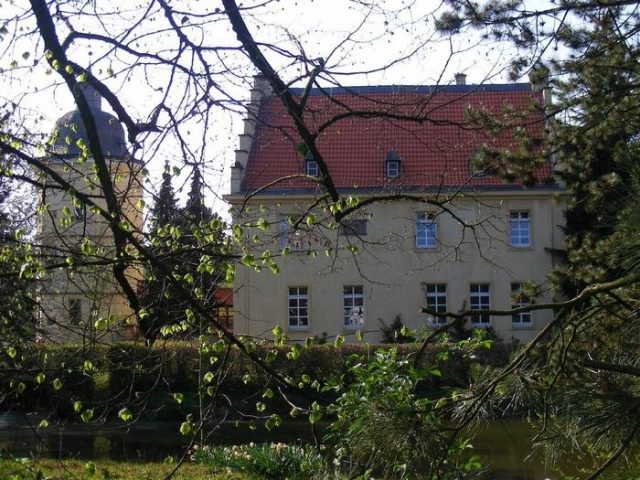
Haus Reck is an old noble seat in the former parish of Kamen, Lerche, today a district of Lerche in the Pelkum borough of the city of Hamm. It is located immediately east of the A1 motorway on the city limits of Bergkamen. The estate only adopted its name in the mid-16th century. Due to its location in the "Pelkumer Heide", it was previously called Haus zur Heyde or Haus zur Heide. It is the ancestral seat of a branch of the von der Recke family. In 1465, "Haus Reck" was mentioned when it was expanded into a fortified castle.
The core of the manor house dates back to the 15th century, the brick barn is from 1715, and the half-timbered sheepfold is from 1775.
The Bauhaus, defensive wall, and defensive tower made of plastered green sandstone masonry date from the mid-16th century. The Bauhaus, a three-aisled Low German hall house, was used for managing the lands belonging to the castle.
Since April 2007, it has been possible to get married in the old tower directly on the old battlement of Haus Reck (civil registry office of the city of Hamm). There is also the possibility of "moonlight weddings" and similar events. The room above the registry office is used for the champagne reception.
Haus Reck should not be confused with the restaurant of the same name in Mülheim an der Ruhr.
The Burgmannshöfe of Kamen
The development of Kamen is closely linked to the history of its Burgmannshöfe (knights' estates). There were at least ten such properties. They were surrounded by ramparts and moats and served to protect the town. Kamen was thus the town with the most Burgmannshöfe in the County of Mark, not even the then important town of Quakenbrück (north of Osnabrück), which today officially calls itself Burgmannstadt Quakenbrück, although it now only owns four Burgmannshöfe.
According to the property register (Urbar C) in Werden Abbey near Essen, there has been a settlement named Kamen since about 1050, but the parish of Kamen with its six farming communities must have existed for longer. At the site of today's Pauluskirche, whose tower is made of green sandstone, a wooden church seems to have stood previously.
At the beginning of the 12th century, the Counts of Altena, the then territorial lords, had a count's castle built as a fortified residential seat west of today's Pauluskirche, similar to what later became Burg Mark in the village of Mark near Nienbrügge or Hamm. The size and nature of the count's castle are no longer known today. From 1225, the Counts of the Mark became territorial lords of the County of Mark, founded by Adolf I of the Mark. Since the Archbishops of Cologne claimed territorial lordship, such strongholds gained particular political significance. Kamen was located at a passable Seseke crossing and thus became a border fortress against Cologne's aspirations for power.
In accordance with this military importance, but also for the organization of their territorial rule, the Counts settled their retinue in the immediate vicinity of their residential castles. Presumably, the Burgmannen came from the respective closer surroundings. For Kamen Castle, in addition to Haus Reck, they also came from Haus Böing, Westick, Heeren, and others. Over time, the Burgmannen settled in an inner and an outer ring around the settlement core consisting of the count's castle and the church. Their estates were large, solid houses. They were usually provided with a lot of surrounding land and were protected by earthworks, wooden palisades, and moats.
The Burgmannen belonged to the ministeriales of the Counts of Altena and Mark. They were responsible for court administration and governance, but were also called upon for defense and military service. Occasionally, they were also responsible for holding court days in the town. Over time, the lower nobility partly recruited from the ranks of the ministeriales. For their services, they received a fief or service estate. In later times, they could freely dispose of these estates and bequeath them. The Burgmannshöfe retained their noble freedom from all urban burdens until the 19th century, even if they already belonged to bourgeois families.
According to the growth phases of the medieval urban area, two construction periods of the Burgmannshöfe can be distinguished. Around the settlement core of the count's castle and the Severinskirche (today's Pauluskirche), the Westerholtschen and Cappenberger Hof were built to the west. In the north, in the area of today's Willy-Brandt-Platz, the Akenschokenhof was built, in the east the Trippenburg on today's Burgstraße, whose exact location is unknown and can only be roughly estimated. To the south, the Hanenhof adjoined the Seseke. These estates were built in the 12th and 13th centuries. They were located on the edge of the then town limits and were therefore fortified with ramparts, moats, and palisades.
In the course of further development phases, the settlement grew towards the west, north, and east. Kamen was granted town rights and fortified with a wall and a double moat system. To the south, the Seseke remained the boundary. It was brought closer to the settlement and straightened. The old street names Westen-, Osten- and Nordenmauer (West, East, and North Wall) bear witness to the former course of the wall. A remnant of the Ostenmauer still exists today.
As part of this town expansion, the Galenhof and the Edelkirchenhof (later Haringshof) were built north and south of Weststraße. To the north, the Reckhof or Pallandscher Hof adjoined, and to the east of it, a Bohlenburg (plank castle), whose exact location is no longer known today. The Reck-zu-Reck-Hof (also Vogelhof, today the Karstadt site) formed the conclusion. These five Burgmannshöfe were also laid out on a large scale and had moats, earthworks, and palisades. It is striking that all the estates were built near earlier or later city gates. The names of the estates usually changed when they acquired new owners. The Galenhof appears to have been the largest and best-fortified of the estates. Its moats and ramparts were only leveled in 1898. It is the only Burgmannshof still preserved in Kamen today.
Haus Reck
From about the second half of the 14th century, Haus zur Heide was owned by the Kamen Burgmann Diedrich (III.) von der Recke zu Heeren. In 1392, an inheritance division occurred between his sons, in which the property, along with the Kamen Burgmannshof, fell to the youngest brother Johann von der Recke. Johann's son Diedrich first called himself Herr zur Heide in 1421. He was followed by seven more generations of owners of the estate with the leading name Diedrich.
Diedrich XIII. "the Rich" became Drost of Unna in 1511 or 1512. The office, with which the Drost position of Kamen was connected, remained with the family until 1753; in that year, the office was dissolved. In 1623, Johann von der Recke, President of the Imperial Aulic Council, was elevated to the status of Imperial Baron. His brother Diedrich XXVI. acquired the judicial lordship and patronage of Frömern in 1636.
In 1649, Diedrich XXXI. founded the chapel on the outer bailey, which was demolished in the 19th century. To his son Diedrich XXXVII., King Frederick I of Prussia granted civil and criminal jurisdiction over the houses of Reck, Raffenberg, and Töddinghausen, as well as the villages/farming communities of Lerche, Rottum, Derne, Bergkamen, and Overberge on April 26, 1709. The thus created Herrlichkeit Reck separated as an independent administrative and judicial district from the association of the Amt Kamen. Another well-known owner of Haus Reck from this period is Dietrich von der Recke (1673–1690) called Oer zu Reck (1695), heir of Burkhart von Oer zu Kakesbeck.
With the introduction of the Landrat's office in the County of Mark, the old Drost positions became obsolete. Diedrich XLI. von der Recke received the Landrat's position in the newly created district of Hamm in 1753 and later bequeathed it to his sons. The elder son, Diedrich Adolf, incurred debts in the wake of the Seven Years' War, which led to the bankruptcy of his possessions. In 1774, 49 farms and cottages in the Herrlichkeit Reck and the Reck estates and rights in the town and Amt Kamen were publicly auctioned for 27,789 thalers. Haus Reck itself and its accessories were bought in 1787 by Baron Senfft von Pilsach for 26,370 thalers. He thus preserved it for his wife Friedrike, the only daughter of Diedrich Adolf's younger brother Gisbert Heinrich Diedrich von der Recke, with whom this line died out in the male line in 1794.
French rule, towards the beginning of the 18th century, destroyed the firm cohesion of the then district of Hamm. The offices of Unna and Kamen were now assigned to the "Arrondissement" of Dortmund and were divided into four Mairies. This division ended in the newly created Prussian province of Westphalia under the Oberpräsident Baron von Vincke with the introduction of a new administrative order.
In 1821, Baron von Syberg zu Busch bought the 308-acre estate for 33,000 thalers. In 1827, he bequeathed it to his grandchildren, the children of the first marriage of Oberpräsident Ludwig Freiherr von Vincke. Since that time, thorough renovations of the manor house and defensive tower have been carried out. Only the 16th-century Bauhaus and the farm buildings from the first half of the 18th century provide information about the original state of construction.
Take Mobile History with you
You are reading this text for free. Premium adds what matters on the road: descriptions read aloud, sites found through your camera, whole regions taken offline.
- Every description, including the ~17,700 Premium sites
- Audio guide: have descriptions read to you on location
- AR finder: see sites through your camera, with distance and bearing
- Unlimited saved sites
14 days free, then from €2.99 a month. Cancel anytime.
Source: Wikipedia · Licence: CC BY-SA 4.0 · Image: http://www.wehrbauten.de/thread.php?threadid=636
This description draws on the facts documented in the linked Wikipedia article; Wikipedia content is licensed under CC BY-SA 4.0. Wording and editing: Mobile History.
Location: 51.6240, 7.6900