ManorKreuzau - Schneidhausen

Schneidhausen Manor
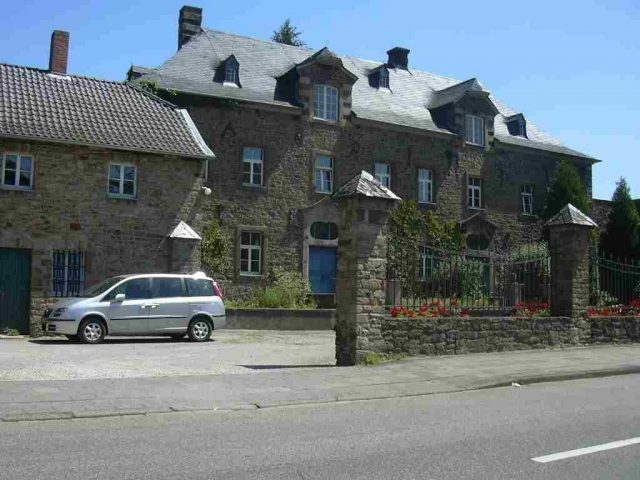
Schneidhausen Manor

Apartments

Haus Schneidhausen is a manor house in Schneidhausen, a hamlet of Kreuzau in the district of Düren in North Rhine-Westphalia on the Rur river.

The building complex, located close to the Kreuzau mill pond, was erected in 1743 by Leonhard Hoesch (1684–1761), initially a master ironworker at Neuenhammer in the Vicht district of Stolberg, now owner of a foundry in Schneidhausen, as a representative residence with an attached iron cutting mill made of quarry stone. On September 14, 1742, Hoesch had received the concession for this factory from the Hofkammer in Düsseldorf. He had been married since 1716 to Elisabeth Schoeller (1698–1778), daughter of the Gemünd ironworks owner Johann Peter Schoeller (1671–1753). The buttons of the iron anchors of Haus Schneidhausen still show the year of construction and the initials of the building couple.

The name Schneidhausen is probably an invention of the builder Leonhard Hoesch. It derives from the iron cutting mill. After Haus Schneidhausen originally served only for iron production, Hugo Ludolf Hoesch (1727–1790), Leonhard's son, expanded the building complex to include a paper mill and an oil mill. This was intended to utilize the abundant water power. The concession for both mills was granted on March 17, 1770.

After the death of Hugo Ludolf Hoesch in 1790, Haus Schneidmühle passed according to his will, half each to his sons Eberhard Hoesch (1756–1811), who bore the epithet "von Schneidhausen", and Jeremias Ludolf Hoesch (1774–1842). These sons founded the two branches of the Düren Hoesch line. Both Jeremias and Eberhard Hoesch lived in Schneidhausen. Since the old ancestral home of the Hoeschs could not accommodate two families, a new dwelling had to be built.

In 1819, the ownership shares were redivided, and Eberhard's sons Eberhard, junior (1790–1852) and Wilhelm Hoesch (1791–1831) remained together as "Gebrüder Eberhard und Wilhelm Hoesch" (Brothers Eberhard and Wilhelm Hoesch) in Schneidhausen, while their older brother Ludolf Matthias Hoesch (1788–1859) received the more highly valued paper mill in Krauthausen and built a flourishing paper industry there.

On October 1, 1846, the company name was changed to "Eberhard Hoesch und Söhne" (Eberhard Hoesch and Sons), after Wilhelm had died early. Between 1845 and 1847, the Hoesch family switched from paper to zinc production. At this time, a zinc rolling mill was established in Haus Schneidhausen. The right half served as a factory, the left as a residence.

At the beginning of the 20th century, the entire building complex was adapted for factory purposes. The foundry operation gave rise to the current bathtub factory Hoesch Metall- und Kunststoffwerk, which is one of the largest bathtub manufacturers in Europe.

Today, Haus Schneidhausen serves as an apartment building. The owner of the building, after the 1972 division of the company "Eberhard Hoesch und Söhne", is the company "Hoesch Metall- und Kunststoffwerk" in Schneidhausen.

Take Mobile History with you

You are reading this text for free. Premium adds what matters on the road: descriptions read aloud, sites found through your camera, whole regions taken offline.

  • Every description, including the ~17,700 Premium sites
  • Audio guide: have descriptions read to you on location
  • AR finder: see sites through your camera, with distance and bearing
  • Unlimited saved sites

14 days free, then from €2.99 a month. Cancel anytime.

Source: Wikipedia · Licence: CC BY-SA 4.0 · Image: http://de.wikipedia.org/wiki/Datei:Schneidhausen_Hoesch.JPG

This description draws on the facts documented in the linked Wikipedia article; Wikipedia content is licensed under CC BY-SA 4.0. Wording and editing: Mobile History.

Location: 50.7526, 6.4812