To be privately owned
ManorHeek - Nienborg
Haus von Heyden
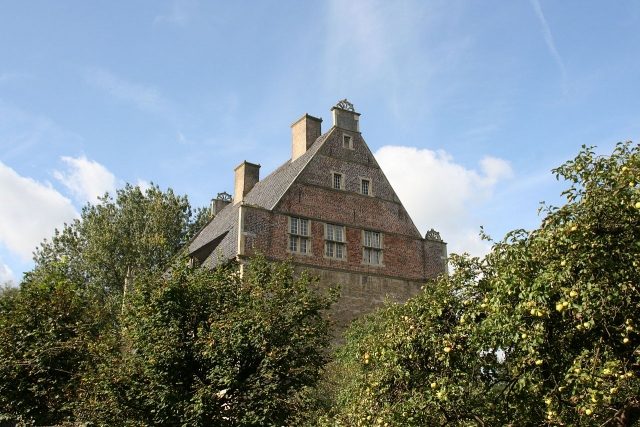
Nienborg dates back to a Münster regional castle founded in 1198 by Bishop Hermann II of Katzenellenbogen. For a time, the castle, which encompassed 125 x 330 meters with a ring wall and wide moats, was home to thirty castlemen and their families. In 1593, Nienborg was burned down by Deventer mercenaries. Ultimately, this led to Nienborg's decline and insignificance.
The Burgmannshof von Heiden is also known as the "Hohes Haus" (High House). It is a two-story Renaissance building with a gabled roof, whose building fabric largely dates back to the 14th century. The Bishop of Münster, Ludwig II of Hesse, had a massive tower-like building made of quarry stone erected around 1344, which was secured by a 15-meter-wide moat. This building served as the episcopal house and possibly also as the seat of the episcopal bailiff. Around 1364/1379, Heidenreich de Sasse held the Hohes Haus as a fief. Later, the house was pledged to the de Sasse family and from 1419 to the Valke family. The pledge was not redeemed by the bishop. In 1618, Dietrich Torck zu Asbeck acquired the house. In the 17th century, the Torck family decided to extend the existing residential tower in the representative Renaissance style. The gables are set on corbels and feature the Münsterland three-tiered form with semi-circular finials. They are flanked by obelisks. In 1673, the Hohes Haus fell by inheritance to the Frei- and Edelherren zu Büren and Ringelstein. Later, the von Droste zu Vischerung family owned the house. In 1812, the two Nienborg cloth makers Johann Bernhard Schwietering and Bernhard Johann Franzbach bought the Hohes Haus. In 1842, Bernhard Johann Franzbach sold the Hohes Haus to Hubert von Heyden, whose father was the district administrator of the Ahaus district. The house was then temporarily used publicly as the district administration office until 1859. Until 1905, Hubert von Heyden's sister, Virginia von Heyden, lived in the house until her death. She was inherited by her Dutch nephew Lodewijk von Bönninghausen zu Herinckhave, the son of her sister Charlotte and Ludovicus von Bönninghausen. The von Bönninghausen family hardly used it in the first half of the 20th century, as they were denied access to Germany during both World Wars.
Source: Wikipedia · Licence: CC BY-SA 4.0 · Image: http://commons.wikimedia.org/wiki/File:Heek_Nienborg_-_Burg_-_Hohes_Haus_02_ies.jpg
This description draws on the facts documented in the linked Wikipedia article; Wikipedia content is licensed under CC BY-SA 4.0. Wording and editing: Mobile History.
Location: 52.1338, 7.0999