Cultural facilitie
ResidenceBochum - Weitmar
Weitmar Manor
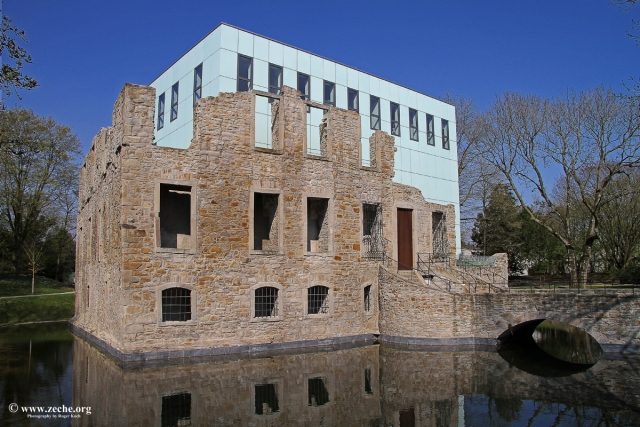
Haus Weitmar is a former noble residence in the Bochum-Weitmar district of Bochum. The seat of the von Berswordt-Wallrabe family, as well as the Sylvester Chapel on the grounds, were destroyed by aerial bombs during the Second World War. Today, part of the grounds is accessible to the public.
Haus Weitmar in Bochum developed from an 11th-century farmstead into a knight's seat when, in 1464, the bailiff Wennemar von der Brüggeney, also known as Hasenkamp, built a new residential house. In this year, Haus Weitmar was first mentioned in a document. The von Galen family had renounced their rights to the estate. In 1481, the abbot of Werden enfeoffed Wennemar von Hasenkamp with the office of forest judge of the Weitmarer Mark and the Bisping estate, which also belonged to the Werden Abbey.
A new two-story house made of Ruhr sandstone, surrounded by a moat fed by the Linnebecke (Lindener Bach), was built in 1592 by Johann von Hasenkamp. After 300 years of ownership, this lineage at Haus Weitmar died out in 1765 with the death of the last, unmarried Johann von Hasenkamp. The Werden monastery took over the castle and estates. Around 1775, Friedrich Goswin von Vaerst acquired the estate, bought himself free from the still existing feudal lordship of the Werden Abbey, and sold the property in 1780 to Friedrich von Berswordt-Wallrabe.
The Sylvester Chapel north of the castle is first mentioned in documents in 1397. In 1890, the Protestant parish sold the church property with the church ruin to Ludwig von Berswordt.
During an air raid on May 13, 1943, in the Second World War, Haus Weitmar was hit by bombs. A stable and residential building from the late 19th century was demolished in 1968. Only the outer walls of the castle and chapel remained. The complex remained in family ownership. In 1968, Alexander von Berswordt founded the Galerie m Bochum in the adjacent area of the castle. The park with its old trees and ruins was leased by the city of Bochum in 1974 and made accessible to the public.
Source: Wikipedia · Licence: CC BY-SA 4.0 · Image: http://www.zeche.org/
This description draws on the facts documented in the linked Wikipedia article; Wikipedia content is licensed under CC BY-SA 4.0. Wording and editing: Mobile History.
Location: 51.4478, 7.1893