ManorGroß-Umstadt

Heddersdorf Manor

Heddersdorf Manor

To be privately owned

The Heddersdorf'sche Adelshof is a former noble court in the west of the old town of Groß-Umstadt in the district of Darmstadt-Dieburg in Hesse. The court is the smallest of the seven former noble residences in Umstadt. It emerged from a small late medieval castle seat from the 13th century. The core of the preserved parts of the complex, the manor house, dates from the late 16th century, the early modern period.

With the entrance from Rodensteiner Straße, formerly featuring a large, no longer existing arched gate portal, the area of the Heddersdorf'sche Adelshof lies within the former city wall of Umstadt, but not leaning against it, as was the case with the Pfälzer Schloss, located only 150 meters further southwest. North above the entrance of the noble court on the other side of the street lies the main building of Rodensteiner Schloss. Formerly, the building bordered the Curti-Schloss to the west. Today, parts of the Max-Planck-Gymnasium of the city are located there. A few steps southwest across Curtigasse, the Wambolt'sche Schloss is within calling distance.

The court was the first castle seat of the Wambolt von Umstadt and was called Alter Wambolts Hof. It was their first allodial property in the city, where they settled in the 13th century. Only in an inheritance dispute between the Umstadt and Weinheim lines of the Wambolt von Umstadt was the property lost. In 1558, the last male descendant of the Umstadt line, Hans von Wambolt, had died. Regina Wambolt von Umstadt, married to Friedrich von Ratzeburg, received the allodial estate as an inheritance from her inheriting cousin Wolf Wambolt von Umstadt, residing in Weinheim, in a settlement. Since she outlived her husband, she bequeathed the estates in her will of September 1, 1568, to her sister Anna Wambolt von Umstadt, who in turn was married to Ulrich von Hedersdorf.

The change of ownership between the Heddersdorf and Wambolt families is an interesting detail, as it also played out in reverse at the Wambolt'sche Schloss. From 1570, the noble court became the hereditary property of the Umstadt line of the Heddersdorf family. Originally, the Heddersdorf family were vassals of the Archbishopric of Mainz, but they also spread beyond the Rheinstrom canton to the Rhön-Werra and Odenwald cantons. Members of the family can be found in the cathedral chapters of Mainz, Fulda, and Würzburg. Like many Catholic families from the Rhine-Main area, they turned to Franconia after the Reformation. Their nearby possessions in the area around Aschaffenburg are to be mentioned first. Ulrich von Hedersdorf himself came from Gut Wendelstein near Laufach. In the chronicle, he is described as "a worthy scion of his ancestors, of fiery temperament and stubborn adherence to unattainable claims." He thus seemed to have accumulated high debts. Having died before 1577, the inheritance passed to his son Hans, who died in 1622. He had two sons, Adam and Hans Ulrich, and one daughter. Only son Hans Ulrich had descendants, but they all died before him, so that with his death in 1658, the Umstadt Heddersdorf line died out. The heir was actually his cousin Johann Schweickard von Heddersdorf. Since the noble seat had probably only been a fief of Kurmainz since the Heddersdorf family, he requested succession to the fief. Due to the indebtedness of the property, this was rejected, and in addition to the Heddersdorf'sche Adelshof, Gut Wendelstein was also used to settle the debts.

The court came, probably through sale as debt settlement, into changing, mostly private ownership. For the year 1686, the cellarer Tobias Chelius is to be mentioned, and from 1725, his grandson, the Princely Hessen-Darmstadt Chamber Scribe and later State Commissioner Georg Heinrich Wendel Musculus. He no longer lived on the property himself and appointed administrators. On January 2, 1742, the Musculus family had the noble house auctioned, which was acquired by the Landgraviate of Hesse-Darmstadt. The latter had the second Lutheran parsonage built there. In the Umstadt building directory of 1802, the value of the complete property is stated as 9960 guilders. In 1849, the successor state of the Landgraviate, the Grand Duchy of Hesse, privatized the property again. The property then passed into bourgeois hands. First it went to the Hillerich family and in 1939 by inheritance to Johannes Ritzert, through whose daughter the court is still in private ownership today.

A designation as the court of the Haxthausen family is based on a confusion.

Description+

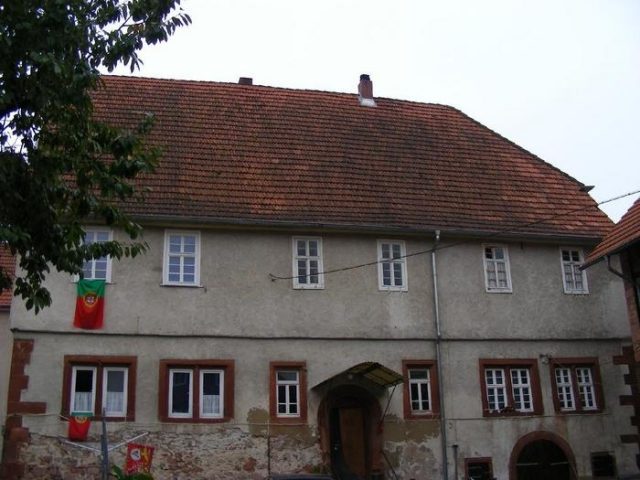
The current view of the manor house and courtyard, as it currently presents itself from the main gate, was not possible in the past, as the property of about 1200 m² was hidden behind a large, closed gatehouse with a surrounding wall about three meters high (presumably the former castle wall). The manor house to the south overlooks an inner courtyard, to which a large barn is added to the west on the left and a raised garden to the east on the right. Old undated sandstone friezes are walled into the archway of the barn.

It is not known whether the buildings south and west of the manor house formerly belonged to the property.

The manor house is a wide, rectangular, two-story building, consisting of a solid ground floor with corner quoins and a projecting upper floor and a steep roof. The half-timbered upper floor, which has partially carved beams, is now hidden under plaster. Noteworthy is the Franconian hall (Franconian Ern) with an oak ceiling on the ground floor and stucco ceilings with geometric figures on the upper floor. Paned windows, Renaissance door frames, and carved sandstone window jambs on the ground floor, as well as wall cupboards inside the building, refer to the formerly representative purpose of the house, while the exterior shows little of its old splendor. The round-arched entrance portal and numerous stonemason's marks on the sandstone jambs date the construction of the manor house to the time of its takeover by the Hedersdorf family around 1570.

Current Use+

The former noble court is now in private ownership and rented for residential purposes; it is not publicly accessible. At the entrance, there is an information board for the city tour with essential information about the building and its history.

Take Mobile History with you

You are reading this text for free. Premium adds what matters on the road: descriptions read aloud, sites found through your camera, whole regions taken offline.

  • Every description, including the ~17,700 Premium sites
  • Audio guide: have descriptions read to you on location
  • AR finder: see sites through your camera, with distance and bearing
  • Unlimited saved sites

14 days free, then from €2.99 a month. Cancel anytime.

Source: Wikipedia · Licence: CC BY-SA 4.0 · Image: http://www.wehrbauten.de/thread.php?threadid=971

This description draws on the facts documented in the linked Wikipedia article; Wikipedia content is licensed under CC BY-SA 4.0. Wording and editing: Mobile History.

Location: 49.8689, 8.9279