The church can be visited
ChurchNeuötting
Heilig Geist Church
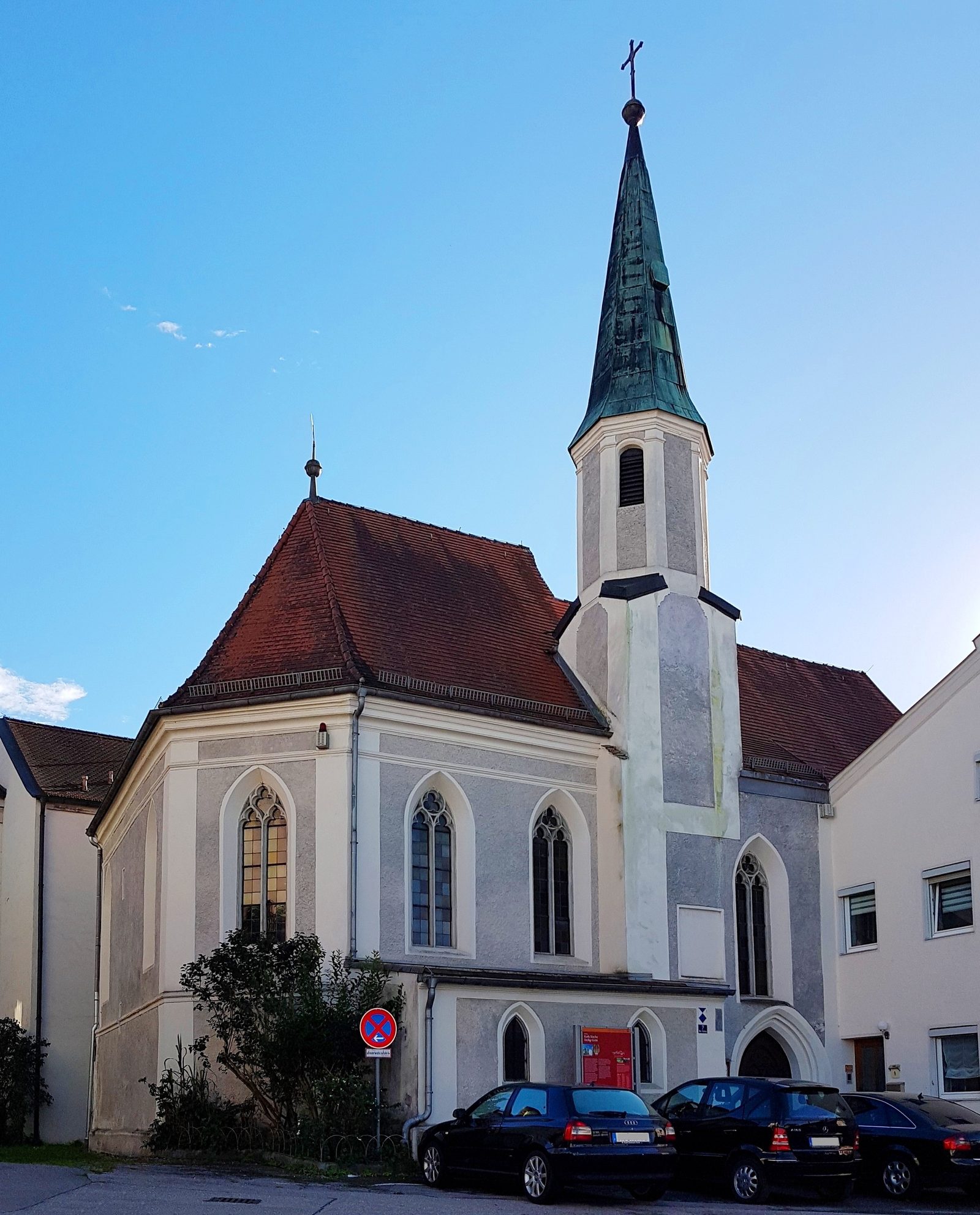
The Roman Catholic former hospital church Heilig Geist is a Gothic hall church in Neuötting in the Upper Bavarian district of Altötting. It belongs to the Neuötting parish association in the Altötting deanery of the Passau diocese and is supported by the Heilig-Geist-Spitalstiftung Neuötting.
History and Architecture+
The hospital church was built around 1500, incorporating a chapel from 1423 to the south, and is structurally connected to the hospital buildings. To the north stands the tower with an octagonal upper story and a pointed spire. Externally, the two altar rooms are combined into a three-sided end. Inside, the two-bay choir is recessed and concludes with a three-eighths end. The choir bays are open to the south towards the side chapel; the associated smaller altar room has a three-sided end and shows stronger net ribs over octagonal services in the vault. Two-light tracery windows illuminate the interior. The three-bay nave received a net vault in 1591 by Ruprecht Kuchlmeister, replacing the earlier flat ceiling. The renovation date 1660 can be found on the chancel arch. A gallery over vaulted arcades with a later balustrade is installed in the west.
Furnishings+
The rich high altar complex was moved here from the Dominican Church in Landshut in 1789. A 15th-century Maria-Schnee icon, designed after the miraculous image in Santa Maria Maggiore in Rome, is used as the central image. The painting of the altar predella shows Saint Stephen and was executed in 1770 by Zacharias Lehrhuber. Carved figures of Saints Rupertus and Nikolaus from the 15th century can be found in the choir. On the choir walls are late Rococo paintings in elaborate carved frames depicting the Holy Trinity and Saint Donatus. A Gothic baptismal font stands at the north entrance. A red marble tombstone commemorates the founder Wilhelm von Fraunhofen († 1423). In the chapel, 16th-century apostle cross paintings and 18th-century carved busts of the Fourteen Holy Helpers can be found. The organ is a work by Franz Borgias Maerz from 1888 with five stops on one manual and pedal.
Take Mobile History with you
You are reading this text for free. Premium adds what matters on the road: descriptions read aloud, sites found through your camera, whole regions taken offline.
- Every description, including the ~17,700 Premium sites
- Audio guide: have descriptions read to you on location
- AR finder: see sites through your camera, with distance and bearing
- Unlimited saved sites
14 days free, then from €2.99 a month. Cancel anytime.
Source: Wikipedia · Licence: CC BY-SA 4.0 · Image: Ricardalovesmonuments (changes by Rabanus Flavus ) · Wikimedia Commons · CC BY-SA 4.0
This description is a machine translation of an excerpt from the linked Wikipedia article. The source text was written by its authors, the translation is by Mobile History; like the original it is licensed under CC BY-SA 4.0.
Location: 48.2424, 12.6819