ManorBatenhorst

Aussel Manor (Batenhorst)
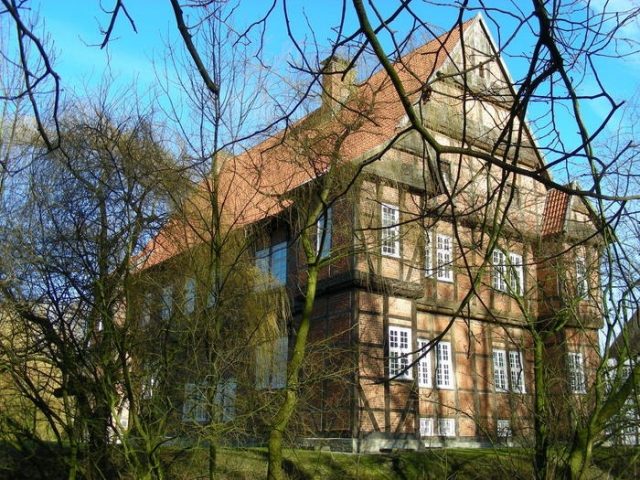
Aussel Manor (Batenhorst)

To be privately owned

The Burgmannsgut Aussel has existed since the end of the 12th century. In 1197, the Lords of Odesloe, burgmanns in the service of the Count of Rietberg, later the Bishops of Osnabrück, are mentioned as residing there. In the 15th century, the estate came into the possession of the Lords of Hachmester through inheritance. At the beginning of the 16th century, it was sold to Moritz I von Amelunxen, the bailiff of the Osnabrück office of Reckenberg in Wiedenbrück. Moritz came from an old noble family from Amelunxen on the Weser. His grandson Moritz II von Amelunxen then built the existing manor house in 1580.

Through inheritance, the manor then belonged to the Haxthausen family in the 17th century, to the Rübell von Biberach family in the 18th century, and finally to the Osnabrück canon von Juden, who sold it in 1830 to his administrator Conrad Schäfer. Inherited by the Henkelmann family, the moated farm was used exclusively for agriculture for generations until it was handed over to the current owner in 1979.

The manor house, built by Moritz II von Amelunxen in 1580, is on the one hand a veritable noble palace with all the attributes befitting its status, such as the four corner towers or the underlying "two-room house" scheme. On the other hand, in stark contrast to the usually emphasized defensiveness of this type of building, it is not a solid construction, but a half-timbered house, which also exhibits peculiarities of farmhouse or burgher house architecture: There is a proper "Deele" — in this case, a transverse "Deele" — located on the ground floor. And this interesting and probably unique hybrid of noble house and farmhouse is built according to the most modern ideas of floor plan organization and room sequence of the time. These are, in particular, the strict symmetry of the ground floor plan and the formerly existing corridor-like rooms on the upper floor before the Baroque renovation: essential features, as shown, for example, by Palladio's villas and the Renaissance castles of France. This reveals artistic, economic-political, and social innovations that generally characterize the Weser Renaissance era in this country.

Take Mobile History with you

You are reading this text for free. Premium adds what matters on the road: descriptions read aloud, sites found through your camera, whole regions taken offline.

  • Every description, including the ~17,700 Premium sites
  • Audio guide: have descriptions read to you on location
  • AR finder: see sites through your camera, with distance and bearing
  • Unlimited saved sites

14 days free, then from €2.99 a month. Cancel anytime.

Source: Wikipedia · Licence: CC BY-SA 4.0

This description draws on the facts documented in the linked Wikipedia article; Wikipedia content is licensed under CC BY-SA 4.0. Wording and editing: Mobile History.

Location: 51.8054, 8.3208