To be privately owned
ManorAugsburg-Bannacker
Bannacker Manor
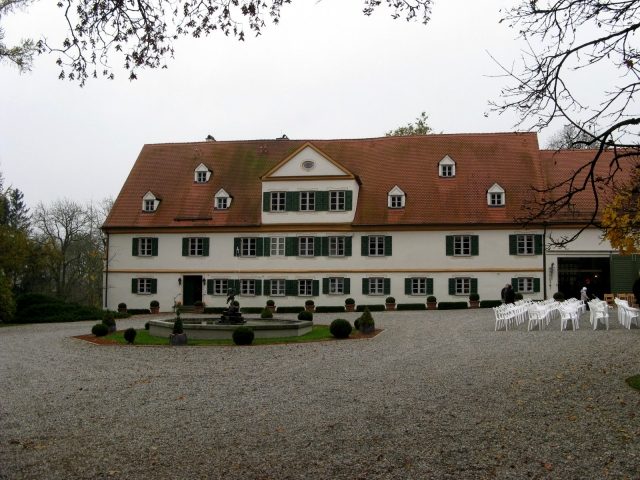
Bannacker is the southwesternmost district of the city of Augsburg. It emerged from the hamlet of Bannacker, which belonged to the municipality of Bergheim, when the municipality of Bergheim became part of the city of Augsburg in 1972 as part of the incorporation. The hamlet of Bannacker consisted of the Bannacker estate, owned by the Bertele family, and the property of the Schäffler family, the so-called Jägersölde. Today, the district of Bannacker still consists of the Bannacker estate, still owned by the Bertele family, the Jägersölde, still owned by the Schäffler family, and the property of the Boecker family, the youngest and smallest with only 2 horse paddocks.
Bannacker is first mentioned as the property of a family "miles de Bonacker". It is not certain what Bannacker looked like at that time. Around 1237, the property passed to the Heilig-Geist-Spital in Augsburg, and the coat of arms of Bannacker was merged with the coat of arms of the Heilig-Geist-Spital.
As can be seen from old maps, Bannacker was a collection of farmsteads. During the secularization, Mr. Süßkind, later Baron von Süßkind, acquired Bannacker together with the associated forests and land from the Heilig-Geist-Spital and built a typical farmhouse and servant's house for this region, as they are still often found in the area today, with a side entrance, servant's rooms and stables under one roof, which, however, corresponded to the size of the new property. After the death of Baron von Süßkind, his daughter Henriette sold the forest (Spitalwald) to the Fugger family and the land and buildings to the Deuringer family.
Various reasons are given for this sale. The correct one, however, seems to be that Bannacker was only a country estate with a farmhouse and no longer met the social demands of the Süßkind family, who had since been ennobled. The Schäffler family continued to own their property Jägersölde. The Deuringer family, being childless, sold the Bannacker estate to the Fugger family. The Fugger family modernized the estate, built agricultural buildings and also the so-called Villa (house no. 6), as the farmhouse (house no. 2), later called the old manor house, was not suitable for somewhat higher living standards and served as a servant's house under the Fugger, Weininger and Bertele families. It was officially given the name "old manor house" by Dr. Konstantin Bertele when the Bavarian list of monuments was drawn up in the early 1970s, whereby the term manor house is not synonymous with castle or similar, but merely indicates that it is the first farmhouse built by Süßkind in Bannacker.
Under the Fugger family, an attempt was made to establish a stud farm at the beginning of the twentieth century, but it was not permanent. It is not certain who or whose initiative this undertaking can be attributed to. In 1931, the Weininger family, based in Berlin, acquired the Bannacker estate. They built a polo field to be able to hold polo games during the season, as accommodation for the horses was partly already available due to the stud farm attempt. A "Polo and Riding Club" was not established, contrary to some publications. With the death of Prince Georg Fugger in 1935, co-founder of the polo games, these ended. This also ended Mr. Weininger's seasonal stays in Bannacker, who from then on no longer came from Berlin to Bannacker. Mrs. Weininger also established an emigration center for Jews to Palestine.
In 1937, the friendly Bertele family took over the Bannacker estate, which, however, was exposed to the same hostilities as the Weininger family by parts of the local population, not least because they were proud to have a Blood Order bearer in the community.
Source: Wikipedia · Licence: CC BY-SA 4.0
This description draws on the facts documented in the linked Wikipedia article; Wikipedia content is licensed under CC BY-SA 4.0. Wording and editing: Mobile History.
Location: 48.2996, 10.8085