To be privately owned
Beck Manor (Löhne)

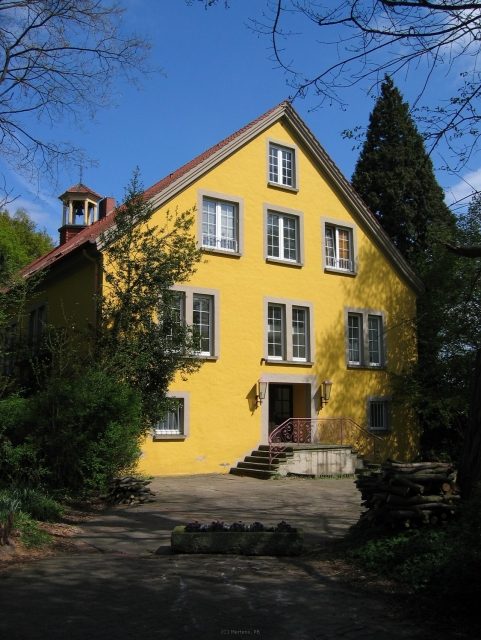
Haus Beck is a manor house in the Ulenburg district of the city of Löhne, North Rhine-Westphalia, Germany. It was first mentioned in 1151 as a fiefdom of Herford Abbey. Haus Beck is the ancestral seat of the Schleswig-Holstein-Sonderburg-Beck family, from which the Danish royal family Schleswig-Holstein-Sonderburg-Glücksburg directly descended.
After the von Beck family ceased to exist, the estate was taken over by the von Quernheim family. In 1605, Duke Alexander of Holstein-Sonderburg bought the Beck estate from a Duke of Oldenburg. His son August had the main house, which still stands today, built in 1648. He then called himself August Philipp Duke of Schleswig-Holstein-Sonderburg-Beck and founded the line of Schleswig-Holstein-Sonderburg-Beck. Family members born at Beck include Field Marshal Friedrich Ludwig von Schleswig-Holstein-Sonderburg-Beck (*1653) and Philipp Ludwig von Schleswig-Holstein-Sonderburg-Wiesenburg (*1620). The descendants inherited the estate until it was acquired in 1745 by Baroness von Ledebur-Königsbrück. It was sold by the last Duke residing at Beck, Friedrich Wilhelm II of Schleswig-Holstein-Sonderburg-Beck, who did not inherit Beck himself but bought it from his cousin and Field Marshal Friedrich Wilhelm I. The title Duke of Beck, however, remained as a titular title. A direct descendant of Duke Friedrich Ludwig, namely Friedrich Wilhelm, born Duke of Schleswig-Holstein-Sonderburg-Beck, founded the Schleswig-Holstein-Sonderburg-Glücksburg line in 1825. He dropped the name component Beck and henceforth called himself Duke of Schleswig-Holstein-Sonderburg-Glücksburg. His son Christian IX became King of Denmark, and the Schleswig-Holstein-Sonderburg-Glücksburg line thus became the royal family of Denmark and subsequently of other high noble royal houses throughout Europe. The title Duke of Beck was also sometimes held by the Princes of Denmark thereafter, but no longer gained great significance. In 1750, the cathedral canon of Magdeburg, Werner Heinrich Christoph von Wulfen, inherited the estate. In 1786, it was sold to Baron Georg von Münster, who sold it four years later to Franz Christian von Borries zu Eckendorf. In the 19th century, the estate was owned from 1846 to 1850 by Prince Telemach Handjery (cf. Nicolaus von Handjery), who subsequently sold it back to the von Borries family. From 1745 to 1899, Haus Beck and Ulenburg Castle each belonged to one owner, until Friedrich Blomeyer bought Haus Beck in 1899. It has been in his family's possession ever since.
The estate also included a double water mill, which consisted of a grain mill and a bark and oil mill. In 1988, the mill was demolished. However, the mill pond remained.
Current Use (November 2009)+
Currently, Haus Beck is used, among other things, as a training and exhibition center. The arable land is used for agriculture. Some farm buildings are leased to a kitchen furniture company.
Take Mobile History with you
You are reading this text for free. Premium adds what matters on the road: descriptions read aloud, sites found through your camera, whole regions taken offline.
- Every description, including the ~17,700 Premium sites
- Audio guide: have descriptions read to you on location
- AR finder: see sites through your camera, with distance and bearing
- Unlimited saved sites
14 days free, then from €2.99 a month. Cancel anytime.
Source: Wikipedia · Licence: CC BY-SA 4.0
This description draws on the facts documented in the linked Wikipedia article; Wikipedia content is licensed under CC BY-SA 4.0. Wording and editing: Mobile History.
Location: 52.2123, 8.7126