School
Bonaparte Manor

Founded in 1825 and no longer existing today, the Graz Sugar Factory was not only significant for Styrian industrial history because it stood on a historically remarkable site.
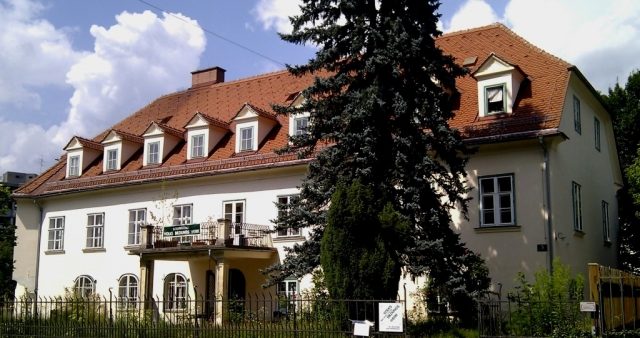
The still existing Bonaparte Villa (Herdergasse 3; formerly Geidorfstraße 2) is an elongated, classical building, whose core dates back to the 16th century. From the original construction period comes the corner oriel on the west side, resting on consoles, as well as the rubble stone cellar (without, however, the brick vault built in the 18th century).
Louis Bonaparte, Napoleon's brother and King of Holland until 1810, went into exile in Austria after his abdication, where he called himself Count Ludwig von Saint Leu. In November 1810, he arrived in Graz. On August 17, 1811, he bought the villa with a large surrounding plot of land in the Geidorf district. The previous owner was Count Vinzenz von Sauer, who had only bought it in 1801 from Sigismund Freiherr von Schwitzen. The latter had acquired it in 1784 from Aloisia Buresch (Edle von Greifenbach). Until then, it was part of the large Erdödy Free Garden, named after the Hungarian noble family Erdödy. After several enlargements, the ex-king's garden extended to today's Liebiggasse. However, he only lived on his property in Graz until 1813 and went to Italy for political reasons.
In May 1814, Ludwig's estate passed into the possession of his brother Jérôme Bonaparte, who was King of Westphalia until 1813 and bore the name Count von Harz. He sold it in November 1814 to Cäcilie Freiin von Bouvier. In the meantime, the former manor house had become a barracks, which was used as a hospital. In 1821, Prince Johannes von Liechtenstein acquired the entire estate.
The Sugar Factory+
Just five years later, the Prince sold his new acquisition for only 2000 guilders to the "k. k. privileged sugar refinery in Graz," founded in 1825. Shortly thereafter, several factory buildings were destroyed by fire. A new building replaced them in 1828. The sugar factory then had several successive owners until it was bought by the Viennese banking house Arnstein and Eskeles in 1837.
Among the modernizations carried out at that time was Styria's first steam engine. It served to pump water from the Kroisbach to the factory. In 1863, it passed into the possession of a new joint-stock company. The cane sugar processed until then was increasingly replaced by beet sugar. In the 1870s, the factory reached its maximum with an annual production of 11,000 tons per year and a short time later its end. The former residence of the ex-king was sold in April 1881.
The sugar factory's estate included the tower-like Venus Temple, already built in the 18th century, which bore a "black Madonna" on one corner. It was owned by the physician Anton Haas from 1820 to 1856 and was sold in 1873 to the joint-stock company that owned the sugar factory. Around 1905, the Venus Temple was demolished. However, the so-called Mozart Temple (the oldest Mozart monument worldwide), built in the same area in 1797, still exists today.
The later development of the area+
The listed manor house (Herdergasse 3) later served as a provincial student dormitory and today houses the Styrian Adult Education Center, the Styrian Nature Conservation Association, and the Styrian Mountain and Nature Watch. Until 2002, a small garden settlement, most recently in church ownership, existed in the immediate vicinity (beyond Herdergasse), which still showed minor wall remnants of the former sugar factory.
In 2002, a large-scale residential complex was built by architects Martin Küng and Peter Reitmayr. A freestanding foundation piece of the former factory was architecturally integrated into the inner green area. The avenue trees that bordered the factory area towards Mariatrosterstraße (today Heinrichstraße) gradually disappeared. The last ones were severely damaged and removed by a major storm on August 29, 2003.
Take Mobile History with you
You are reading this text for free. Premium adds what matters on the road: descriptions read aloud, sites found through your camera, whole regions taken offline.
- Every description, including the ~17,700 Premium sites
- Audio guide: have descriptions read to you on location
- AR finder: see sites through your camera, with distance and bearing
- Unlimited saved sites
14 days free, then from €2.99 a month. Cancel anytime.
Source: Wikipedia · Licence: CC BY-SA 4.0 · Image: http://commons.wikimedia.org/wiki/File:Graz_Landessch%C3%BClerheimHerdergasse3.jpg
This description draws on the facts documented in the linked Wikipedia article; Wikipedia content is licensed under CC BY-SA 4.0. Wording and editing: Mobile History.
Location: 47.0810, 15.4536