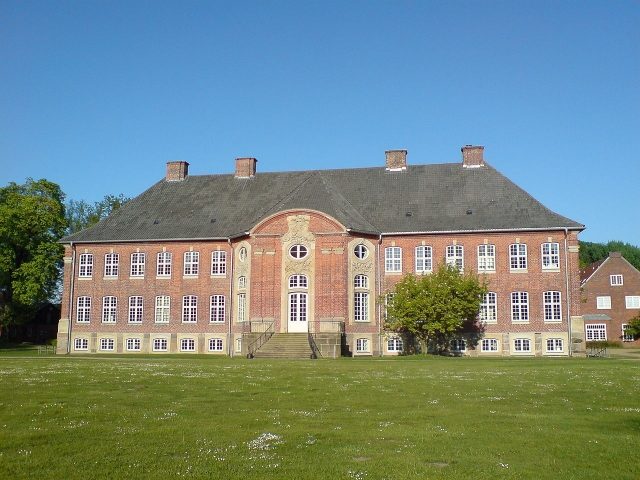
ManorSülfeld-Borstel

Borstel Manor

Borstel Manor

Cultural center

The Borstel Estate is located in Borstel, about 30 kilometers north of Hamburg and approx. 13 kilometers south of Bad Segeberg in the Segeberg district in the federal state of Schleswig-Holstein. It was managed for centuries until its fragmentation in the years 1933/38. The manor house of the former noble Borstel Estate is one of the few Rococo buildings in the federal state. It is now owned by the Borstel Research Center. The garden, originally laid out as a Baroque garden and later transformed into a landscape garden, has retained its basic structure, once belonged to the most significant facilities of its kind in Schleswig-Holstein, and is open to visitors as a natural and cultural monument.

Origin, Size, and Development of the Estate

It is not known since when the Borstel Estate existed in its extent with the villages of Sülfeld, Seth, and Oering, along with Grabau and Kayhude (later Borstel area) on the one hand, and with the Jersbek Estate and the villages of Bargfeld, Elmenhorst, and Nienwohld, the Stegen Estate, the Meierhöfe Wulksfelde with Rade and Mönkenbrook (later Jersbek area) on the other. Bock lists the first mentions of the individual "villages and deserted settlements, estates and farms," criticizes some temporal assignments by Laur, and assigns Borstel, Sülfeld, and Itzstedt to the von Borstel family for the period around 1250 to around 1350, the village of Seth and the Stegen Estate to the von Hagen family, and the villages of Bargfeld, Elmenhorst, and Nienwohld as well as the Stegen Estate to the Hummersbutle family. The village of Wulksfelde was only sold by the Hamburg Cathedral Chapter to Marquard von Bockwolde auf Borstel in 1537.

The Borstel Estate, covering about 12,000 ha in the 16th century, had until then passed by inheritance from the noble families von Borstel(de) and Hummersbutle (Hummersbüttel) to the von Bockwolde family (later "von Bougwald" or "von Buchwaldt"). The Borstel Estate also included the "Jersbek Estate," which at least by the end of the 16th century already existed as a noble property complex under regional law, but belonged to the Borstel Estate, as Jasper von Buchwaldt from Gerisbecke [Jersbek] wrote a letter to Duke Franz I of Saxe-Lauenburg on January 30, 1568, and was already referred to as the hereditary lord of Jersbek on his tombstone in the Basilica of Altenkrempe/Ostholstein. After Jasper von Buchwaldt's death on February 24, 1587, at Borstel Estate, disputes arose between his widow and his three sons Claus, Hans, and Johann on the one hand, and the eldest son Heinrich on the other, regarding the paternal inheritance. As a result, after a settlement was reached through the mediation of their relative Heinrich Rantzau, the estates of Borstel and Jersbek, which had always been united in one hand, were divided. This significant inheritance contract of December 6, 1588, is preserved in its original form in the Borstel and Jersbek estate archives in the Schleswig-Holstein State Archive, Schleswig. Due to the division of inheritance by lot, the youngest son Johann von Buchwaldt, who no longer wrote himself von Bockwolde, became the first lord (1588–1621) of the now divided Borstel Estate. It then consisted of the Borstel farm with the villages of Grabau, Oering, Seth, and Sülfeld, and the "Santkrug" (later called Alter Heidkrug Kayhude), as well as some peasant holdings located in the district. The Borstel Estate was sold in 1631 to Otto von Buchwaldt a. d. H. Jersbek for 70,000 Reichstalers, in 1798 to Matthias (Matthijs) Ooster jun. for 314,000 Reichstalers, in 1801 to Joachim Christoph Janisch, and in 1803 to Demetrius Graf de Wuits for originally 510,000 Reichstalers. The Borstel Estate was auctioned on March 19, 1806, by Cay Lorenz Freiherr von Brockdorff from the bankruptcy of Count de Wuits for 200,000 Reichstalers, on February 1, 1839, to Joseph Graf von Baudissin sen. for 350,000 Reichstalers, and in 1930 to Friedrich Bölck for 1.5 million Marks. Bölck had already sold the Borstel Estate in 1932 – retaining the Borstel manor house, the children's home, the pond, the nursery, and some woodlands (Viert, Gartenholz, and Wildkoppel) with the forestry – to the settlement company Bauernland AG, Berlin, which resold the lands to settlers between 1932 and 1938, so that Borstel ceased to exist as an estate. Bölck sold his remaining holdings from the former Borstel Estate in 1938.

Hardly any other period brought as many profound changes for the Schleswig-Holstein estates as the 19th century, namely the abolition of serfdom (1805), the abolition of patrimonial jurisdiction, the elimination of church patronage, the dissolution of noble estate districts, the creation of rural communities, and the redemption of real burdens. The 20th century for the Schleswig-Holstein estates was marked by the elimination of school patronage, the dissolution of estate districts, and expropriation according to the Schleswig-Holstein settlement law.

Estate Management

The noble Borstel Estate belonged to the Itzehoe estate district. The estate owners were privileged and led a certain independent life in the Duchy of Holstein. As a small "state within a state," the lord of the manor exercised not only his own (lower) estate jurisdiction (patrimonial jurisdiction) over his tenants, but also the entire (district) judicial, regulatory, police, and social system until the separation of judiciary and administration after 1864.

The cultivation of the farm fields in Borstel and Holm (= manorial self-management) was carried out until 1797, thus even before the end of serfdom (December 31, 1804), with the help of manual and team services, namely the labor of the farmhands and maids of the Hufner (farmers) and the wagons of the serf subjects ("partial farm economy"), and thereafter by estate-employed farmhands and day laborers. Manual services included field and garden work, road improvements, drainage, building demolition and construction, cleaning of the mill ditch and the Sülfeld church well. Team services consisted of work with horse teams for plowing, sowing, and harvesting, but also freight, (construction) timber, peat, hunting, and (in September) fish transports, carriage rides, and additional team services. The Holm Meierhof and the main Borstel farm were continuously leased to a tenant from May 1, 1808, and May 1, 1849, respectively. Furthermore, leases of cattle herds to Dutchmen have been documented at Borstel Estate since at least the end of the 17th century.

The serf Hufner cultivated the peasant fields provided to them by the manorial lord with employed farmhands and maids. Joachim Friedrich Graf von Bernstorff concluded temporary and lease contracts for ten years each with all Hufner in the villages of Oering, Seth, and Sülfeld in November 1797, thereby abolishing serfdom and farm corvée seven years before its official abolition. Cay Lorenz Freiherr von Brockdorff concluded/extended temporary lease contracts with all estate residents from May 1, 1808, which were converted into hereditary lease contracts by Joseph Graf von Baudissin on May 1, 1849. Through the Real Burdens Redemption Law of January 3, 1873, the hereditary tenants (but not the temporary tenants) became owners, who then had to pay a rent limited to 50 years – payable to the Stettin Rentenbank – instead of the hereditary lease. The lord of the manor received, based on the Real Burdens Redemption Law, annuity bonds bearing 4% p.a. interest, totaling a nominal 904,815.00 Marks, which corresponds to a value of only 251,338 Reichstalers.

Lords of Borstel Estate

The lords of the Borstel Estate were:

Von Borstel Family

  • Heinricus de Borstelde, circa 1258
  • Bertoldus de Borstelde, circa 1259
  • Christoforus von Borstel, circa 1288 – circa 1300
  • Luder von Borstel, circa 1321 - 1352
  • Luder von Borstel, circa 1353

Von Hummersbutle (Hummelsbüttel) Family

  • Hartwich III. Hummersbutle, squire, circa 1336 – circa 1380 (married to Adelheid von Borstelde)
  • Johann IV. Hummersbutle, circa 1380 – before 1396
  • Hartwich IV. Hummersbutle, squire, circa 1380-1394
  • Johann V. Hummersbutle, circa 1418 – circa 1445
  • Hartwich V. Hummersbutle, squire, circa 1446 – circa 1468

Von Bockwolde (Buchwaldt) Family from Sierhagen

  • Detlev von Bockwolde the Elder, * 1429 - † 24.12.1487 Sierhagen (married to Magdalena von Hummersbüttel)
  • Detlev von Bockwolde the Younger, † 17.02.1500 in the Battle of Hemmingstedt
  • Marquard von Bockwolde, † 1545
  • Jasper von Bockwolde, * approx. March 1519 - † 24.2.1587, buried in the church in Altenkrempe/Neustadt
  • Johann von Buchwaldt, * presumably 1567 - † 1621
  • Marquard von Buchwaldt, † 1626

Von Buchwaldt Family from Jersbek

  • Otto von Buchwaldt, * presumably 1596 - † 1635
  • Hans Adolph von Buchwaldt zu Borstel, Grabau and Troiburg, * 28.11.1631 - † 2.10.1679 Hamburg
  • Otto Friedrich von Buchwaldt, * 17.08.1661 - † 18.12.1739
  • Friedrich von Buchwaldt, * 14.11.1697 - † 16.08.1761 in Preetz

Von Bernstorff Family

  • Johann Hartwig Ernst Freiherr (since 1767: Count) von Bernstorff zu Wotersen and Lancken, * 13.05.1712 in Hamburg - † 18.02.1772 in Hamburg, buried on 07.03.1772 in the church of Siebeneichen (married to Charitas Emilie von Buchwaldt)
  • Andreas Peter Freiherr (since 1767: Count) von Bernstorff, * 28.08.1735 in Gartow - † 21.06.1797 in Copenhagen, buried in Dreilützow
  • Joachim Friedrich Graf von Bernstorff, * 05.10.1771 Dreilützow - † 28.10.1835 Cismar

Individual Lords of the Manor

  • Matthias (Matthijs) Ooster, * 28.10.1747 Amsterdam - † 17.01.1842 Utrecht
  • Joachim Christoph Janisch zu Dömitz/Mecklenburg, * approx. 1747 - † approx. 1808
  • Simon Demetrius Graf de Wuits (a commoner impostor), * approx. 1768 in Poland? - † presumably in Kasteel Lachenen near Lier southeast of Antwerp
  • Cay Lorenz Freiherr (since 1837 Count) von Brockdorff, * 26.01.1766 Klein Nordsee - † 18.05.1840 Hamburg, buried in Sülfeld

Von Baudissin Family

  • Joseph Franz Christian Graf von Baudissin, * 09.01.1797 Knoop - † 05.04.1871 Borstel
  • Adelbert Heinrich Ernst Graf von Baudissin, * 12.01.1821 Projenstorf near Kiel - † 09.08.1875 Gersau/Switzerland
  • Joseph Ernst Adolf Graf von Baudissin, * 04.11.1861 Glückstadt - † 11.04.1940 Kiel

The Last Lord of Borstel Estate

  • Friedrich Bölck, * 16.07.1877 in Oldenburg i. H. and baptized on 5.8.1877 in Lensahn - † 27.9.1940 car accident near Süsler Moor southeast of Eutin
Buildings+

The Manor House

The current Borstel Manor House is the successor to an estate house destroyed by fire in 1737 at another location. Its construction was initiated by Friedrich von Buchwaldt in 1743. The builder was one of the leading politicians of the country during the so-called Grand Ducal era, when the ducal parts of Holstein were ruled from Russia. The manor house was completed in 1751; this year is also found in the portal.

Inscription above the portal of the manor house: HAS AEDES EXSTRVXIT / FRIDERICVS DE BVCHWALD / M[agnus]. R[ussia]. PR[inceps]. SLESW[ig]. AC. HOLS[atia]. DVCIS. CONS[ilium]. INT[imus] / ORD[o]. ST. ANNÆ. EQV[is]. CŒN[obium]. PRETZ. PRÆP[ositus]. / DOM[us]. PRÆD[dium]. BORSTELL. ET. TROYBVRG / ANNO 1751 (This house was built by Friedrich von Buchwaldt, Privy Councillor to the Grand Duke of Russia, Duke of Schleswig and Holstein, Knight of the Order of St. Anna, Provost of Preetz Monastery, Lord of the Estates of Borstel and Troiburg, in the year 1751).

The manor house acquired castle-like dimensions and is one of the largest buildings of its kind and time in the country. Johann Christian Böhme, among others, is presumed to be the architect. The broad front of the fifteen-axis house can still be attributed to the Baroque style. However, the fine decorations of the courtyard and garden sides, as well as the original interior furnishings, already belong to the Rococo, a style that is relatively rare in the less courtly and more rural Schleswig-Holstein.

The courtyard side of the house is emphasized by two polygonal risalits, the center of the building by a narrow, pilaster-framed portal. In addition, the facade here is framed by two smaller outbuildings, which together create an open courtyard of honor. The interior rooms on the courtyard side are arranged in an enfilade in Baroque style. The garden facade is dominated by a central pavilion-like risalit, whose interior is occupied by the large garden hall. This Rococo hall was renovated in the 19th century in the Neoclassical style with relief copies by the Danish sculptor Bertel Thorvaldsen on one of the two fireplace surrounds (three Graces with singing Cupid) on the walls (four seasons and hunting scenes) and above the two doors as supraports (Cupid with the lion and dance of the Muses on Mount Helicon), but parts of the older decoration were preserved.

In 1930, the manor house of the estate was converted into a children's convalescent home by Friedrich Bölck. From then on, it had a checkered history, including from 1938 as District School III of the RAD (Reich Labor Service) for female youth, and after the bombing of Hamburg in the summer of 1944 and in the period after World War II as a reception camp for refugees and accommodation for 500 Poles "who had worked for farmers in the area during the war." Since 1947, the remaining part of the Borstel Estate has been the seat of the Borstel Research Center, founded by the state of Schleswig-Holstein and converted into a foundation in 1963, and its associated research clinic. The manor house has served the research center as a library and conference house, among other things, since 1947. In 1992, massive mold and fungal infestation was detected. In the 21st century, the building had to undergo fundamental renovation. The renovation work cost almost 7 million Euros and has now been completed. On June 15, 2007, it was handed over to its new use as a knowledge, culture, and communication center with a festive ceremony.

Courtyard of Honor and Park

Only a few buildings from the former Borstel Estate remain; the extensive estate grounds are now largely occupied by functional buildings of the clinic. Only the courtyard facade of the manor house is flanked by two cavalier houses, which convey an impression of the former courtyard of honor. The manor house is still surrounded by a spacious landscape park, which emerged from an earlier Baroque garden. The park is accessible to visitors.

Take Mobile History with you

You are reading this text for free. Premium adds what matters on the road: descriptions read aloud, sites found through your camera, whole regions taken offline.

  • Every description, including the ~17,700 Premium sites
  • Audio guide: have descriptions read to you on location
  • AR finder: see sites through your camera, with distance and bearing
  • Unlimited saved sites

14 days free, then from €2.99 a month. Cancel anytime.

Source: Wikipedia · Licence: CC BY-SA 4.0 · Image: http://de.wikipedia.org/wiki/Datei:Herrenhaus_Borstel.JPG

This description draws on the facts documented in the linked Wikipedia article; Wikipedia content is licensed under CC BY-SA 4.0. Wording and editing: Mobile History.

Location: 53.8184, 10.1992