Museum
ManorRatingen
Cromford Manor
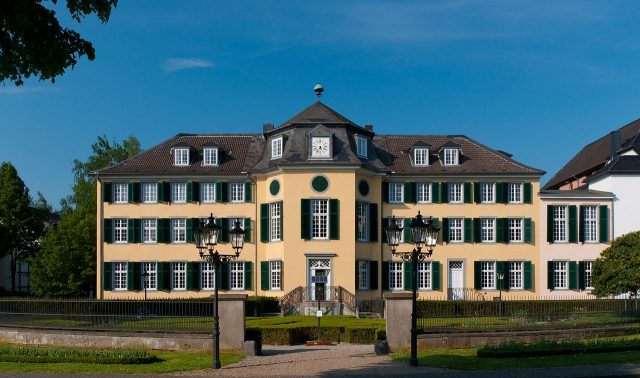
In Ratingen, North Rhine-Westphalia, Cromford Manor House was part of the first factory established in 1783, modeled after an English prototype, introducing mechanized cotton spinning to Germany.
History+
The origins of the manor house are linked to Johann Gottfried Brügelmann, a merchant from Elberfeld. In the 1770s, he learned about Richard Arkwright's invention of the water frame in England, which revolutionized spinning. Despite strict secrecy and British export bans, Brügelmann managed to acquire a model of this machine in 1783. The exact circumstances are unclear; rumors range from industrial espionage to the help of an English friend. Brügelmann sought a suitable location away from the Wuppertal yarn trade and found a disused oil mill in Ratingen. There, he erected two factory halls and began production in 1784. The factory, named after its English model Cromford, grew rapidly. In addition to the five-story factory building, a manor house and a garden were built. After Brügelmann's death in 1802, his sons continued the business, which operated until the 1960s.
Source: Wikipedia · Licence: CC BY-SA 4.0 · Image: http://de.wikipedia.org/wiki/Datei:Herrenhaus_Cromford_Br%C3%BCgelmann.jpg
This description draws on the facts documented in the linked Wikipedia article; Wikipedia content is licensed under CC BY-SA 4.0. Wording and editing: Mobile History.
Location: 51.3061, 6.8529